
Q1i Write short note on the following I.Esterification ii. Dehydration iii. Oxidation Q1b explain acidity of ROH, metal alkoxide and salt formation with bronsted acids Q1ci.Draw the structure and names of simple polyhydroxylalkanes diols and triols Q1cii.mention the source of propane-1,2,3-triols from hydrolysis of triglycerides in soap manufacture Q2a explain the acidic nature of phenol ii.recall the directing ability -0H in electrophilic substitution reaction on the Benzene ring of phenol Bromination sulphonation Nitration Q2b relate the reactions of the-0H group on phenol in I ether formation ii Esterification iii alcoholysis in reaction with haloalkanes
Chemistry
ScanSolve AI Answer
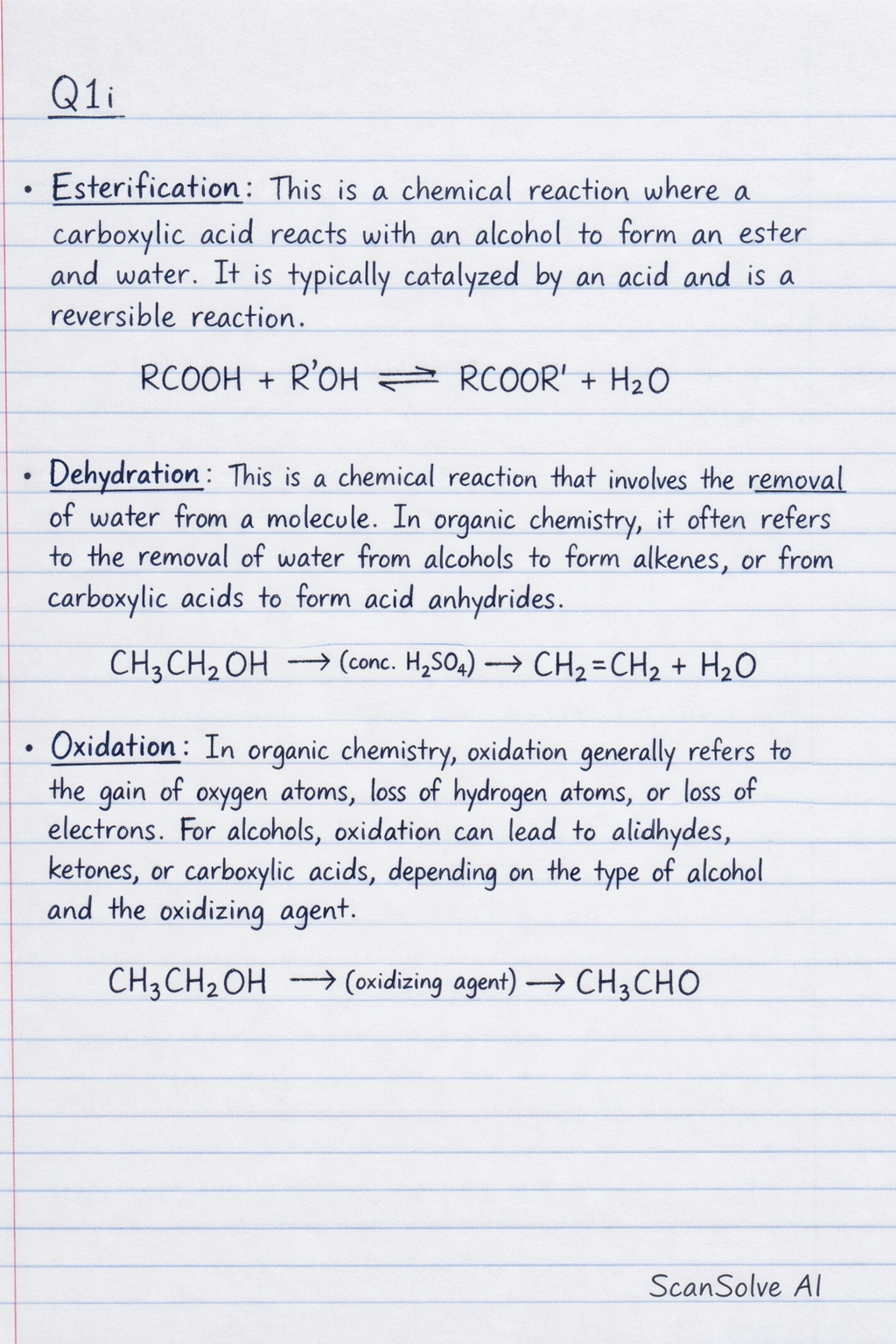
Q1i
- Esterification: This is a chemical reaction where a carboxylic acid reacts with an alcohol to form an ester and water. It is typically catalyzed by an acid and is a reversible reaction.
- Dehydration: This is a chemical reaction that involves the removal of water from a molecule. In organic chemistry, it often refers to the removal of water from alcohols to form alkenes, or from carboxylic acids to form acid anhydrides.
- Oxidation: In organic chemistry, oxidation generally refers to the gain of oxygen atoms, loss of hydrogen atoms, or loss of electrons. For alcohols, oxidation can lead to aldehydes, ketones, or carboxylic acids, depending on the type of alcohol and the oxidizing agent.
Q1b
- Acidity of ROH (Alcohols): Alcohols () are very weak acids, even weaker than water. They can donate a proton () to a very strong base, forming an alkoxide ion (). The acidity of alcohols decreases as the alkyl group becomes larger due to the electron-donating effect of alkyl groups, which destabilizes the alkoxide ion.
- Metal Alkoxide Formation: Alcohols react with active metals (like sodium or potassium) to form metal alkoxides and hydrogen gas. This reaction demonstrates the acidic nature of alcohols, as the alcohol donates a proton to the metal.
- Salt Formation with Brønsted Acids: Alkoxide ions () are very strong Brønsted bases. They readily react with Brønsted acids (proton donors) to form the corresponding alcohol (a salt in the sense of an ionic compound formed from an acid and a base, though here it's the conjugate acid of the alkoxide).
Q1ci
- Simple Polyhydroxylalkanes (Diols and Triols):
- Diols:
- Ethane-1,2-diol (Ethylene Glycol):
- Propane-1,2-diol:
- Propane-1,3-diol:
- Triols:
- Propane-1,2,3-triol (Glycerol/Glycerin):
- Diols:
Q1cii
- Source of Propane-1,2,3-triol from Hydrolysis of Triglycerides in Soap Manufacture: Propane-1,2,3-triol (glycerol) is a byproduct of the saponification process, which is the alkaline hydrolysis of triglycerides (fats and oils). Triglycerides are esters formed from glycerol and three fatty acid molecules. During soap manufacture, triglycerides are heated with a strong base (like sodium hydroxide). This breaks the ester bonds, releasing the fatty acid salts (which are soap) and glycerol.
Q2a
- Acidic Nature of Phenol: Phenol () is more acidic than alcohols but less acidic than carboxylic acids. Its acidity arises from the resonance stabilization of its conjugate base, the phenoxide ion (). The negative charge on the oxygen atom of the phenoxide ion can be delocalized into the benzene ring through resonance. This delocalization spreads the charge over multiple atoms, making the phenoxide ion more stable than an alkoxide ion, thus favoring the dissociation of the proton from phenol. The resonance structures for phenoxide ion show the negative charge delocalized to the ortho and para positions of the benzene ring.
Q2aii
- Directing Ability of -OH in Electrophilic Substitution Reaction on the Benzene Ring of Phenol:
The hydroxyl () group is a strong activating group and an ortho-para director in electrophilic aromatic substitution reactions. This is because the lone pair of electrons on the oxygen atom can be donated into the benzene ring through resonance, increasing the electron density, particularly at the ortho and para positions. This makes these positions more susceptible to attack by electrophiles.
- Bromination: Phenol reacts very readily with bromine water (aqueous bromine) at room temperature, without a catalyst, to form 2,4,6-tribromophenol. The reaction is so vigorous that it does not stop at mono-substitution.
- Sulphonation: Phenol reacts with concentrated sulfuric acid to form phenolsulfonic acids. The product distribution is temperature-dependent:
- At low temperatures (e.g., ), ortho-phenolsulfonic acid is the major product.
- At higher temperatures (e.g., ), para-phenolsulfonic acid is the major product (thermodynamic control).
- Nitration: Phenol reacts with dilute nitric acid at room temperature to yield a mixture of ortho-nitrophenol and para-nitrophenol. Due to the strong activating nature of the -OH group, concentrated nitric acid can lead to the formation of 2,4,6-trinitrophenol (picric acid), which is explosive.
Q2b
- Reactions of the -OH group on Phenol:
- i. Ether Formation: Phenols can be converted into ethers through the Williamson ether synthesis. This involves first converting phenol into its more nucleophilic phenoxide ion by reacting it with a strong base (like ). The phenoxide ion then reacts with a primary haloalkane () via an mechanism to form an aryl alkyl ether.
- ii. Esterification: Phenols react with acyl chlorides or acid anhydrides to form esters (phenyl esters). Unlike alcohols, phenols do not readily react with carboxylic acids directly under typical acid-catalyzed conditions due to the lower nucleophilicity of the phenolic oxygen.
- iii. Alcoholysis in Reaction with Haloalkanes: This term is typically used for reactions where an alcohol acts as a nucleophile. In the context of phenol's -OH group reacting with haloalkanes, it primarily refers to the formation of ethers, as described in part (i) (Williamson ether synthesis). The phenoxide ion (formed from phenol) acts as a nucleophile to displace the halide from the haloalkane. If "alcoholysis" is interpreted as the reaction of the -OH group of phenol with a haloalkane, it is essentially the Williamson ether synthesis where the phenoxide is the "alcoholate" (alkoxide) equivalent.
Was this helpful?
Still stuck on this one?
Ask a follow-up, and the answer starts from this question.
Got a different question?Ask your own question
More Chemistry Questions
QExplain alkanoates. 2. State any three members of the alkanoate family. 3. Explain esterification…QComplete the following reaction: xxviii. CH3CH2OH + CH3COOH → ? + ? (2 marks) xxix. CH3-C=O + H2O…QA) Write the structural formula of 2-bromo-4-methylpentane. b) Write the equation of reaction of…QSPT STANDARD UTME QUESTIONS 🔥 🔥 1. What is the general formula for alkenes? A) CnH2n B) CnH2n+2 C)…QComplete the following reactions with relevant structures: a) H3C-C(CH3)=CH2…
Browse by topic:Organic Chemistry
Handwritten Step-by-Step Solution
Get this as a handwritten image on WhatsApp — like a tutor wrote it for you.
Try on WhatsApp