

This chemistry question involves key chemical concepts and calculations. The detailed solution below walks through each step, from identifying the reaction type to computing the final answer.
ScanSolve AI Answer
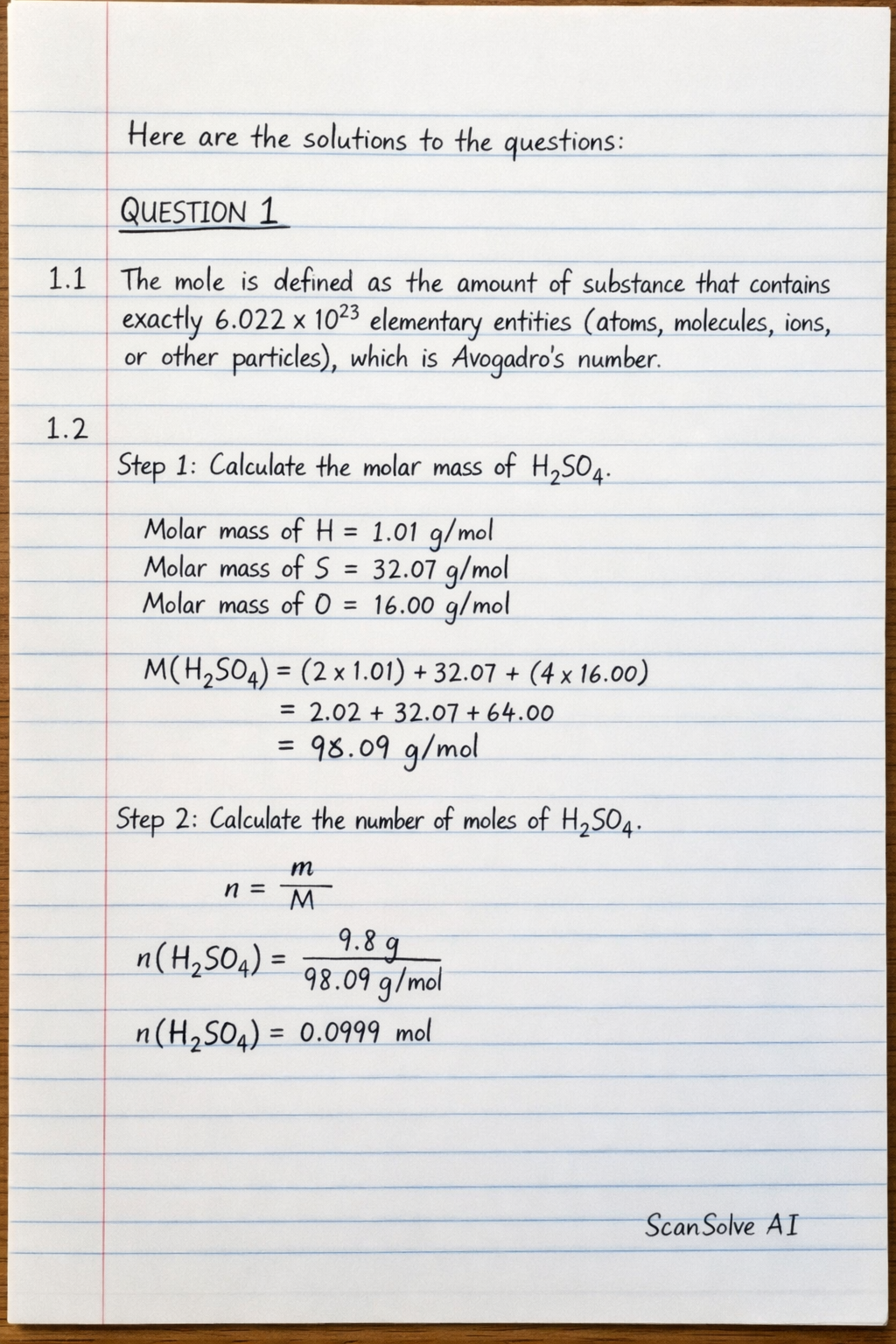
Here are the solutions to the questions: QUESTION 1 1.1 The mole is defined as the amount of substance that contains exactly 6.022 × 10^23 elementary entities (atoms, molecules, ions, or other particles), which is Avogadro's number. 1.2 Step 1: Calculate the molar mass of H_2SO_4. Molar mass of H = 1.01 g/mol Molar mass of S = 32.07 g/mol Molar mass of O = 16.00 g/mol M(H_2SO_4) = (2 × 1.01) + 32.07 + (4 × 16.00) M(H_2SO_4) = 2.02 + 32.07 + 64.00 M(H_2SO_4) = 98.09 g/mol Step 2: Calculate the number of moles of H_2SO_4. n = (m)/(M) n(H_2SO_4) = 9.8 g98.09 g/mol n(H_2SO_4) = 0.0999 mol Step 3: Calculate the number of H_2SO_4 molecules. Number of molecules = n × N_A Number of H_2SO_4 molecules = 0.0999 mol × 6.022 × 10^23 molecules/mol Number of H_2SO_4 molecules = 6.0159 × 10^22 molecules Step 4: Calculate the number of oxygen atoms. Each H_2SO_4 molecule contains 4 oxygen atoms. Number of oxygen atoms = Number of H_2SO_4 molecules × 4 Number of oxygen atoms = 6.0159 × 10^22 × 4 Number of oxygen atoms = 2.41 × 10^23 atoms 1.3.1 The percentage hydrogen will REMAIN THE SAME. 1.3.2 The law applied is the Law of Definite Proportions (or Law of Constant Composition). 1.4.1 Concentration is defined as the amount of solute (in moles) dissolved per unit volume of solution (in dm^3 or liters). 1.4.2 Step 1: Calculate the molar mass of NaOH. Molar mass of Na = 22.99 g/mol Molar mass of O = 16.00 g/mol Molar mass of H = 1.01 g/mol M(NaOH) = 22.99 + 16.00 + 1.01 M(NaOH) = 40.00 g/mol Step 2: Calculate the number of moles of NaOH. n = (m)/(M) n(NaOH) = 4.4 g40.00 g/mol n(NaOH) = 0.11 mol Step 3: Determine the volume of the solution. C = (n)/(V) V = (n)/(C) V = 0.11 mol0.22 mol/dm^3 V = 0.50 dm^3 That's 2 down. 3 left today — send the next one.