
We read your photo as:
Question 1: Which structural information about an organic compound is obtained from UV spectroscopy?
ScanSolve AI Answer
Answer
Here's the solution for Question 1:
- Question 1: Which structural information about an organic compound is obtained from UV spectroscopy?
UV-Vis spectroscopy (Ultraviolet-Visible spectroscopy) measures the absorption of ultraviolet or visible light by a substance. This absorption is due to electronic transitions, primarily and transitions. These transitions occur in molecules containing chromophores, which are groups with unsaturated bonds (like C=C, C=O, C=N, N=N) or lone pairs of electrons, especially when they are conjugated.
- A) types of hydrogen atoms present: This information is typically obtained from Nuclear Magnetic Resonance (NMR) spectroscopy, specifically H NMR.
- B) types of functional groups: While UV-Vis can indicate the presence of certain functional groups that act as chromophores (e.g., carbonyls, alkenes in conjugation), it is not a general method for identifying all types of functional groups. Infrared (IR) spectroscopy is more commonly used for this purpose.
- C) types of bonds and functional groups: Similar to B, UV-Vis is specific to certain types of bonds (multiple bonds) and functional groups that contain them.
- D) presence of multiple bonds: UV-Vis spectroscopy is highly effective at detecting the presence of multiple bonds, particularly conjugated double or triple bonds, as these are responsible for the electronic transitions observed in the UV-Vis region.
Therefore, the most accurate answer is that UV spectroscopy provides information about the presence of multiple bonds, especially in conjugated systems.
The correct option is D.
Try one yourself
A new problem that tests the same skill.
Still stuck on this one?
Ask a follow-up, and the answer starts from this question.
More Chemistry Questions
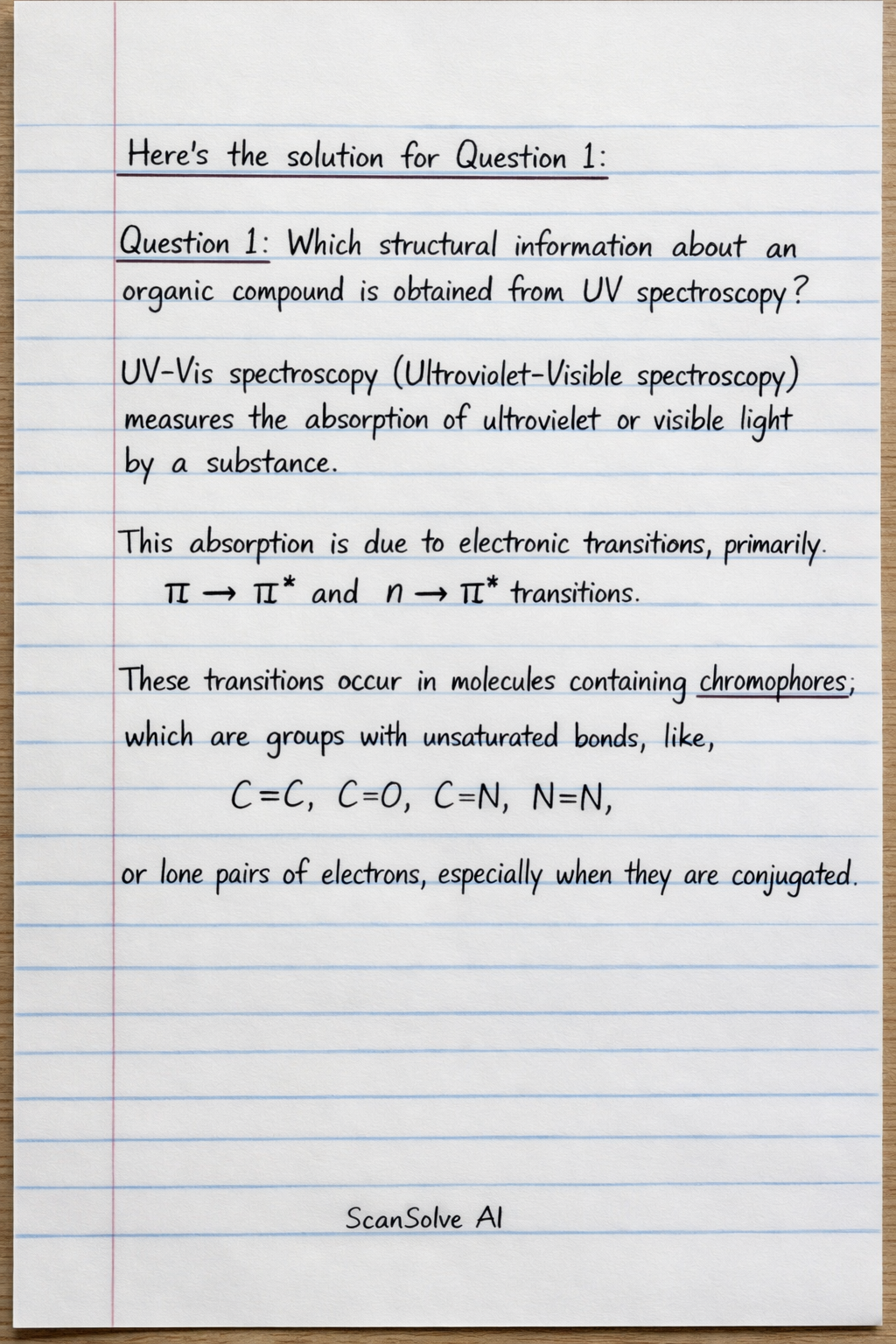
Handwritten Step-by-Step Solution
Get this as a handwritten image on WhatsApp — like a tutor wrote it for you.
Try on WhatsApp