
We read your photo as:
The question describes an organic compound that:
Chemistry
ScanSolve AI Answer
Here are the solutions to the chemistry questions from the image:
Question 11:
The question describes an organic compound that:
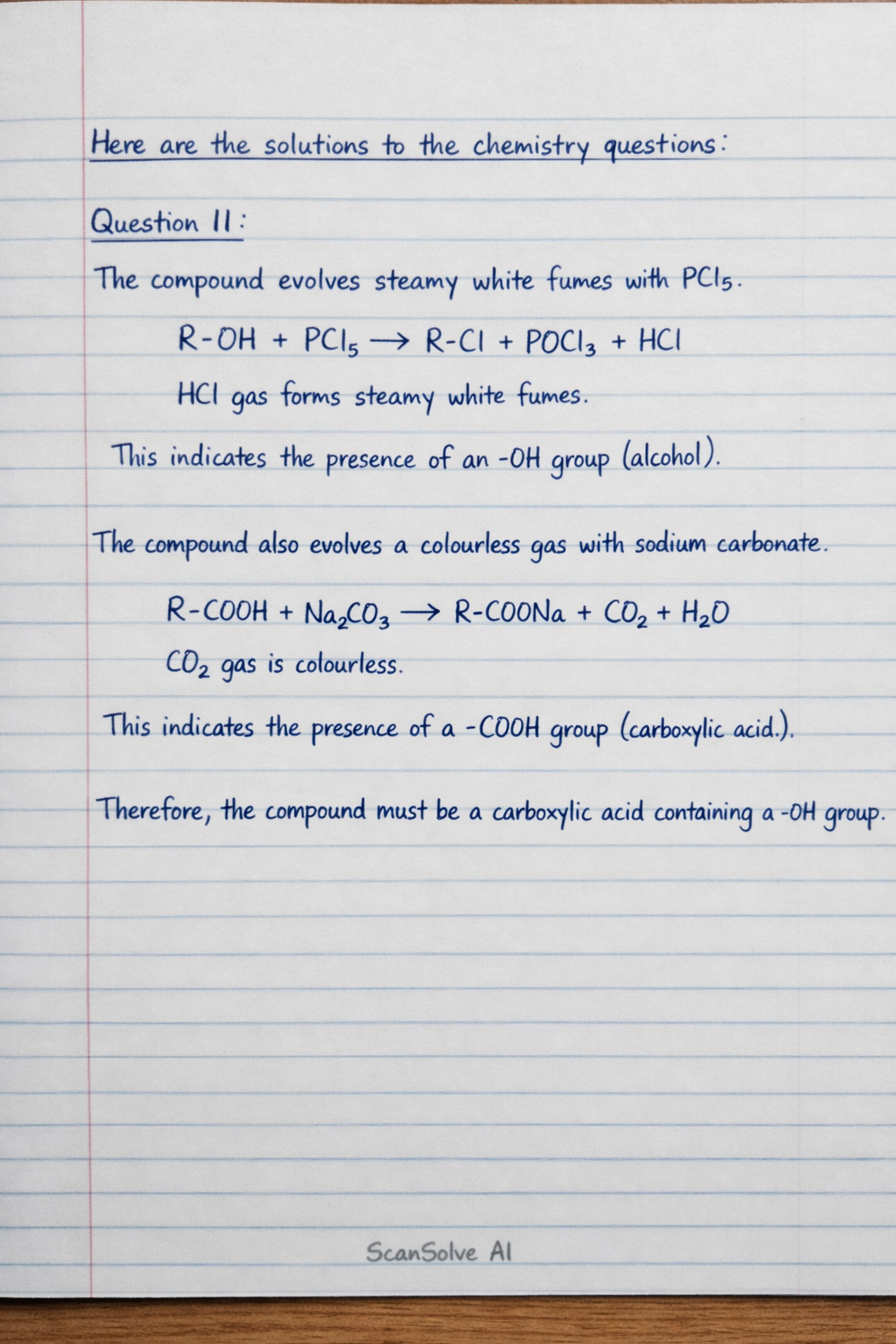
- "Evolve steamy white fumes with " - This indicates the presence of a hydroxyl (-OH) group, characteristic of alcohols or carboxylic acids. The reaction produces gas, which forms steamy white fumes.
- "Equally evolve a colourless gas with sodium carbonate" - This indicates the presence of a carboxylic acid (-COOH) group, as carboxylic acids react with carbonates to produce carbon dioxide () gas, which is colourless. Alcohols do not react with sodium carbonate.
Combining these two observations, the compound must be a carboxylic acid.
Let's examine the options:
- A. (Propan-1-ol) is an alcohol. It reacts with but not with sodium carbonate.
- B. (Propen-1-ol) is an enol, which is generally unstable. It has an -OH group but is not a carboxylic acid.
- C. (1-Chloropropane) is a haloalkane. It does not have an -OH group and does not react with sodium carbonate to produce gas.
- D. (Propanoic acid) is a carboxylic acid. It contains an -OH group (within the -COOH) that reacts with and a -COOH group that reacts with sodium carbonate to produce .
The final answer is .
Was this helpful?
Still stuck on this one?
Ask a follow-up, and the answer starts from this question.
Got a different question?Ask your own question
More Chemistry Questions
QName the following organic compound:QQ5: Organic Compound Q (C4H8O₂)QWhich organic compound, given its properties (high boiling point, viscous, non-toxic, miscible with…QOn Exam: ? -> complex organic molecule starting from benzene.QIdentify and name the organic compounds shown in the image.
Browse by topic:Organic Chemistry
Handwritten Step-by-Step Solution
Get this as a handwritten image on WhatsApp — like a tutor wrote it for you.
Try on WhatsApp