
We read your photo as:
Question 12: Solvent for UV must be
ScanSolve AI Answer
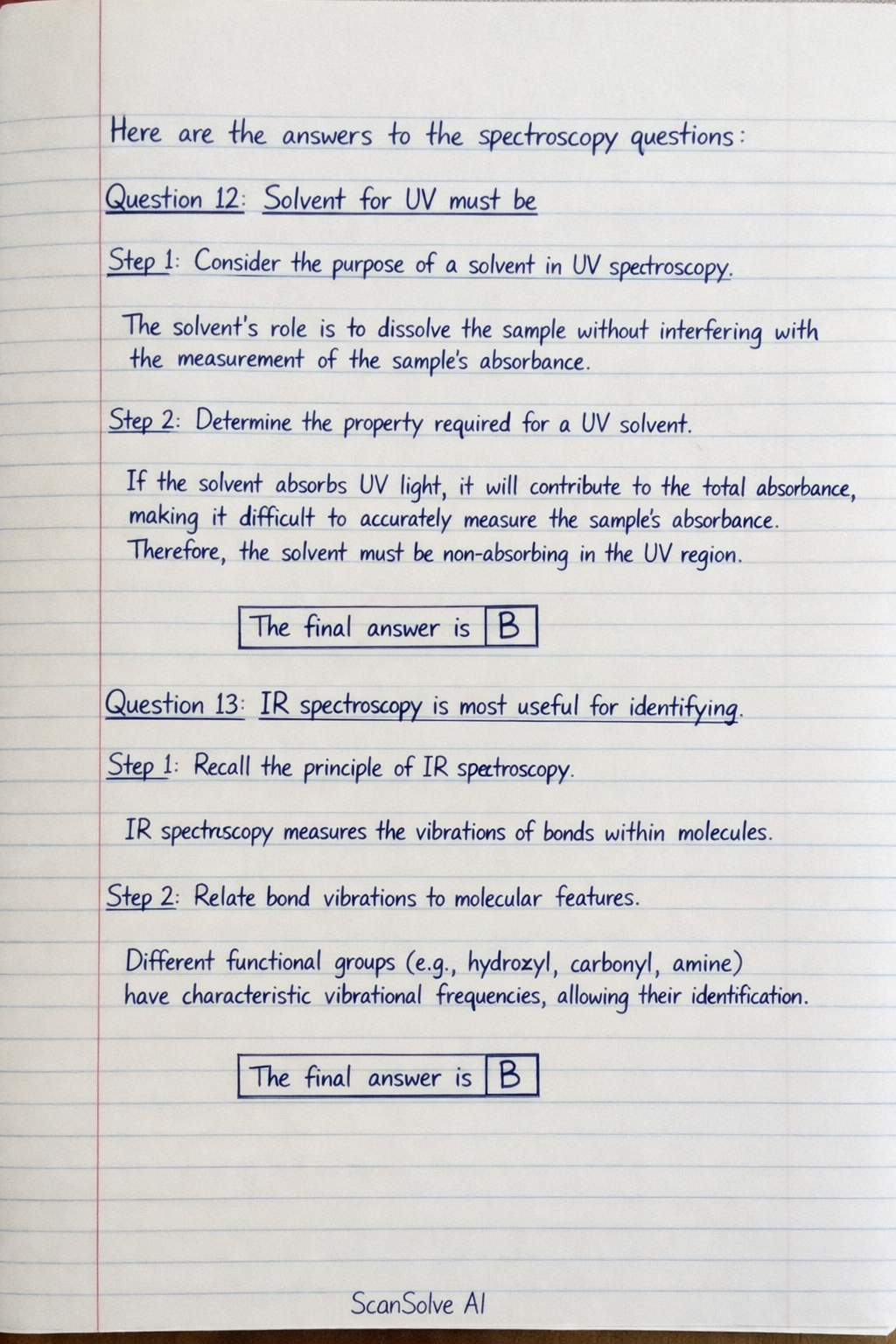
Here are the answers to the spectroscopy questions:
Question 12: Solvent for UV must be
- Step 1: Consider the purpose of a solvent in UV spectroscopy. The solvent's role is to dissolve the sample without interfering with the measurement of the sample's absorbance.
- Step 2: Determine the property required for a UV solvent. If the solvent absorbs UV light, it will contribute to the total absorbance, making it difficult to accurately measure the sample's absorbance. Therefore, the solvent must be non-absorbing in the UV region.
The final answer is
Question 13: IR spectroscopy is most useful for identifying
- Step 1: Recall the principle of IR spectroscopy. IR spectroscopy measures the vibrations of bonds within molecules.
- Step 2: Relate bond vibrations to molecular features. Different functional groups (e.g., hydroxyl, carbonyl, amine) have characteristic vibrational frequencies, allowing their identification.
The final answer is
Question 14: GC-MS combines
- Step 1: Understand the acronym GC-MS. GC stands for Gas Chromatography, and MS stands for Mass Spectrometry.
- Step 2: Identify the techniques combined. GC is a separation technique, and MS is a detection/identification technique.
The final answer is
Question 15: Fluorimetry measures
- Step 1: Define fluorimetry. Fluorimetry (or fluorescence spectroscopy) is a technique where a sample absorbs light at one wavelength and then re-emits light at a longer wavelength.
- Step 2: Identify what is being measured. The technique measures the light that is emitted by the sample.
The final answer is
Question 16: IR spectroscopy is based on
- Step 1: Recall the energy transitions involved in IR spectroscopy. When molecules absorb infrared radiation, their bonds vibrate.
- Step 2: Identify the type of transition. These vibrations correspond to changes in the vibrational energy levels of the molecule, known as vibrational transitions.
The final answer is
Question 17: Which nucleus is commonly used in carbon NMR?
- Step 1: Understand the principle of NMR. NMR (Nuclear Magnetic Resonance) spectroscopy detects nuclei with a non-zero spin.
- Step 2: Identify the NMR-active isotope of carbon. The most abundant isotope of carbon, , has zero nuclear spin and is therefore NMR-inactive. The isotope has a nuclear spin of and is used in carbon NMR.
The final answer is
Question 18: Functional groups absorb in
- Step 1: Recall the regions of an IR spectrum. An IR spectrum is typically divided into the functional group region and the fingerprint region.
- Step 2: Identify where characteristic functional group absorptions occur. The functional group region (higher wavenumbers) is where the characteristic stretching and bending vibrations of specific functional groups are observed.
The final answer is
Question 19: Fingerprint region range
- Step 1: Recall the typical ranges for IR spectroscopy. IR spectra are usually presented in wavenumbers ().
- Step 2: Identify the range for the fingerprint region. The fingerprint region in IR spectroscopy is typically from approximately to . This region is complex and unique to each molecule.
The final answer is
Question 20: NMR is based on
- Step 1: Understand the full name of NMR. NMR stands for Nuclear Magnetic Resonance.
- Step 2: Identify the fundamental property it exploits. NMR spectroscopy relies on the magnetic properties of atomic nuclei, specifically their nuclear spin, which interacts with an external magnetic field.
The final answer is
Still stuck on this one?
Ask a follow-up, and the answer starts from this question.
More Chemistry Questions
Handwritten Step-by-Step Solution
Get this as a handwritten image on WhatsApp — like a tutor wrote it for you.
Try on WhatsApp