
We read your photo as:
Question 28(b): Explain why copper displaces Q from its nitrate solution, given the standard electrode potentials.
ScanSolve AI Answer
Step-by-step solution
3 stepsHere is the answer for question 28 b):
b)
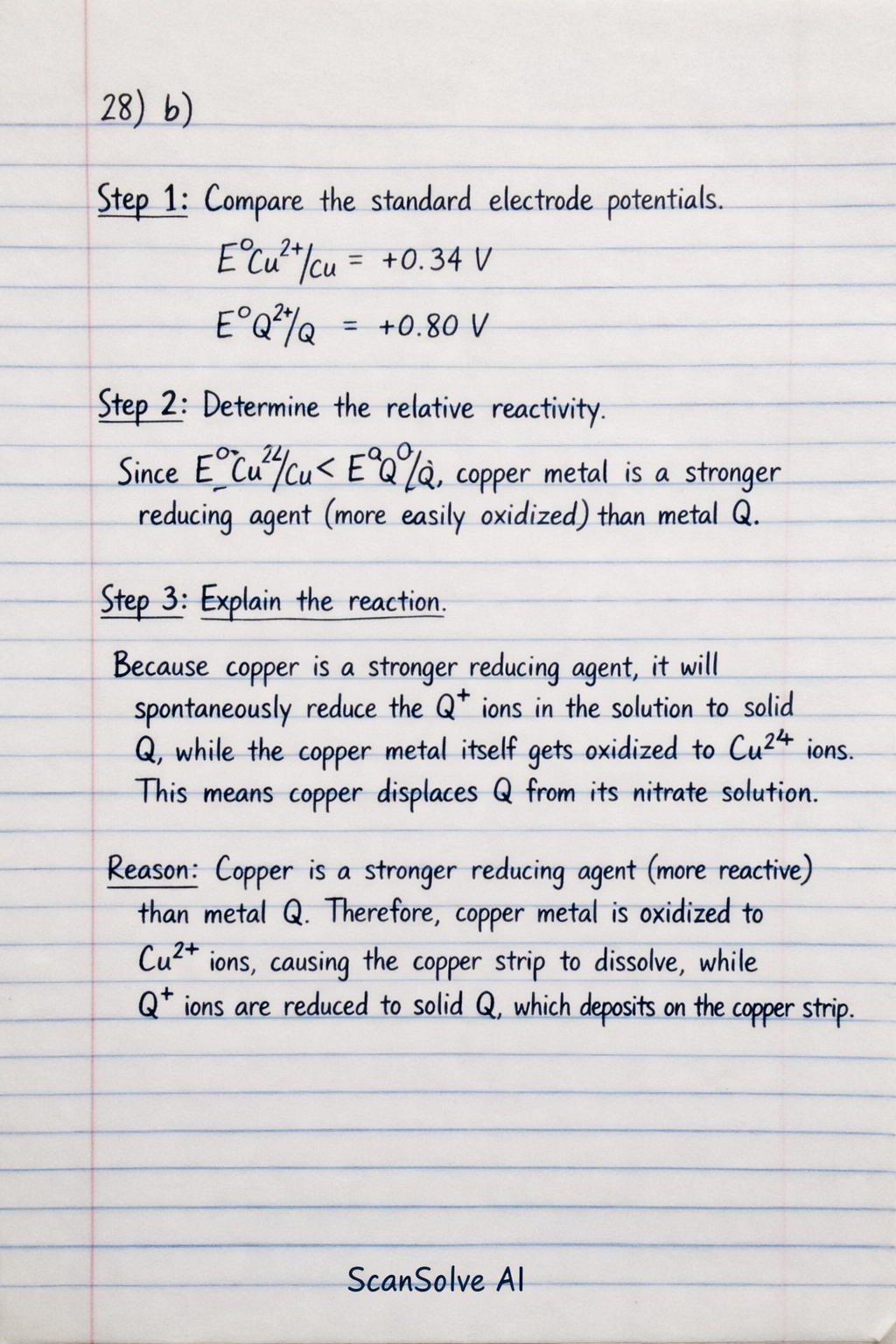
Compare the standard electrode potentials () of copper and Q.
Determine the relative reactivity.
Since is less positive than , copper metal is a stronger reducing agent (more easily oxidized) than metal Q.
Explain the reaction.
Because copper is a stronger reducing agent, it will spontaneously reduce the ions in the solution to solid Q, while the copper metal itself gets oxidized to ions. This means copper displaces Q from its nitrate solution.
Reason: Copper is a stronger reducing agent (more reactive) than metal Q. Therefore, copper metal is oxidized to ions, causing the copper strip to dissolve, while ions are reduced to solid Q, which deposits on the copper strip.
Still stuck on this one?
Ask a follow-up, and the answer starts from this question.
More Chemistry Questions
Handwritten Step-by-Step Solution
Get this as a handwritten image on WhatsApp — like a tutor wrote it for you.
Try on WhatsApp