
We read your photo as:
QUESTION 4 NOV 2014 The boiling points of four compounds of hydrogen, represented by the letters P, Q, R and S, are given in the table below.
ScanSolve AI Answer
Step-by-step solution
17 stepsQUESTION 4 NOV 2014
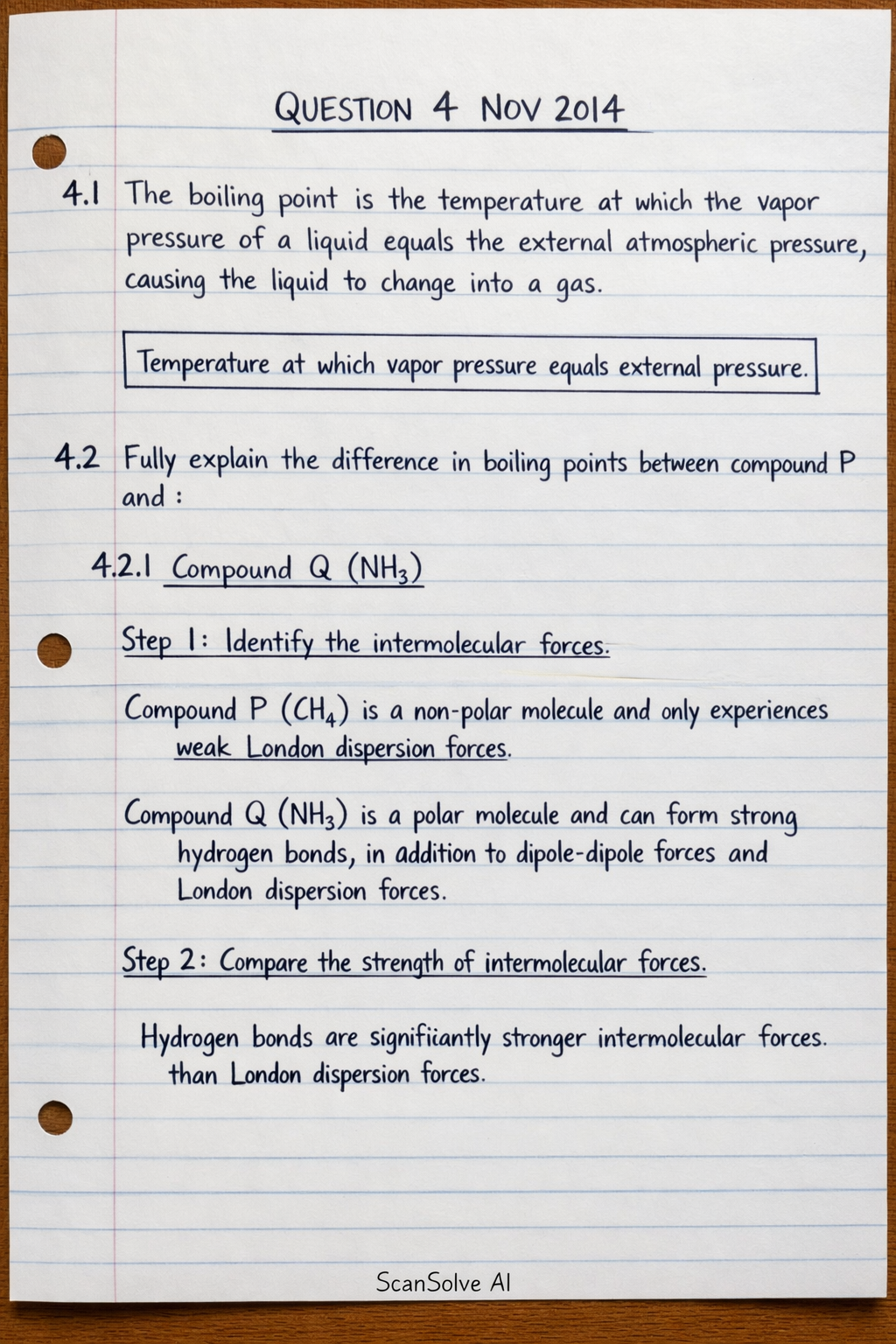
4.1 The boiling point is the temperature at which the vapor pressure of a liquid equals the external atmospheric pressure, causing the liquid to change into a gas.
4.2 Fully explain the difference in boiling points between compound P and:
4.2.1 Compound Q ()
Identify the intermolecular forces.
Compound P () is a non-polar molecule and only experiences weak London dispersion forces. Compound Q () is a polar molecule and can form strong hydrogen bonds, in addition to dipole-dipole forces and London dispersion forces.
Compare the strength of intermolecular forces.
Hydrogen bonds are significantly stronger intermolecular forces than London dispersion forces.
Relate intermolecular forces to boiling point.
More energy is required to overcome the strong hydrogen bonds in compared to the weak London dispersion forces in . Therefore, has a higher boiling point () than ().
4.2.2 Compound S ()
Identify the intermolecular forces.
Both compound P () and compound S () are non-polar molecules with tetrahedral shapes, meaning they only experience London dispersion forces.
Compare molecular masses.
The molecular mass of is approximately , while the molecular mass of is approximately . has a higher molecular mass and more electrons.
Relate molecular mass to the strength of London dispersion forces.
As the molecular mass and number of electrons increase, the electron cloud becomes more polarizable, leading to stronger London dispersion forces between molecules.
Relate intermolecular forces to boiling point.
More energy is required to overcome the stronger London dispersion forces in compared to . Therefore, has a higher boiling point () than ().
4.3 Explain why the boiling points of compounds Q () and R () differ by referring to ELECTRONEGATIVITY and DEGREE OF POLARITY:
Compare boiling points and identify intermolecular forces.
Compound R () has a boiling point of , while compound Q () has a boiling point of . Both molecules are polar and can form hydrogen bonds.
Compare electronegativity and bond polarity.
Oxygen is more electronegative than nitrogen. This makes the O-H bonds in more polar than the N-H bonds in .
Compare the extent and strength of hydrogen bonding.
Due to the greater electronegativity of oxygen and the presence of two lone pairs, can form more and stronger hydrogen bonds per molecule (up to four) compared to (which typically forms fewer and weaker hydrogen bonds).
Conclude the effect on boiling point.
The stronger and more extensive network of hydrogen bonds in requires significantly more energy to overcome during boiling, resulting in a much higher boiling point than .
4.4 Write down the letter from the table that represents the following:
4.4.1 ONE polar compound:
4.4.2 ONE non-polar compound:
QUESTION 3 NOV 2015
3.1 The boiling point is the temperature at which the vapor pressure of a liquid equals the external atmospheric pressure, causing the liquid to change into a gas.
3.2 Calculate the molecular mass of compound D ():
Write down the formula for molecular mass.
Molecular mass =
Substitute atomic masses.
Atomic mass of C
Atomic mass of H
Molecular mass ofCalculate the molecular mass.
Molecular mass
3.3 In what phase is compound B at 25 °C?
Compound B () has a boiling point of . Since is above its boiling point, compound B will be in the gaseous phase.3.4 Name the type of intermolecular force present in compound A ():
Compound A () is a non-polar molecule.3.5 Explain why the boiling point increases from compound A to E:
Identify the trend in molecular structure.
Compounds A to E are alkanes with increasing chain length and molecular mass (, , , , ).
Relate molecular mass to intermolecular forces.
As the molecular mass increases, the number of electrons in the molecule increases. This leads to a greater polarizability of the electron cloud, resulting in stronger London dispersion forces between molecules.
Conclude the effect on boiling point.
More energy is required to overcome these stronger London dispersion forces, causing the boiling point to increase from compound A to E.
3.6 How does the vapour pressure of compound B compare to the vapour pressure of compound C? Write down only HIGHER THAN, LOWER THAN or EQUAL TO.
Compound B has a boiling point of . Compound C has a boiling point of . A lower boiling point indicates weaker intermolecular forces, which means molecules can escape into the gas phase more easily, leading to a higher vapor pressure. Therefore, compound B will have a higher vapor pressure than compound C.
Still stuck on this one?
Ask a follow-up, and the answer starts from this question.
More Chemistry Questions
Handwritten Step-by-Step Solution
Get this as a handwritten image on WhatsApp — like a tutor wrote it for you.
Try on WhatsApp