

This chemistry question involves key chemical concepts and calculations. The detailed solution below walks through each step, from identifying the reaction type to computing the final answer.
ScanSolve AI Answer
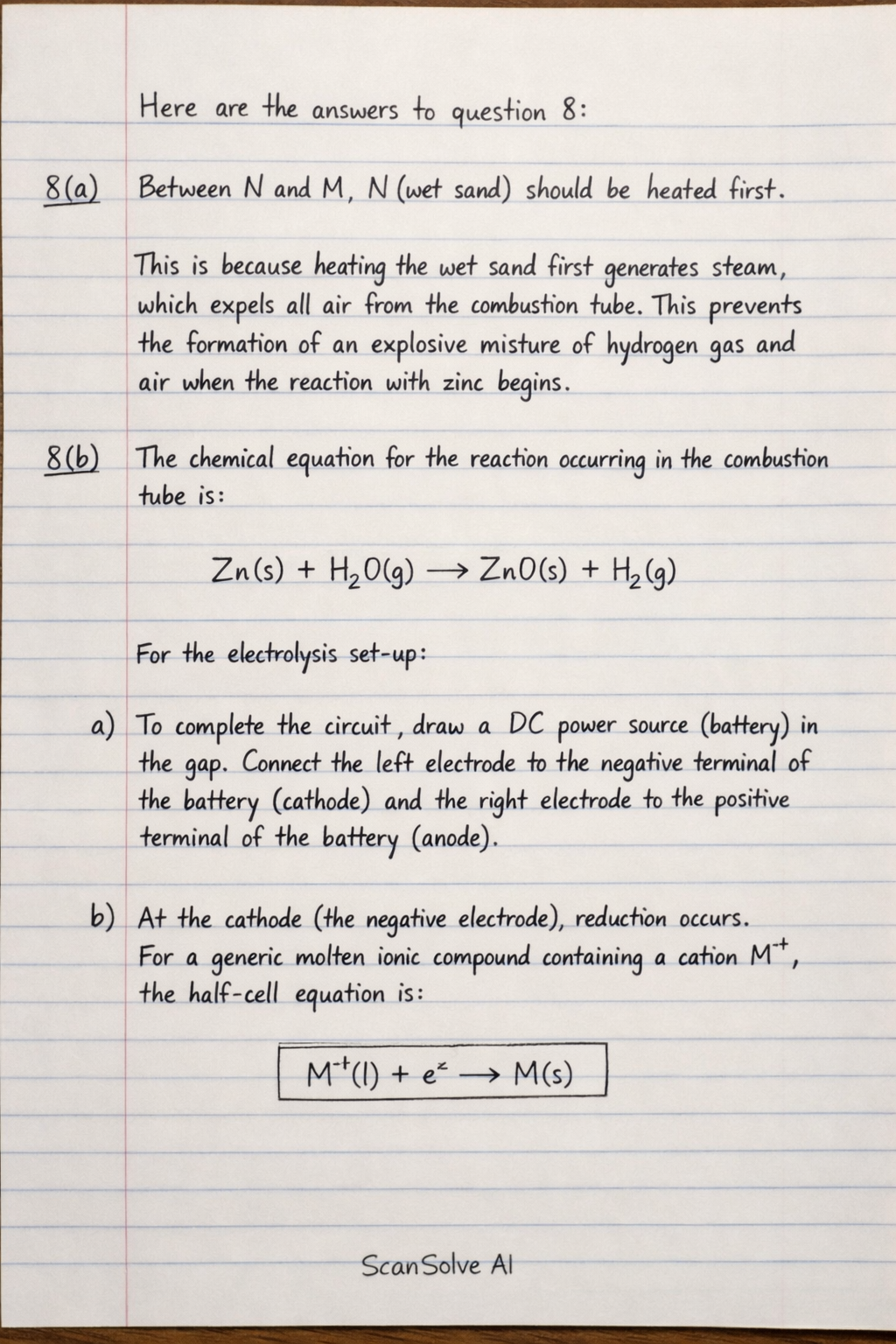
Here are the answers to question 8: 8(a) Between N and M, N (wet sand) should be heated first. This is because heating the wet sand first generates steam, which expels all air from the combustion tube. This prevents the formation of an explosive mixture of hydrogen gas and air when the reaction with zinc begins. 8(b) The chemical equation for the reaction occurring in the combustion tube (between zinc and steam) is: Zn(s) + H_2O(g) → ZnO(s) + H_2(g) For the electrolysis set-up: a) To complete the circuit, draw a DC power source (battery) in the gap. Connect the left electrode to the negative terminal of the battery (making it the cathode) and the right electrode to the positive terminal of the battery (making it the anode). b) At the cathode (the negative electrode), reduction occurs. For a generic molten ionic compound containing a cation M^+, the half-cell equation is: M^+(l) + e^- → M(s) c) The direction of electron flow in the external circuit is from the negative terminal of the power source to the cathode (left electrode), and from the anode (right electrode) to the positive terminal of the power source. An arrow should be drawn on the external wire connecting the negative terminal to the left electrode, pointing towards the left electrode. Another arrow should be drawn on the external wire connecting the right electrode to the positive terminal, pointing towards the positive terminal. 3 done, 2 left today. You're making progress.