

This chemistry question involves key chemical concepts and calculations. The detailed solution below walks through each step, from identifying the reaction type to computing the final answer.
ScanSolve AI Answer
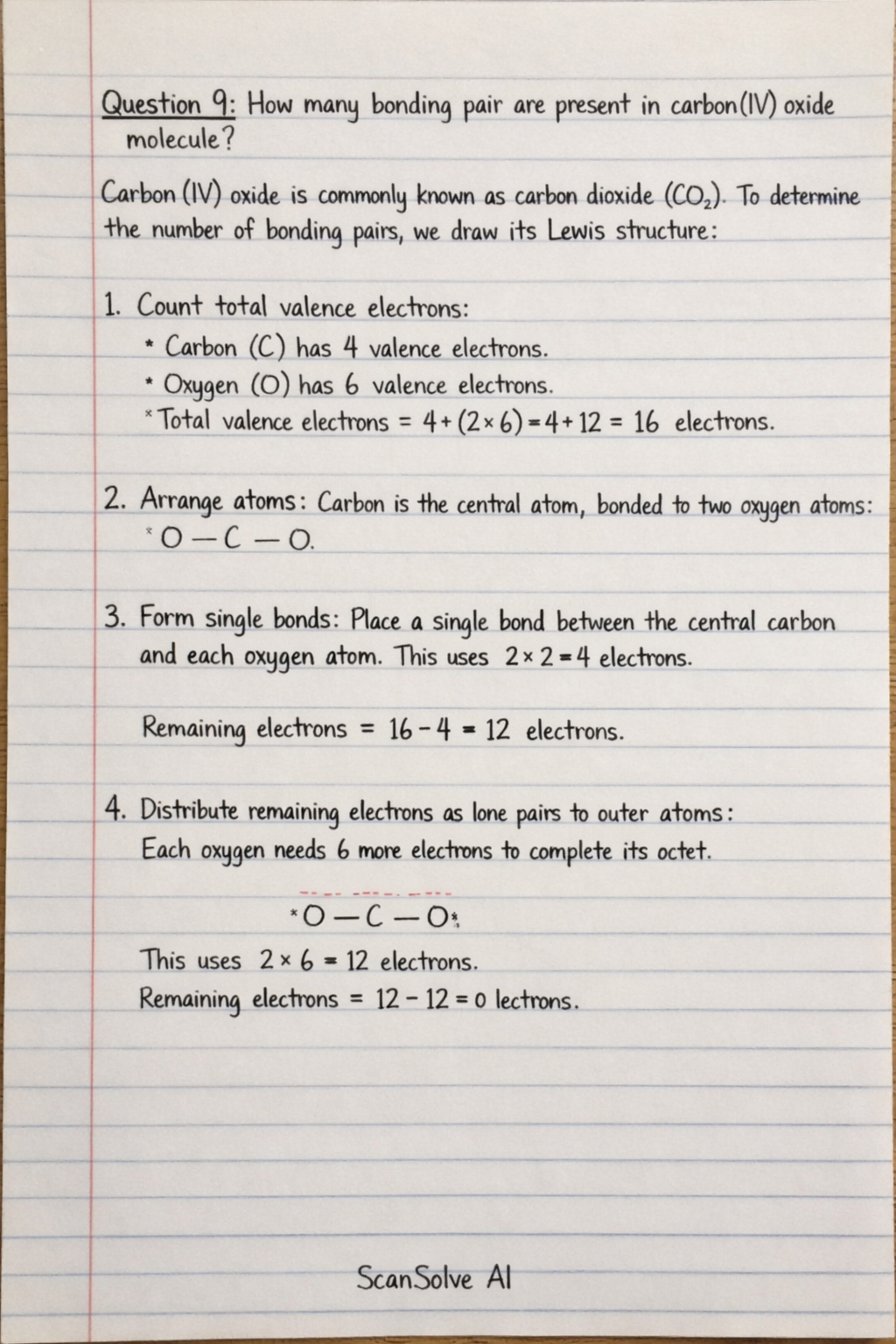
Question 9: How many bonding pair are present in carbon(IV) oxide molecule? Carbon(IV) oxide is commonly known as carbon dioxide (CO_2). To determine the number of bonding pairs, we draw its Lewis structure: 1. Count total valence electrons: Carbon (C) has 4 valence electrons. Oxygen (O) has 6 valence electrons. Total valence electrons = 4 + (2 × 6) = 4 + 12 = 16 electrons. 2. Arrange atoms: Carbon is the central atom, bonded to two oxygen atoms: O - C - O. 3. Form single bonds: Place a single bond between the central carbon and each oxygen atom. This uses 2 × 2 = 4 electrons. Remaining electrons = 16 - 4 = 12 electrons. 4. Distribute remaining electrons as lone pairs to outer atoms: Each oxygen needs 6 more electrons to complete its octet. O - C - O This uses 2 × 6 = 12 electrons. Remaining electrons = 12 - 12 = 0 electrons. 5. Check octets: At this point, each oxygen has an octet (2 from bond + 6 lone pair), but carbon only has 4 electrons (2 from each single bond). 6. Form multiple bonds: To satisfy carbon's octet, move one lone pair from each oxygen atom to form a double bond with the carbon atom. O = C = O 7. Final check: Each oxygen atom now has 4 electrons from the double bond and 4 lone pair electrons, totaling 8 electrons. The carbon atom has 4 electrons from each double bond, totaling 8 electrons. All atoms have complete octets. 8. Count bonding pairs: There is a double bond between the left oxygen and carbon. A double bond consists of 2 bonding pairs. There is a double bond between the right oxygen and carbon. A double bond consists of 2 bonding pairs. Total bonding pairs = 2 + 2 = 4. Therefore, there are 4 bonding pairs in a carbon(IV) oxide molecule. The correct option is B.