
We read your photo as:
Describe reaction rate, state an investigative question about factors affecting reaction rates and identify which curve represents a lower concentration of HCl.
ScanSolve AI Answer
Answer
Step-by-step solution
7 stepsAddress Question 10.1.
Reaction rate is defined as the change in concentration of reactants or products per unit time. It measures how fast a reaction proceeds.
The definition of reaction rate is:
The change in concentration of reactants or products per unit time.Address Question 10.2.
The investigation aims to study factors affecting the rate of reaction between zinc and hydrochloric acid. The table shows varying concentrations of HCl.
An investigative question for this investigation is:
How does the concentration of hydrochloric acid affect the rate of reaction with zinc?Address Question 10.3.
- Experiment I: Concentration of HCl = 0.25 mol/dm³
- Experiment II: Concentration of HCl = 0.40 mol/dm³ Both experiments use the same mass of zinc and are at the same temperature. Since Experiment II has a higher concentration of HCl, it will have a faster reaction rate. A faster reaction rate is represented by a steeper slope on the graph and reaches the maximum product volume in less time. Curve P is steeper and finishes earlier than curve Q.
Curve Q represents the results of experiment I.
Explanation: Experiment I has a lower concentration of HCl (0.25 mol/dm³) compared to Experiment II (0.40 mol/dm³). A lower concentration means fewer reactant particles per unit volume, leading to fewer effective collisions per unit time, and thus a slower reaction rate. Curve Q shows a slower rate of reaction (less steep slope) than curve P.Address Question 10.4.
The average rate of production of hydrogen gas for graph P was 15 cm³/s.
From the graph, curve P completes the reaction (reaches its plateau) at approximately 30 seconds.
The balanced equation is:
From the equation, 1 mole of Zn produces 1 mole of H.
Molar gas volume at 25 °C = 24 000 cm³/mol.
Molar mass of Zn = 65.38 g/mol.First, calculate the total volume of H produced:
Next, calculate the moles of H produced:
Since 1 mole of Zn produces 1 mole of H:
Finally, calculate the mass of zinc used:
Rounding to two decimal places:
The mass of zinc used is .Address Question 10.5.1.
The heat of reaction () is determined by the difference in energy between the reactants and products. It is independent of factors like concentration, temperature, or surface area. Since Experiment II and Experiment III involve the same chemical reaction (Zn + HCl), their heat of reaction will be the same.
The heat of reaction of experiment II will compare with that of experiment III as: EQUAL TO.
Address Question 10.5.2.
Activation energy is the minimum energy required for a reaction to occur. It is an intrinsic property of the reaction pathway and is not affected by changes in concentration, temperature, or surface area. Only a catalyst can change the activation energy.
The activation energy of the reaction in experiment III will compare with that of the reaction in experiment II as: EQUAL TO.
Address Question 10.6.
- Experiment I: Temperature = 25 °C, Concentration = 0.25 mol/dm³ HCl, Zinc powder.
- Experiment III: Temperature = 35 °C, Concentration = 0.25 mol/dm³ HCl, Zinc powder. The only difference between Experiment I and Experiment III is the temperature. Experiment III is at a higher temperature (35 °C) than Experiment I (25 °C).
According to the collision theory:
- At a higher temperature, the reactant particles (zinc and HCl) possess higher average kinetic energy.
- This increased kinetic energy leads to more frequent collisions between the reactant particles.
- More importantly, a larger proportion of these collisions will have kinetic energy equal to or greater than the activation energy, resulting in more effective collisions.
- Both increased collision frequency and a higher proportion of effective collisions contribute to a faster rate of reaction in Experiment III compared to Experiment I.
Try one yourself
A new problem that tests the same skill.
Still stuck on this one?
Ask a follow-up, and the answer starts from this question.
More Chemistry Questions
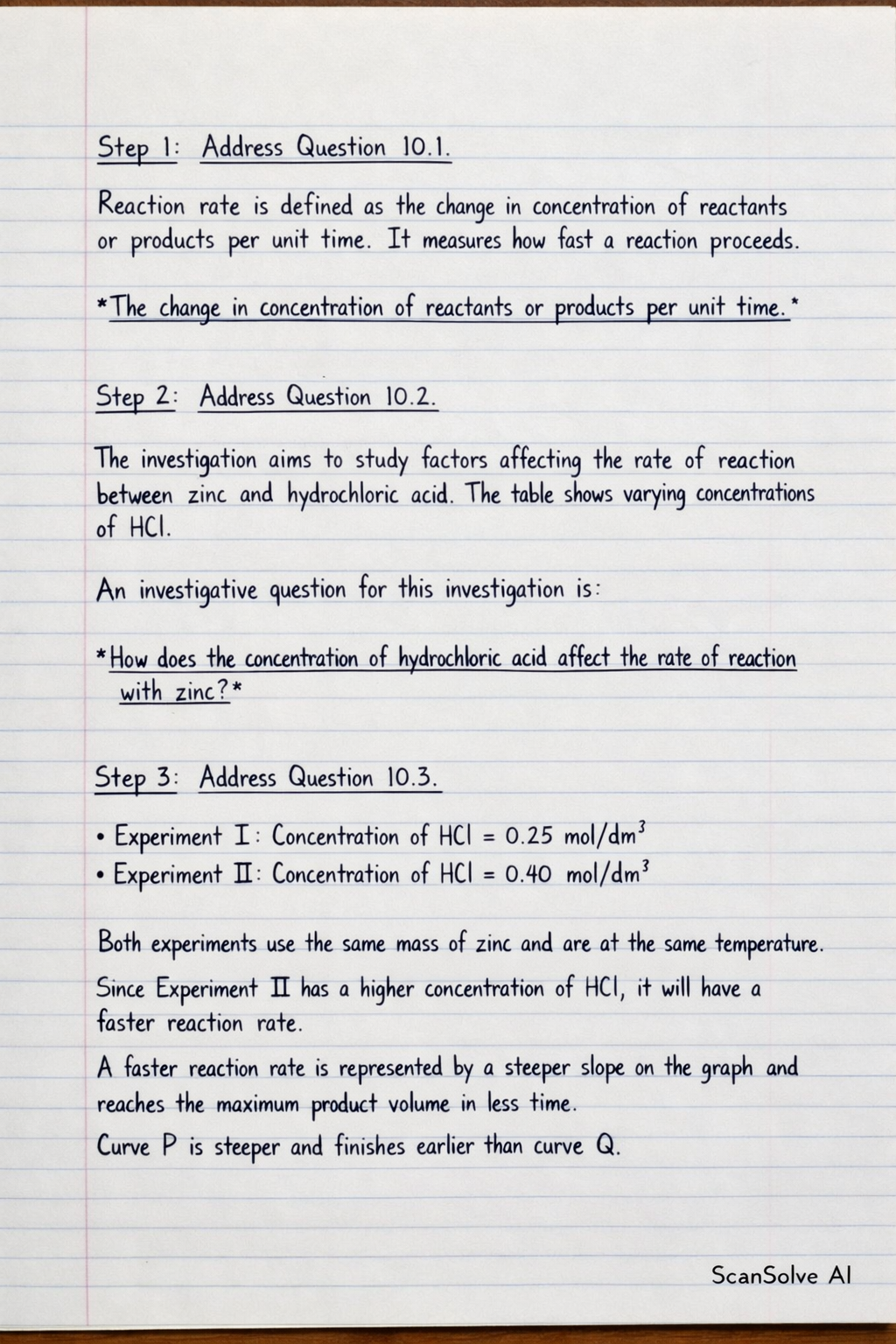
Handwritten Step-by-Step Solution
Get this as a handwritten image on WhatsApp — like a tutor wrote it for you.
Try on WhatsApp