
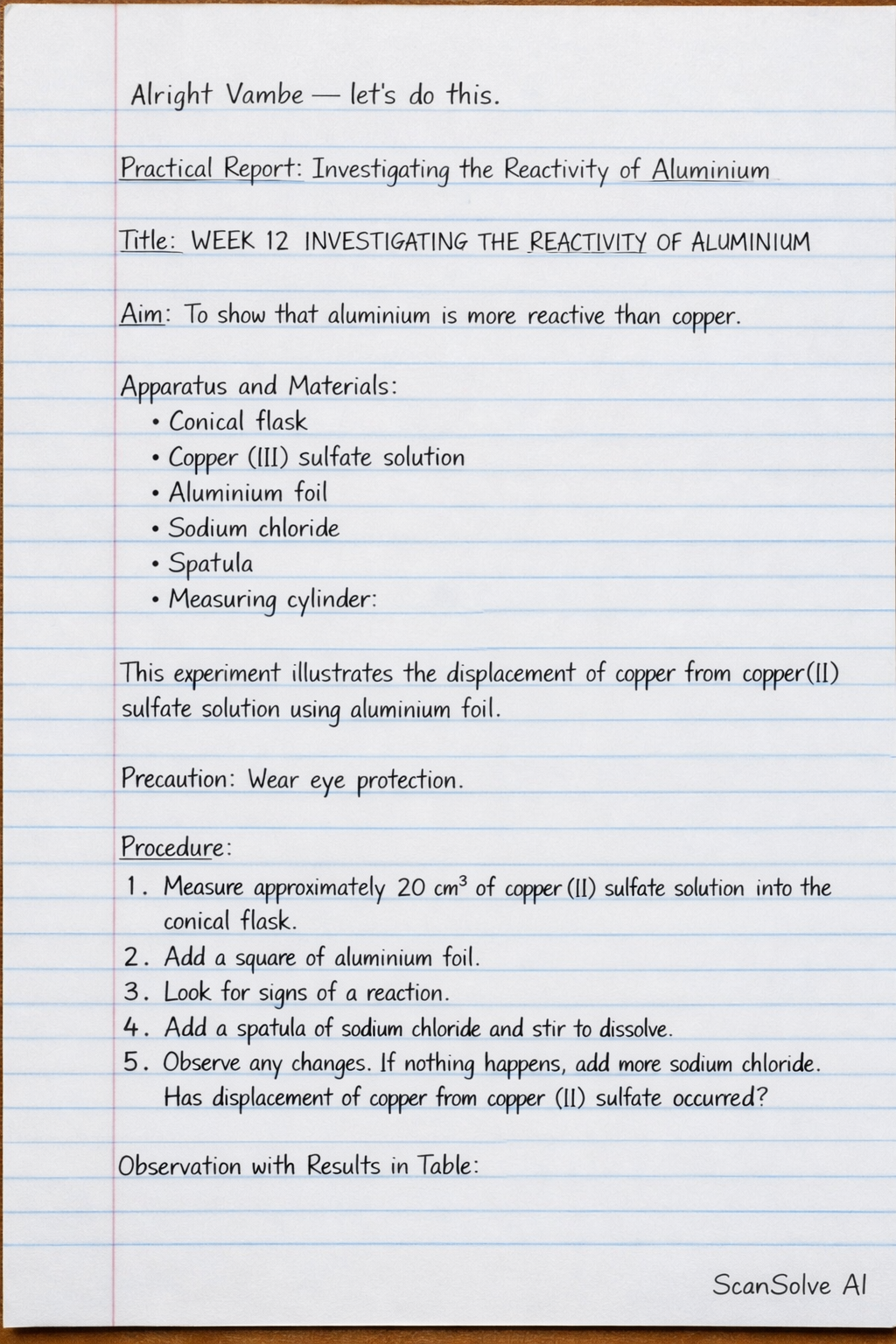
We read your photo as:
Report the practical using the following Harding title, aim, apparatus, introduction, precaution, procedure, observation with results in table, and equation of the reaction.
ScanSolve AI Answer
Practical Report: Investigating the Reactivity of Aluminium
Title: WEEK 12 INVESTIGATING THE REACTIVITY OF ALUMINIUM
Aim: To show that aluminium is more reactive than copper.
Apparatus and Materials:
- Conical flask
- Copper (II) Sulfate solution
- Aluminium foil
- Sodium chloride
- Spatula
- Measuring cylinder (implied for measuring solution volume)
Introduction:
This experiment illustrates the displacement of copper from copper(II) sulfate solution using aluminium foil.
Precaution:
Wear eye protection.
Procedure:
- Measure approximately of copper(II) sulfate solution into the conical flask.
- Add a square of aluminium foil.
- Look for signs of a reaction.
- Add a spatula of sodium chloride and stir to dissolve.
- Observe any changes. If nothing happens, add more sodium chloride. Has displacement of copper from copper(II) sulfate occurred?
Observation with Results in Table:
| Observations | Before sodium chloride is added | After sodium chloride is added |
|---|---|---|
| Bubbles observed | No | Yes |
| Colour changes | No (or very slow fading) | Yes (blue fades, becomes colorless) |
| Temperature change | No (or negligible) | Yes (temperature increases) |
| Copper observed | No | Yes (reddish-brown solid deposits) |
Explanation of Observations:
Initially, aluminium is protected by a thin, unreactive layer of aluminium oxide, preventing it from reacting with copper(II) sulfate. Adding sodium chloride helps to break down this oxide layer, allowing the more reactive aluminium to displace copper from the copper(II) sulfate solution. This results in the formation of reddish-brown solid copper and aluminium sulfate solution, which is colorless. The reaction is exothermic, causing a temperature increase and potentially some bubbling.
Equation of the Reaction:
Still stuck on this one?
Ask a follow-up, and the answer starts from this question.
More Chemistry Questions
Handwritten Step-by-Step Solution
Get this as a handwritten image on WhatsApp — like a tutor wrote it for you.
Try on WhatsApp