Determine the tension force in each of the wires shown in Figure 1 Below.

Physics
Determine the tension force in each of the wires shown in Figure 1 Below.

ScanSolve AI Answer

Answer

T_Q \cos(30^\circ) - T_

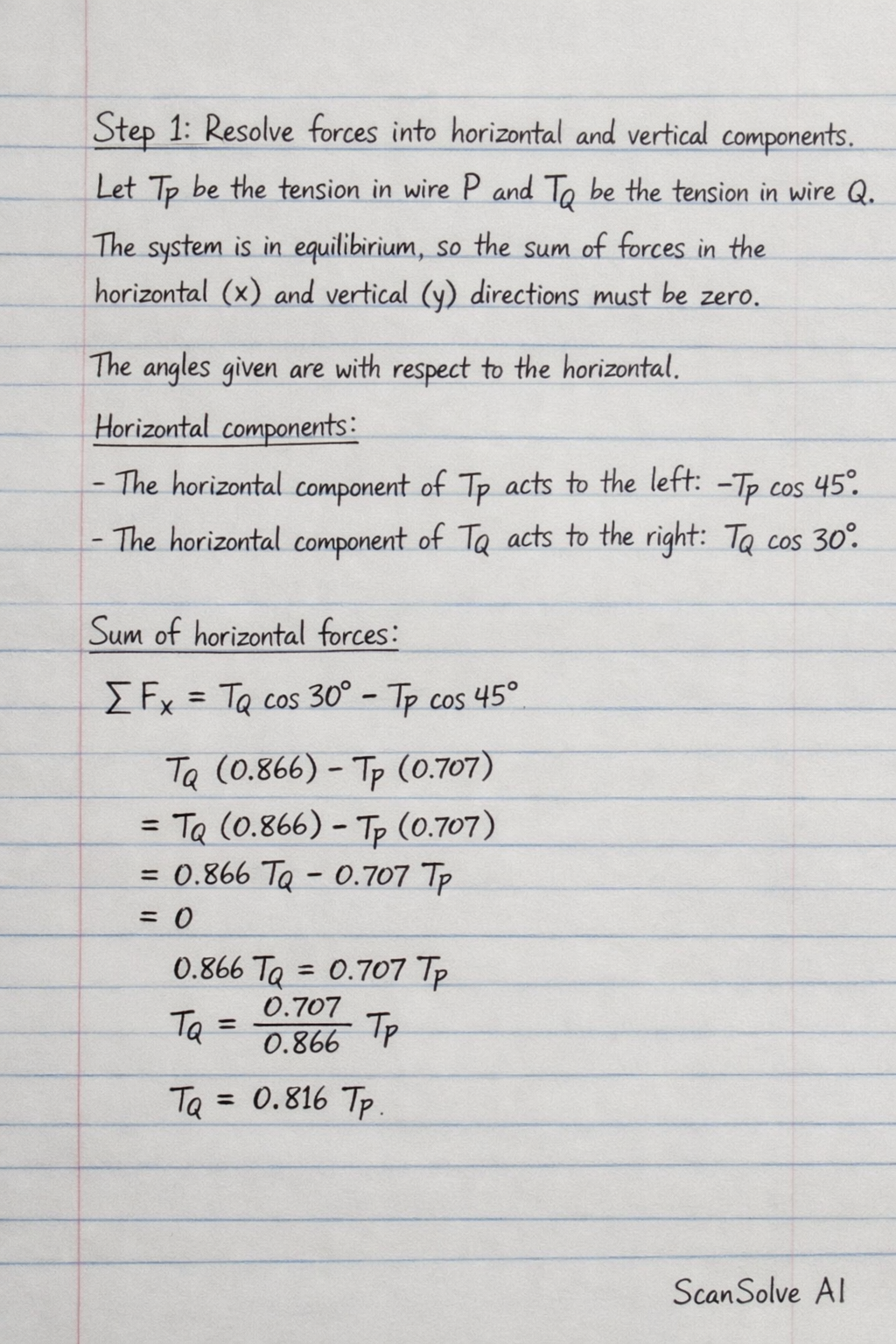
Step 1: Resolve forces into horizontal and vertical components. Let TPT_P be the tension in wire P and TQT_Q be the tension in wire Q. The system is in equilibrium, so the sum of forces in the horizontal (x) and vertical (y) directions must be zero.

The angles given are with respect to the horizontal. Horizontal components: The horizontal component of TPT_P acts to the left: TPcos(45)-T_P \cos(45^\circ). The horizontal component of TQT_Q acts to the right: TQcos(30)T_Q \cos(30^\circ). Sum of horizontal forces:

Was this helpful?

Need help with your own homework?

Get instant step-by-step solutions to any question. Free to start.

Ask Your Question
Handwritten step-by-step solution preview

Handwritten Step-by-Step Solution

Get this as a handwritten image on WhatsApp — like a tutor wrote it for you.

Try on WhatsApp

Still have questions?

Quick Answer

Resolve forces into horizontal and vertical components. Let T_P be the tension in wire P and T_Q be the tension in wire Q.

Determine the tension force in each of the wires shown in Figure 1 Below.
Physics

This physics problem tests your understanding of fundamental physical laws and their applications. The step-by-step solution below breaks down the problem using relevant equations and physical reasoning.

ScanSolve AI Answer
Step 1: Resolve forces into horizontal and vertical components. Let T_P be the tension in wire P and T_Q be the tension in wire Q. The system is in equilibrium, so the sum of forces in the horizontal (x) and vertical (y) directions must be zero. The angles given are with respect to the horizontal. Horizontal components: The horizontal component of T_P acts to the left: -T_P (45^). The horizontal component of T_Q acts to the right: T_Q (30^). Sum of horizontal forces: F_x = T_Q (30^) - T_