
We read your photo as:
Calculate the force F on the wire shown in the figure, given the current I = 1A, magnetic field B = 2T, and the parabolic shape of the wire described by y2 = 2x, with AC = 2m.
ScanSolve AI Answer
Answer
Step-by-step solution
2 stepsIdentify the given parameters and the effective length vector.
The magnetic field is uniform and into the page, with magnitude .
The current flowing through the wire is .
The wire segment follows the path of the parabola from point C to point A.
The vertical distance between C and A is given as .
Since the parabola is symmetric about the x-axis and the points C and A lie on a vertical line (same x-coordinate), if the y-coordinate of C is and A is , then .
Given .
Therefore, and .
Now, find the x-coordinates using :
For point C: . So, .
For point A: . So, .
The current flows from C to A. The effective length vector is the displacement vector from C to A:The magnetic field is into the page. If is along x and is along y, then is out of the page. So, into the page is .
Calculate the magnetic force.
For a current-carrying wire in a uniform magnetic field, the magnetic force is given by:
Substitute the values:
Recall the cross product identity :
The magnitude of the force is .
Try one yourself
A new problem that tests the same skill.
Still stuck on this one?
Ask a follow-up, and the answer starts from this question.
More Physics Questions
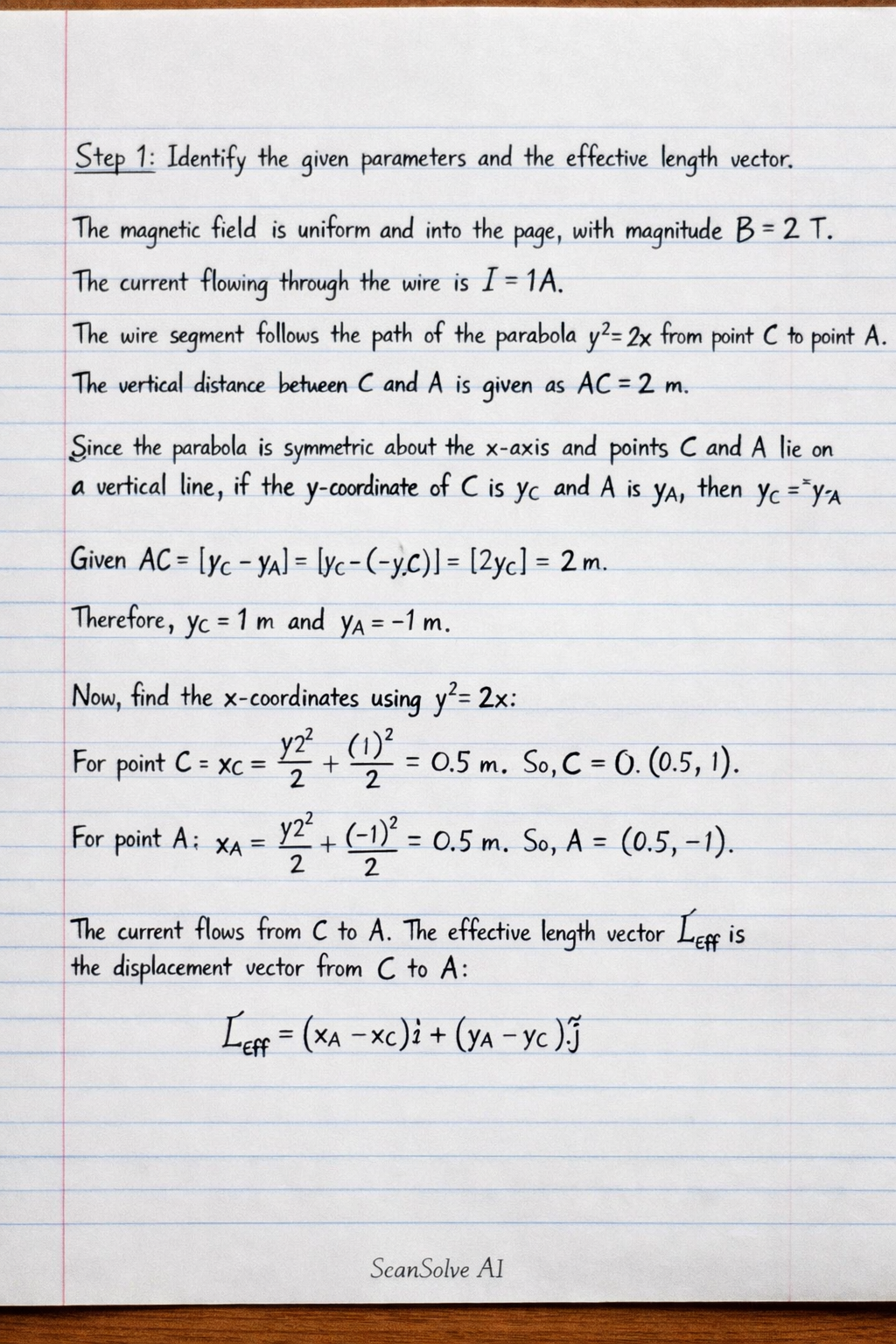
Handwritten Step-by-Step Solution
Get this as a handwritten image on WhatsApp — like a tutor wrote it for you.
Try on WhatsApp