
We read your photo as:
Give Short Answers to the following questions. (Any EIGHT) 1. Why some of the elements show variable oxidation numbers while others do not? 2. 1st electron affinity of Oxygen is -141 KJ/mol but 2nd el
ScanSolve AI Answer
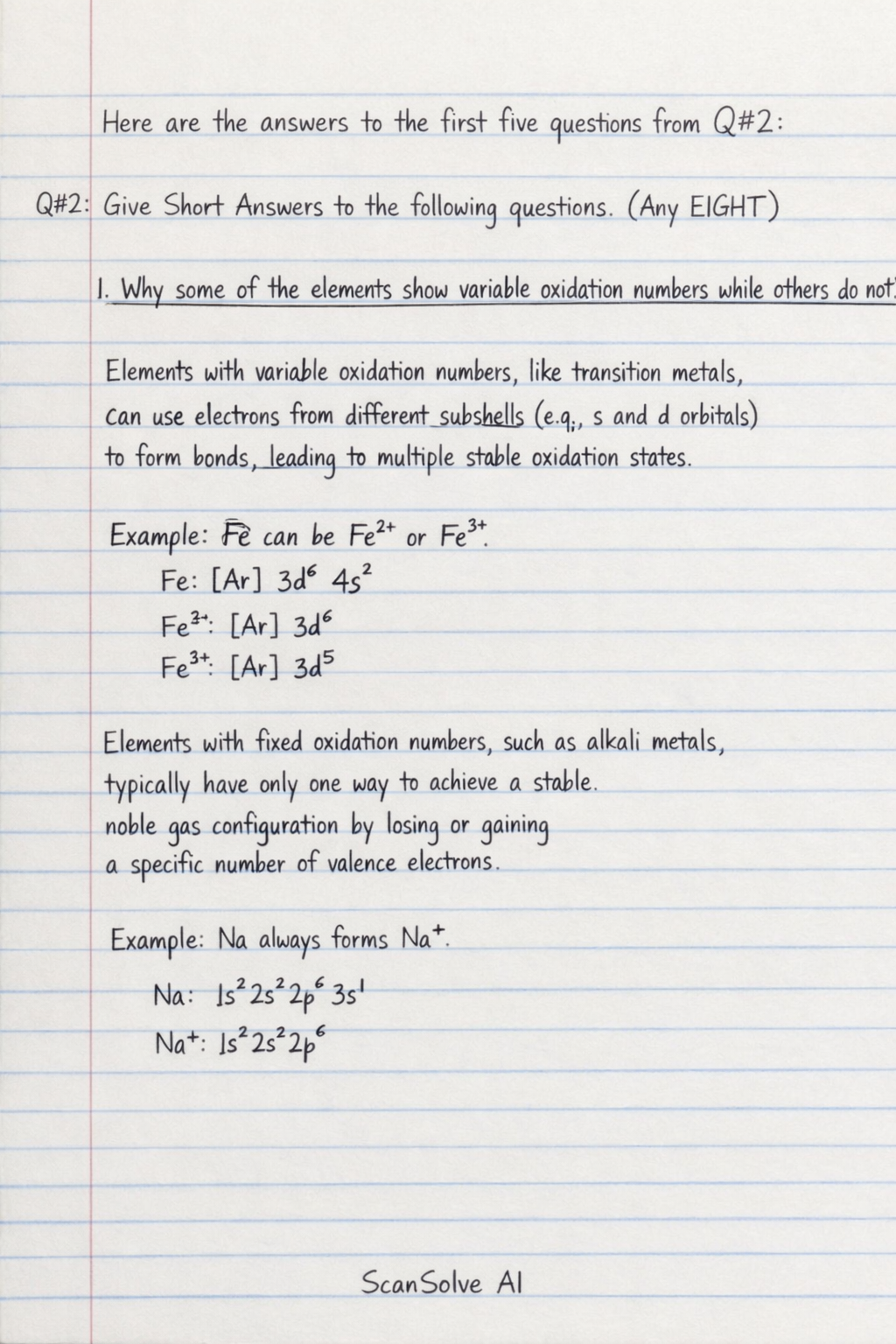
Here are the answers to the first five questions from Q#2:
Q#2: Give Short Answers to the following questions. (Any EIGHT)
-
Why some of the elements show variable oxidation numbers while others do not? Elements with variable oxidation numbers, like transition metals, can use electrons from different subshells (e.g., s and d orbitals) to form bonds, leading to multiple stable oxidation states. Elements with fixed oxidation numbers, such as alkali metals, typically have only one way to achieve a stable noble gas configuration by losing or gaining a specific number of valence electrons.
-
1st electron affinity of Oxygen is but 2nd electron affinity is . The first electron affinity of oxygen is exothermic because energy is released when an electron is added to a neutral atom to form . The second electron affinity is endothermic because energy is required to add an electron to an already negatively charged ion to form , overcoming the strong electrostatic repulsion between the incoming electron and the existing negative charge.
-
Why oxides of sodium and magnesium are more ionic than the oxides of nitrogen and phosphorous? Sodium and magnesium are metals with low electronegativity, forming ionic bonds with oxygen due to a large electronegativity difference. Nitrogen and phosphorus are non-metals with higher electronegativity, resulting in smaller electronegativity differences and the formation of covalent bonds with oxygen.
-
Compare orbit and orbital.
- An orbit is a fixed, two-dimensional circular path around the nucleus where electrons revolve, as per Bohr's model.
- An orbital is a three-dimensional region of space around the nucleus where there is a high probability of finding an electron, described by quantum mechanics.
-
There are three orientations of p-orbital due to three values of magnetic quantum number. Justify it. For a p-subshell, the azimuthal quantum number () is 1. The magnetic quantum number () can have three values: . Each value corresponds to a distinct spatial orientation of the p-orbital along the x, y, and z axes (), making them mutually perpendicular.
Still stuck on this one?
Ask a follow-up, and the answer starts from this question.
More Chemistry Questions
Handwritten Step-by-Step Solution
Get this as a handwritten image on WhatsApp — like a tutor wrote it for you.
Try on WhatsApp