

This chemistry question involves key chemical concepts and calculations. The detailed solution below walks through each step, from identifying the reaction type to computing the final answer.
ScanSolve AI Answer
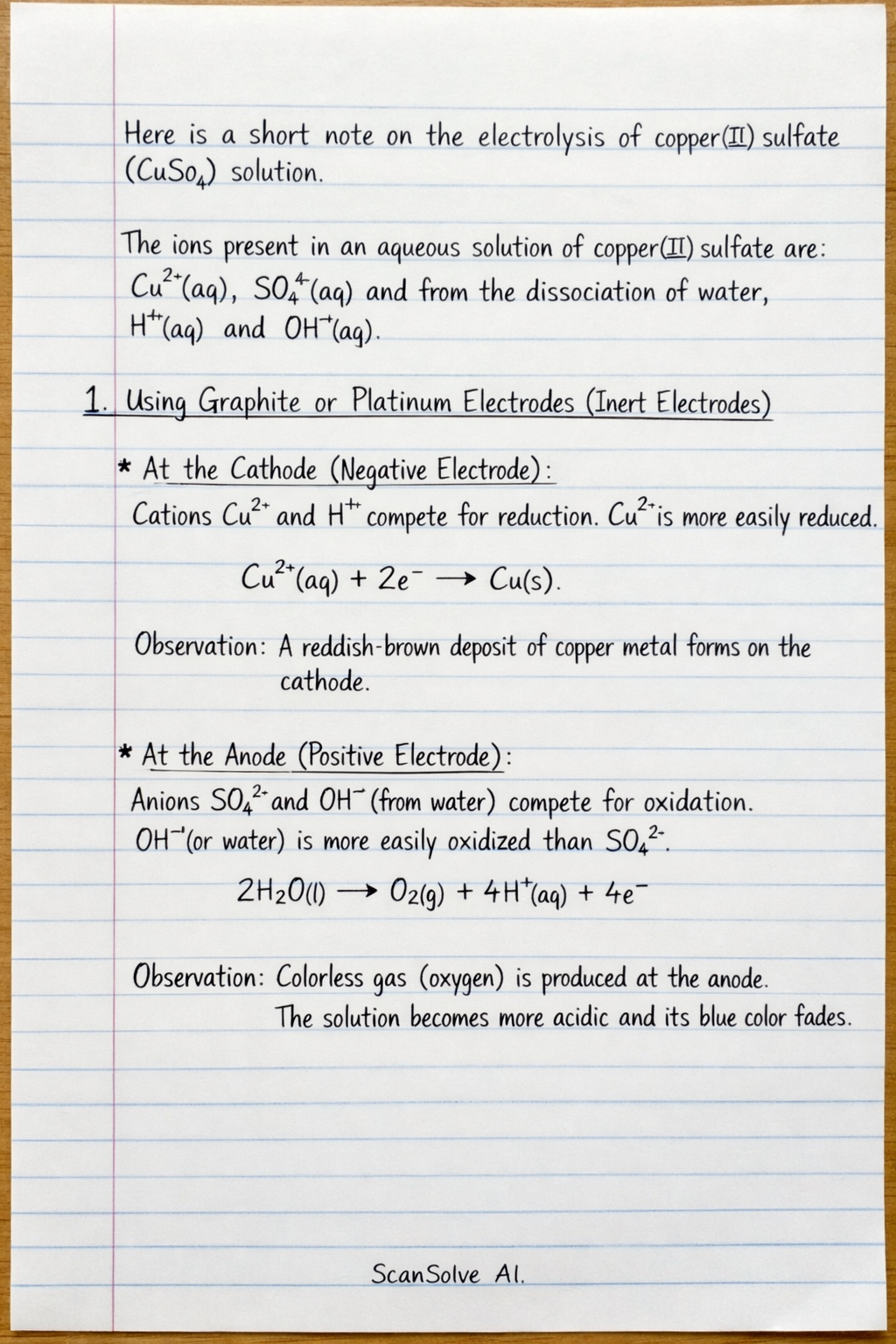
Here is a short note on the electrolysis of copper(II) sulfate (CuSO_4) solution. The ions present in an aqueous solution of copper(II) sulfate are Cu^2+(aq), SO_4^2-(aq), and from the dissociation of water, H^+(aq) and OH^-(aq). 1. Using Graphite or Platinum Electrodes (Inert Electrodes) At the Cathode (Negative Electrode): Cations Cu^2+ and H^+ compete for reduction. Cu^2+ is more easily reduced. Cu^2+(aq) + 2e^- Cu(s) Observation: A reddish-brown deposit of copper metal forms on the cathode. At the Anode (Positive Electrode): Anions SO_4^2- and OH^- (from water) compete for oxidation. OH^- (or water) is more easily oxidized than SO_4^2-. 2H_2O(l) O_2(g) + 4H^+(aq) + 4e^- Observation: Colorless gas (oxygen) is produced at the anode. The solution becomes more acidic and its blue color fades. Overall Reaction: 2CuSO_4(aq) + 2H_2O(l) 2Cu(s) + O_2(g) + 2H_2SO_4(aq) Summary: Copper metal is deposited, oxygen gas is evolved, and sulfuric acid is formed. 2. Using Copper Electrodes (Active Electrodes) At the Cathode (Negative Electrode): Cations Cu^2+ and H^+ compete for reduction. Cu^2+ is more easily reduced. Cu^2+(aq) + 2e^- Cu(s) Observation: A reddish-brown deposit of copper metal forms on the cathode. At the Anode (Positive Electrode): The copper anode itself is an active electrode. Copper metal is more easily oxidized than water or sulfate ions. Cu(s) Cu^2+(aq) + 2e^- Observation: The copper anode gradually dissolves, and its mass decreases. Overall Reaction: Cu(s) (anode) Cu(s) (cathode) Summary: Copper is transferred from the anode to the cathode. The concentration of CuSO_4 in the solution remains relatively constant. This process is used for refining copper.