
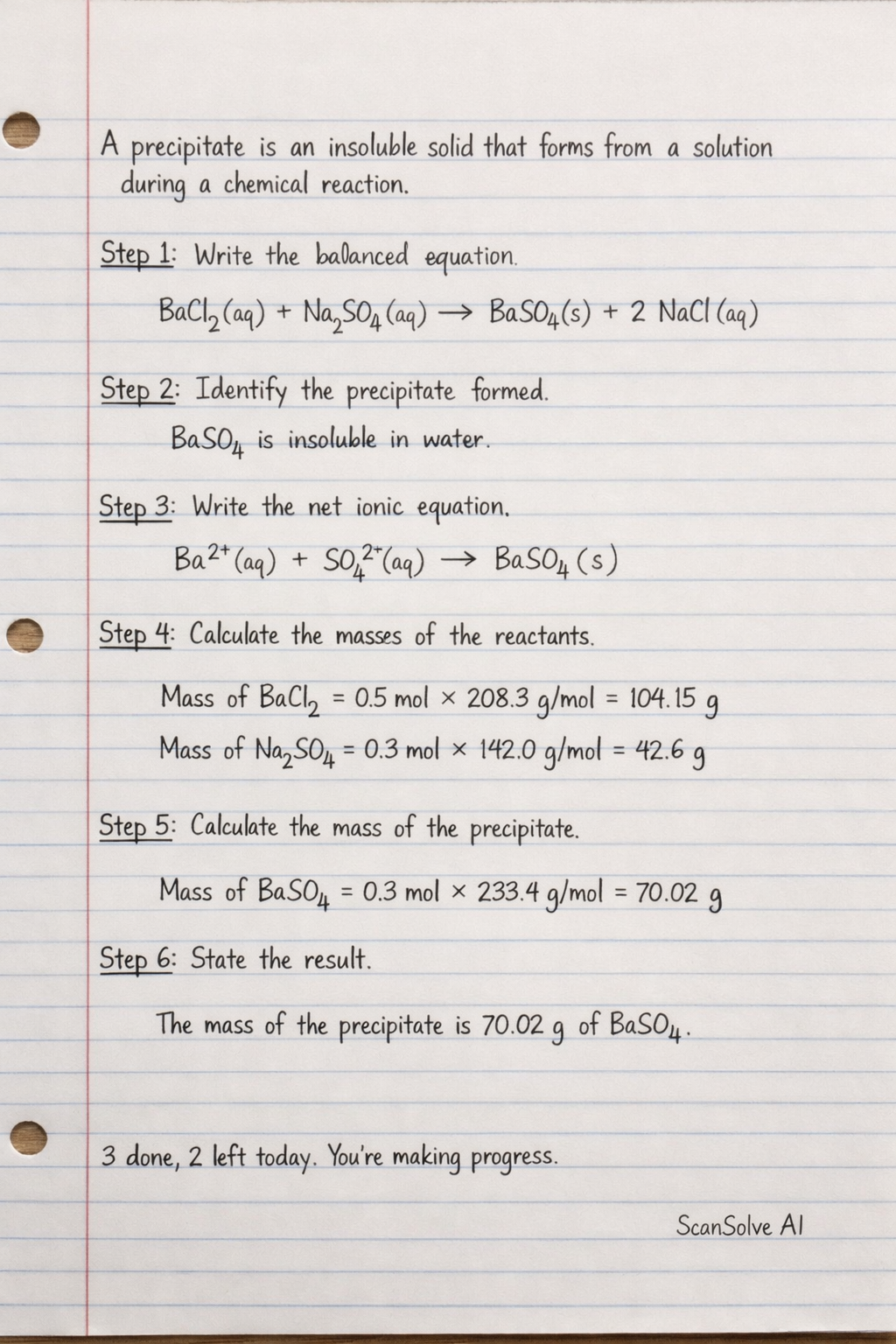
This chemistry question involves key chemical concepts and calculations. The detailed solution below walks through each step, from identifying the reaction type to computing the final answer.
ScanSolve AI Answer
A precipitate is an insoluble solid that forms from a solution during a chemical reaction. A substance is considered soluble if it dissolves in a solvent (like water) to form a homogeneous solution. Soluble substances do not form precipitates. A substance is considered insoluble if it does not dissolve significantly in a solvent. When an insoluble substance forms from a reaction in solution, it is called a precipitate. Therefore, a precipitate is, by definition, an insoluble solid. The term "insoluble precipitate" is redundant because all precipitates are insoluble. The term "soluble precipitate" is a contradiction, as a soluble substance would not precipitate out of solution. 3 done, 2 left today. You're making progress.