
We read your photo as:
Which statement is true for an equilibrium system when a catalyst is used.
ScanSolve AI Answer
The question asks which statement is true for an equilibrium system when a catalyst is used.
-
A. The concentrations of reactants increase while the concentrations of products decrease. At equilibrium, the concentrations of reactants and products remain constant. A catalyst speeds up the rate at which equilibrium is reached but does not change the equilibrium concentrations. Therefore, this statement is incorrect.
-
B. The rate of forward reaction is equal to the rate of reverse reaction. This is the definition of a chemical equilibrium. At equilibrium, the forward and reverse reaction rates are equal, resulting in no net change in the concentrations of reactants and products. A catalyst increases the rates of both the forward and reverse reactions equally, allowing the system to reach equilibrium faster, but it does not alter the fundamental condition of equilibrium. Therefore, this statement is correct.
-
C. The value of the equilibrium constant is decreased. The equilibrium constant () is a measure of the ratio of products to reactants at equilibrium and depends only on temperature. A catalyst does not affect the position of equilibrium or the value of the equilibrium constant. Therefore, this statement is incorrect.
-
D. The value of the equilibrium constant is increased. Similar to C, a catalyst does not change the value of the equilibrium constant. Therefore, this statement is incorrect.
The correct statement is that at equilibrium, the rate of the forward reaction is equal to the rate of the reverse reaction, regardless of whether a catalyst is present.
- B. The rate of forward reaction is equal to the rate of reverse reaction.
Still stuck on this one?
Ask a follow-up, and the answer starts from this question.
More Chemistry Questions
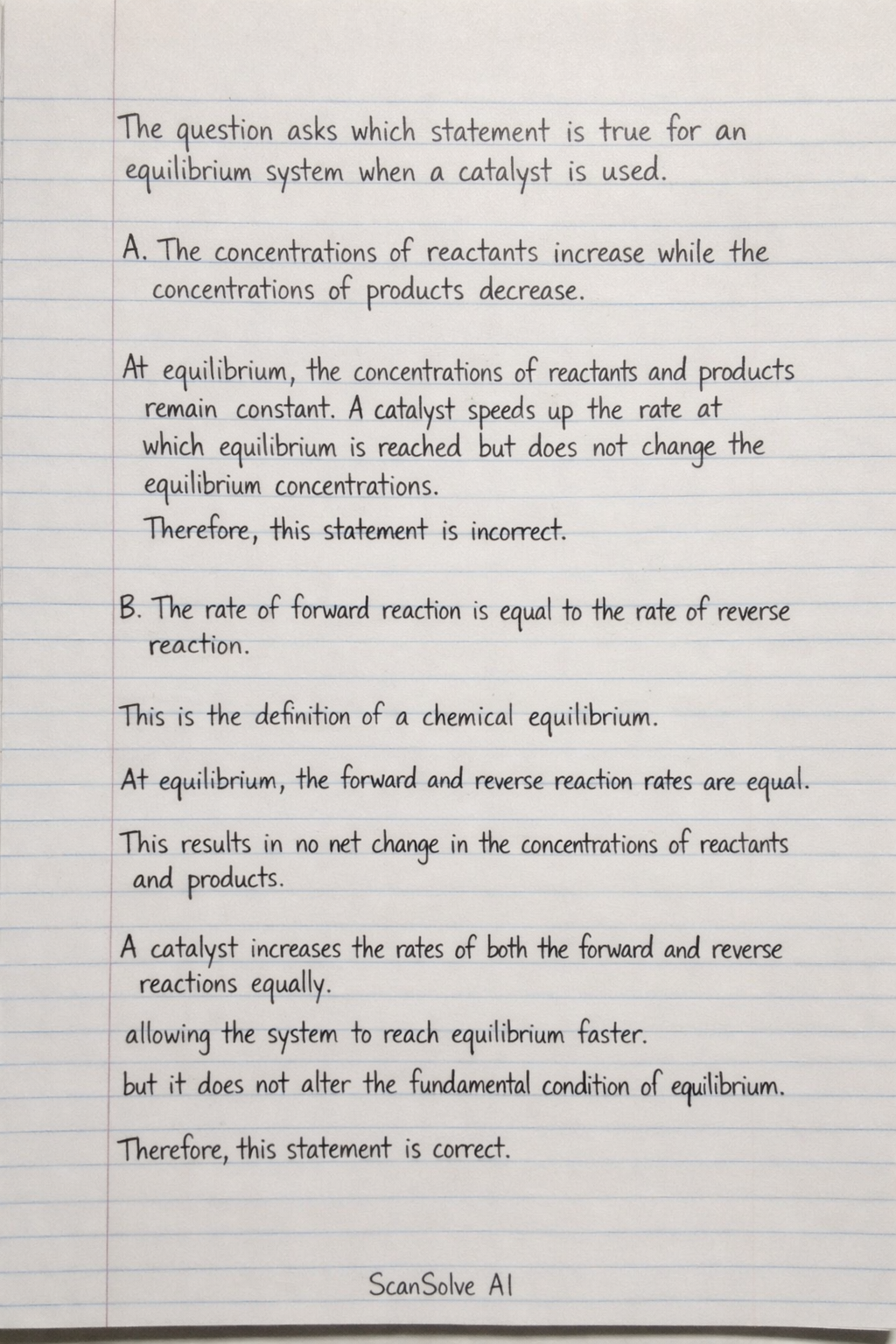
Handwritten Step-by-Step Solution
Get this as a handwritten image on WhatsApp — like a tutor wrote it for you.
Try on WhatsApp