
We read your photo as:
Q13: Which of the following best describes the relationship between pH and H+ ion concentration?
ScanSolve AI Answer
Step-by-step solution
9 stepsQ19:
Identify the given values for the initial concentration (), initial volume (), and final volume ().
The dilution formula is .
Rearrange the formula to solve for the new concentration () and substitute the values.
Calculate the new concentration.
The new concentration is B. 0.5 mol/dm³.
Q20:
The pH scale is a measure of the acidity or alkalinity of a solution.
The pH scale ranges from D. 1 to 14. (Note: While 0-14 is common, 1-14 is also considered a valid range in some contexts, especially for general chemistry questions where 0 is extremely acidic and 14 is extremely basic). Given the options, 1 to 14 is the most appropriate choice.Q21:
Identify the given values for the initial concentration (), final concentration (), and final volume ().
The dilution formula is .
Rearrange the formula to solve for the original volume () and substitute the values.
Calculate the original volume.
The original volume was B. 100 cm³.
Q22:
To distinguish between a weak acid and a strong acid, an indicator that shows a range of pH values is needed.
Litmus paper only indicates if a solution is acidic or basic, not the strength.
Phenolphthalein changes color in a basic range (pH 8.2-10), making it unsuitable for distinguishing between acids.
Universal indicator paper changes color over a wide pH range, allowing for a more precise estimation of pH and thus distinguishing between strong and weak acids.
The most suitable indicator is C. Universal indicator paper.Q23:
Identify the chemical formula for calcium carbonate, which is CaCO₃.
List the atomic masses of each element
Calculate the molar mass by summing the atomic masses of all atoms in the formula.
The molar mass of calcium carbonate is C. 100 g/mol.
Q24:
When a strong acid is diluted by adding water, the concentration of hydrogen ions () decreases.
A decrease in concentration means the solution becomes less acidic.
Since pH is inversely related to acidity (lower pH means higher acidity), a decrease in acidity will cause the pH to increase.
The pH will B. increase (become less acidic).
Still stuck on this one?
Ask a follow-up, and the answer starts from this question.
More Chemistry Questions
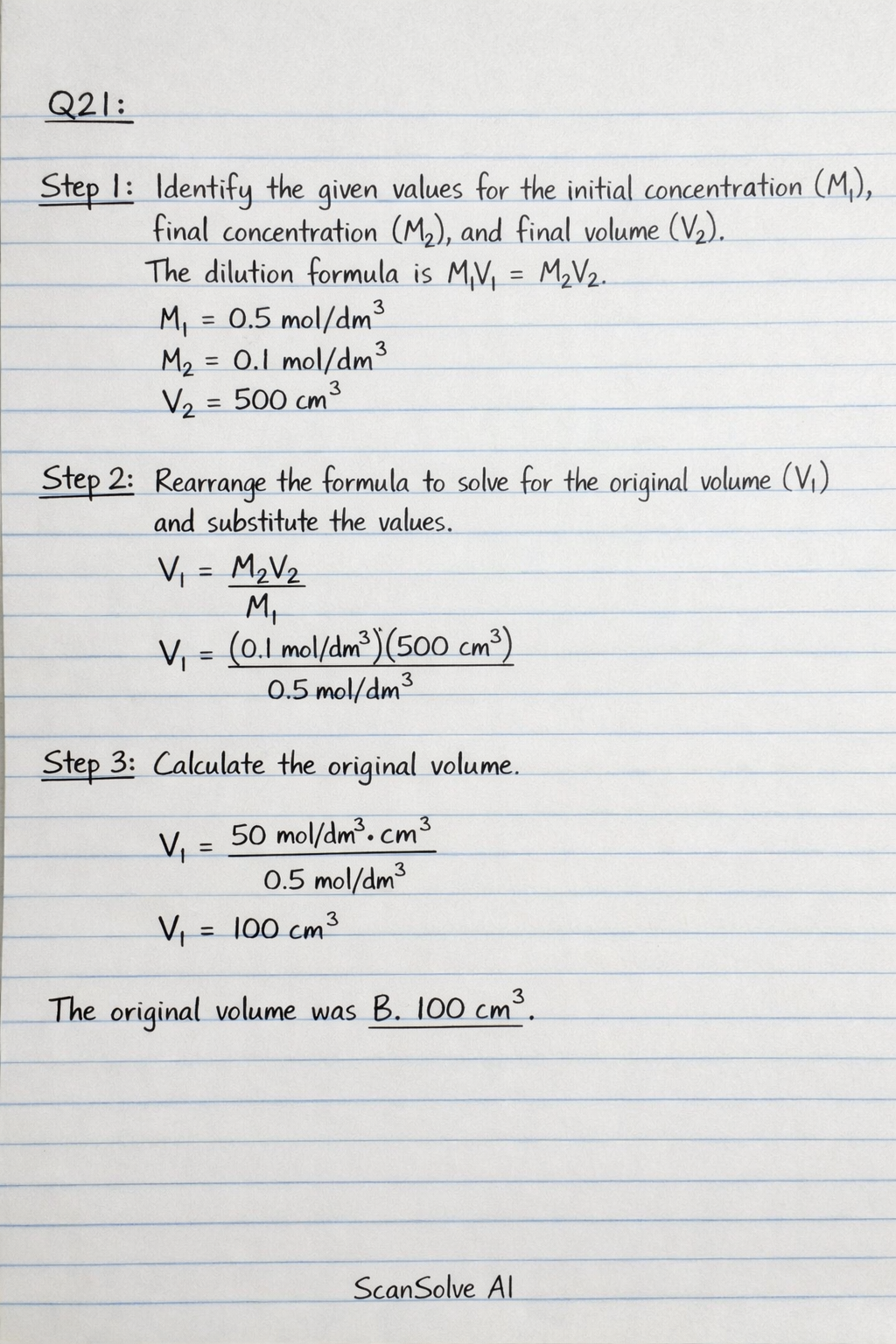
Handwritten Step-by-Step Solution
Get this as a handwritten image on WhatsApp — like a tutor wrote it for you.
Try on WhatsApp