
We read your photo as:
Study the flow chart and answer the questions that follow: i) Identify gas X. ii) Write an equation for the reaction between ammonia and gas X. iii) Write an equation to show the formation of G and J.
ScanSolve AI Answer
26) Study the flow chart below and answer the questions that follow
i) Identify gas X
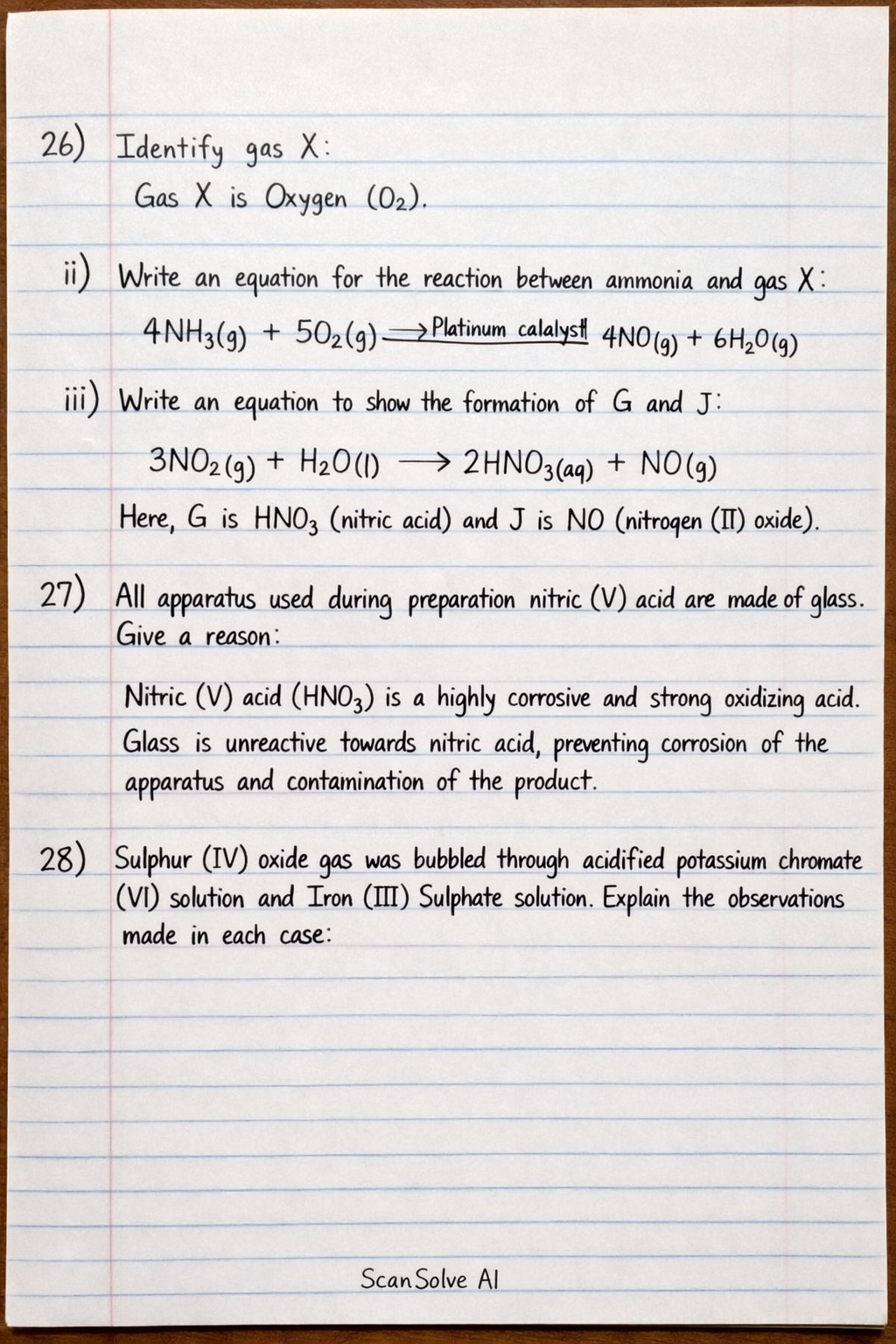
Gas X is Oxygen ().
ii) Write an equation for the reaction between ammonia and gas X
iii) Write an equation to show the formation of G and J
Here, G is (nitric acid) and J is (nitrogen (II) oxide).
27) All apparatus used during preparation nitric (V) acid are made of glass. Give a reason.
Nitric (V) acid () is a highly corrosive and strong oxidizing acid. Glass is unreactive towards nitric acid, preventing corrosion of the apparatus and contamination of the product.
28) Sulphur (IV) oxide gas was bubbled through acidified potassium chromate (VI) solution and Iron (III) Sulphate solution. Explain the observations made in each case.
i) With Potassium Chromate (VI) solution.
- Observation: The orange solution turns green.
- Explanation: Sulphur (IV) oxide () acts as a reducing agent. It reduces the orange chromate (VI) ions ( or in acidic solution) to green chromium (III) ions ().
ii) Iron (III) Sulphate solution
- Observation: The yellow/brown solution turns pale green.
- Explanation: Sulphur (IV) oxide () acts as a reducing agent. It reduces the yellow/brown iron (III) ions () to pale green iron (II) ions ().
Still stuck on this one?
Ask a follow-up, and the answer starts from this question.
More Chemistry Questions
Handwritten Step-by-Step Solution
Get this as a handwritten image on WhatsApp — like a tutor wrote it for you.
Try on WhatsApp