
We read your photo as:
Describe the tests used to identify the following ions: a) Chloride, b) Sulphate, c) Potassium, d) Sodium and Bromide.
ScanSolve AI Answer
Step-by-step solution
6 stepsHere are the answers for question 20:
Part a
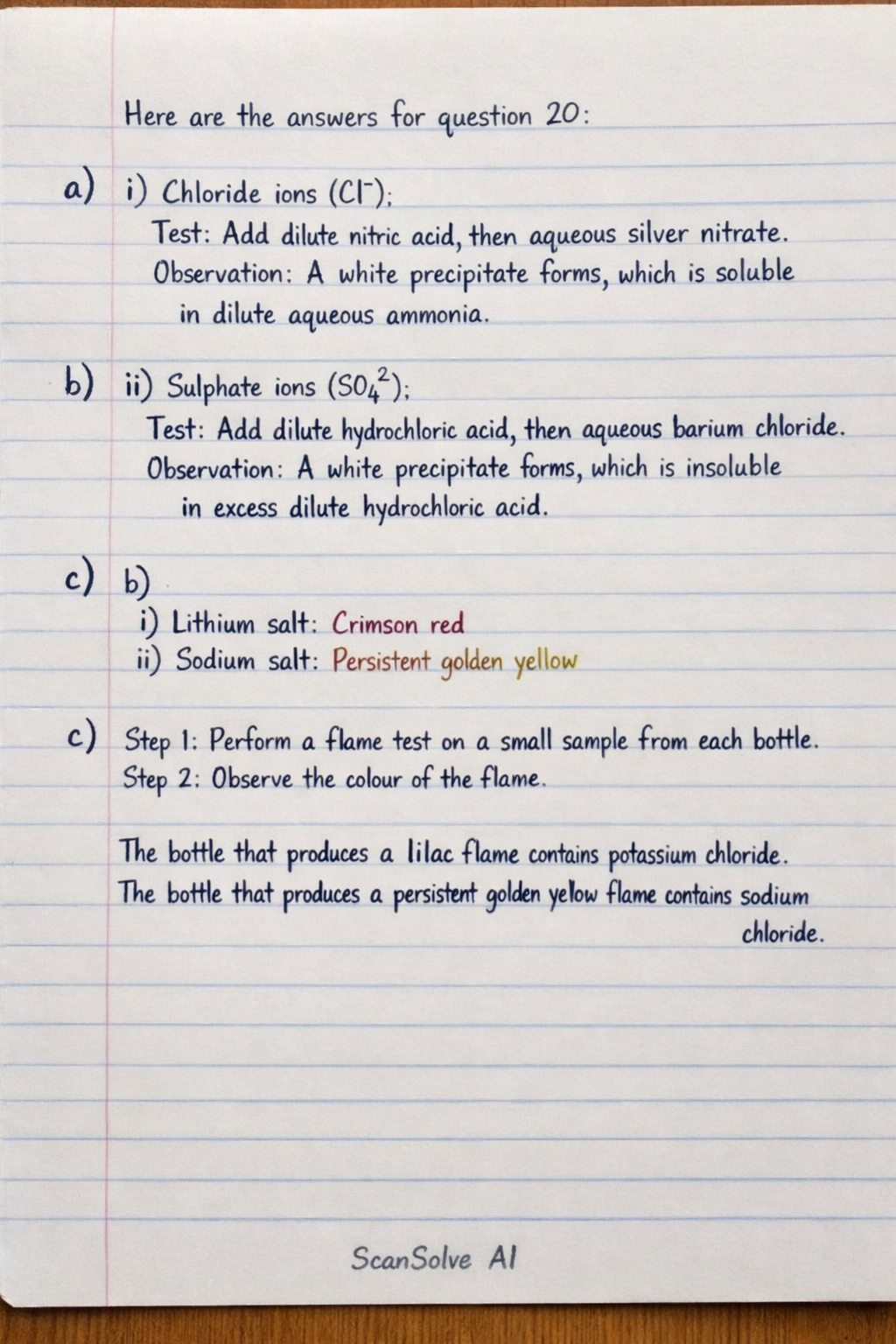
- i) Chloride ions (Cl⁻): Test: Add dilute nitric acid, then aqueous silver nitrate. Observation: A white precipitate forms, which is soluble in dilute aqueous ammonia.
- ii) Sulphate ions (SO₄²⁻): Test: Add dilute hydrochloric acid, then aqueous barium chloride. Observation: A white precipitate forms, which is insoluble in excess dilute hydrochloric acid.
Part b
- i) Lithium salt: Crimson red
- ii) Sodium salt: Persistent golden yellow
Part c· 2 steps
Perform a flame test on a small sample from each bottle.
Observe the colour of the flame.
The bottle that produces a lilac flame contains potassium chloride.
The bottle that produces a persistent golden yellow flame contains sodium chloride.
Part d· 4 steps
Analyze the flame test result.
A persistent golden yellow flame indicates the presence of sodium ions ().
Analyze the precipitate formation with acidified silver nitrate.
A pale yellow precipitate with acidified silver nitrate indicates the presence of bromide ions ().
Analyze the solubility of the precipitate.
The precipitate being sparingly soluble in concentrated ammonia confirms the presence of bromide ions ().
Combine the identified ions to name and formulate the salt.
The salt contains sodium ions () and bromide ions ().
Name: Sodium bromide
Formula: NaBr
Still stuck on this one?
Ask a follow-up, and the answer starts from this question.
More Chemistry Questions
Handwritten Step-by-Step Solution
Get this as a handwritten image on WhatsApp — like a tutor wrote it for you.
Try on WhatsApp