

This chemistry question involves key chemical concepts and calculations. The detailed solution below walks through each step, from identifying the reaction type to computing the final answer.
ScanSolve AI Answer
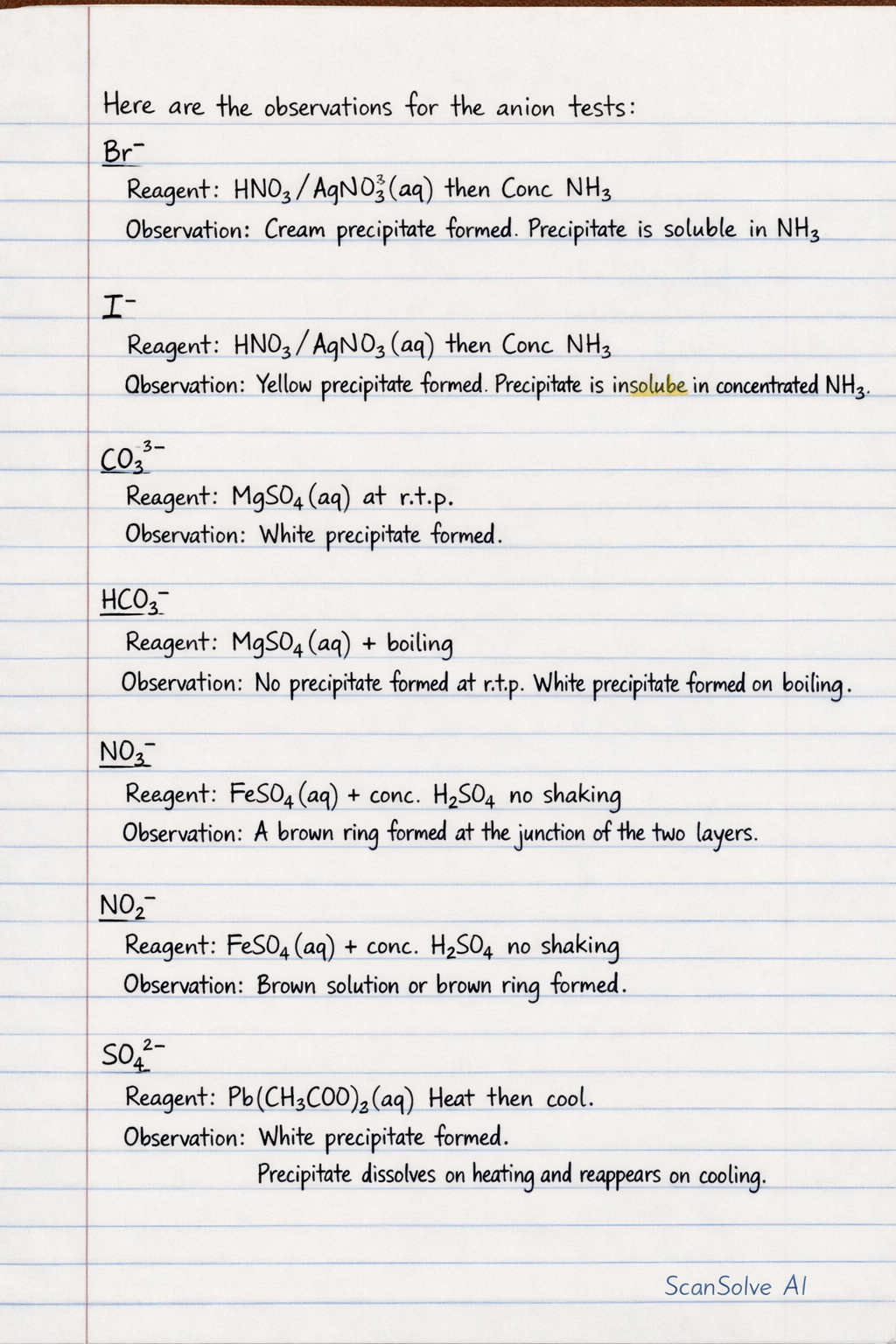
Here are the observations for the anion tests: Br⁻ Reagent: HNO₃/AgNO₃(aq) then Conc NH₃ Observation: Cream precipitate formed. Precipitate is soluble in concentrated NH₃.* I⁻ Reagent: HNO₃/AgNO₃(aq) then Conc NH₃ Observation: Yellow precipitate formed. Precipitate is insoluble in concentrated NH₃.* CO₃²⁻ Reagent: MgSO₄(aq) at r.t.p. Observation: White precipitate formed.* HCO₃⁻ Reagent: MgSO₄(aq) + boiling Observation: No precipitate formed at r.t.p. White precipitate formed on boiling.* NO₃⁻ Reagent: FeSO₄(aq) + conc. H₂SO₄, no shaking Observation: A brown ring formed at the junction of the two layers.* NO₂⁻ Reagent: FeSO₄(aq) + conc. H₂SO₄, no shaking Observation: Brown solution or brown ring formed.* SO₄²⁻ Reagent: Pb(CH₃COO)₂(aq), Heat then cool. Observation: White precipitate formed. Precipitate dissolves on heating and reappears on cooling.* I⁻ Reagent: Pb(CH₃COO)₂(aq), Heat then cool. Observation: Yellow precipitate formed. Precipitate dissolves on heating to form a colorless solution and reappears as golden-yellow flakes on cooling.* CH₃COO⁻ Reagent: FeCl₃(aq) at r.t.p Observation: Blood-red coloration formed.* S₂O₃²⁻ Reagent: FeCl₃(aq) at r.t.p Observation: Transient violet coloration formed, which quickly fades.* CrO₄²⁻ Reagent: AgNO₃(aq) + NH₃(aq) then dil HNO₃ Observation: Reddish-brown precipitate formed. Precipitate dissolves in NH₃(aq) and reappears upon addition of dil HNO₃.* Cr₂O₇²⁻ Reagent: Dil. SnCl₂(aq) Observation: Orange solution turns green.* That's 2 down. 3 left today — send the next one.