

This chemistry question involves key chemical concepts and calculations. The detailed solution below walks through each step, from identifying the reaction type to computing the final answer.
ScanSolve AI Answer
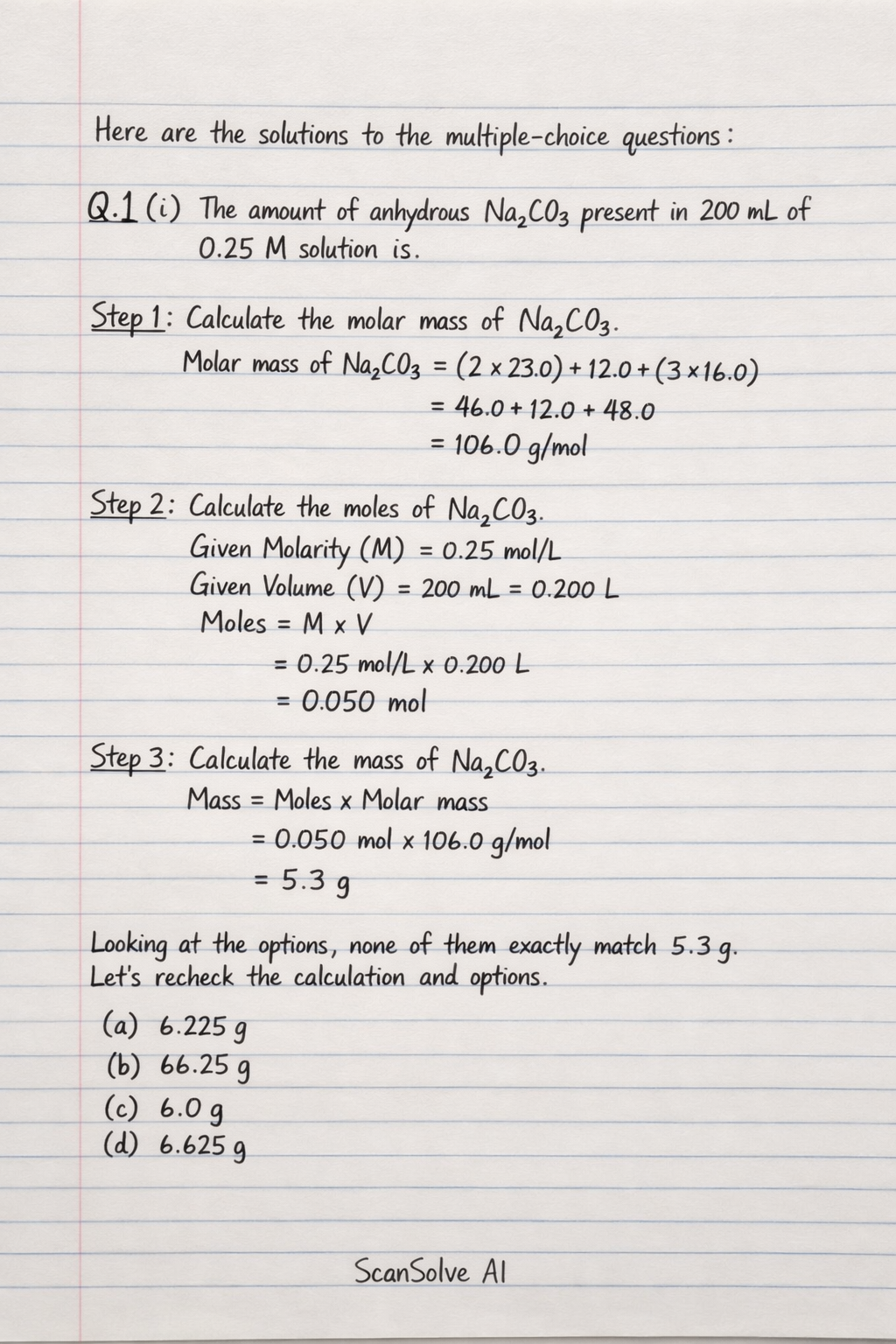
Here are the solutions to the multiple-choice questions: Q.1 (i) The amount of anhydrous Na_2CO_3 present in 200 ml of 0.25 M solution is. Step 1: Calculate the molar mass of Na_2CO_3. Molar mass of Na_2CO_3 = (2 × 23.0) + 12.0 + (3 × 16.0) = 46.0 + 12.0 + 48.0 = 106.0 g/mol. Step 2: Calculate the moles of Na_2CO_3. Given Molarity (M) = 0.25 mol/L Given Volume (V) = 200 mL = 0.200 L Moles = M × V = 0.25 mol/L × 0.200 L = 0.050 mol Step 3: Calculate the mass of Na_2CO_3. Mass = Moles × Molar mass = 0.050 mol × 106.0 g/mol = 5.3 g Looking at the options, none of them exactly match 5.3 g. Let's recheck the calculation and options. (a) 6.225 g (b) 66.25 g (c) 6.0 g (d) 6.625 g There might be a slight discrepancy in the question or options provided. However, if we assume a typo and look for the closest option, 6.0 g (c) is the closest to 5.3 g. Let's re-evaluate if there's any common mistake or alternative interpretation. If the molarity was 0.25 M and volume 250 mL (0.25 L), then moles = 0.25 0.25 = 0.0625 mol. Mass = 0.0625 106 = 6.625 g. This matches option (d). It's possible the volume was intended to be 250 mL instead of 200 mL, or the molarity was different. Given the options, 6.625 g is a direct calculation if the volume was 250 mL. Let's assume the question intended for 250 mL or there's a typo in the options. If we strictly follow 200 mL, the answer is 5.3 g. Since 6.625 g is an option, it's highly likely that the volume was meant to be 250 mL. Let's assume the volume is 250 mL for option (d) to be correct. Moles = 0.25 mol/L × 0.250 L = 0.0625 mol Mass = 0.0625 mol × 106.0 g/mol = 6.625 g Given the options, this is the most plausible intended answer. The final answer is (d) 6.625 g. Q.1 (ii) Molarity of pure water is Step 1: Assume a volume of pure water, e.g., 1 L. Density of water is approximately 1 g/mL. Mass of 1 L (1000 mL) of water = 1000 mL × 1 g/mL = 1000 g. Step 2: Calculate the molar mass of water (H_2O). Molar mass of H_2O = (2 × 1.0) + 16.0 = 18.0 g/mol. Step 3: Calculate the moles of water in 1 L. Moles = MassMolar mass = 1000 g18.0 g/mol ≈ 55.55 mol Step 4: Calculate the molarity. Molarity = Moles / Volume (L) Molarity = 55.55 mol1 L = 55.55 M The final answer is (d) 55.5 M. Q.1 (iii) If 4g of NaOH are dissolved in 500 ml of water, the concentration of the solution will be. Step 1: Calculate the molar mass of NaOH. Molar mass of NaOH = 23.0 + 16.0 + 1.0 = 40.0 g/mol. Step 2: Calculate the moles of NaOH. Given mass of NaOH = 4 g. Moles = MassMolar mass = 4 g40.0 g/mol = 0.1 mol Step 3: Calculate the molarity of the solution. Given volume of solution = 500 mL = 0.500 L. Molarity = MolesVolume (L) = 0.1 mol0.500 L = 0.2 M The final answer is (b) 0.2 M. Q.1 (iv) Which of the following has the minimum vapour pressure? Vapour pressure is a colligative property, which means it depends on the number of solute particles in the solution. A higher concentration of solute particles leads to a lower vapour pressure. We need to calculate the effective concentration (i × M) for each option, where i is the van't Hoff factor and M is the molarity. (a) 0.1 M BaCl_2 solution: BaCl_2 dissociates into Ba^2+ and 2Cl^-, so i = 3. Effective concentration = 3 × 0.1 M = 0.3 M. (b) 0.1 M Phenol solution: Phenol (C_6H_5OH) is a non-electrolyte (or very weak acid, usually considered non-dissociating for colligative properties). So, i = 1. Effective concentration = 1 × 0.1 M = 0.1 M. (c) 0.1 M sucrose solution: Sucrose (C_12H_22O_11) is a non-electrolyte. So, i = 1. Effective concentration = 1 × 0.1 M = 0.1 M. (d) 0.1 M solution of sodium chloride (NaCl): NaCl dissociates into Na^+ and Cl^-, so i = 2. Effective concentration = 2 × 0.1 M = 0.2 M. Comparing the effective concentrations: (a) 0.3 M (b) 0.1 M (c) 0.1 M (d) 0.2 M The 0.1 M BaCl_2 solution has the highest effective concentration (0.3 M), and therefore it will have the minimum vapour pressure. The final answer is (a) 0.1 M BaCl_2 solution. Q.1 (v) Benzene and toluene form a Benzene and toluene are structurally similar non-polar organic compounds. When mixed, the intermolecular forces between benzene-benzene, toluene-toluene, and benzene-toluene molecules are very similar. This leads to a solution that closely obeys Raoult's law. The final answer is (a) Ideal solution. Q.1 (vi) Which of the following solutions has the highest osmotic pressure? Osmotic pressure () is a colligative property, directly proportional to the effective molar concentration (i × C), where i is the van't Hoff factor and C is the molar concentration. All options have a concentration of 1 M. We need to find the solution with the highest i value. *