
We read your photo as:
Describe how the cleansing agent removes grease from a piece of cloth. (b) Study the flow chart below and answer the questions that follow. (i) State the conditions necessary for fermentation of gluco
ScanSolve AI Answer
Step-by-step solution
3 stepsHere are the solutions:
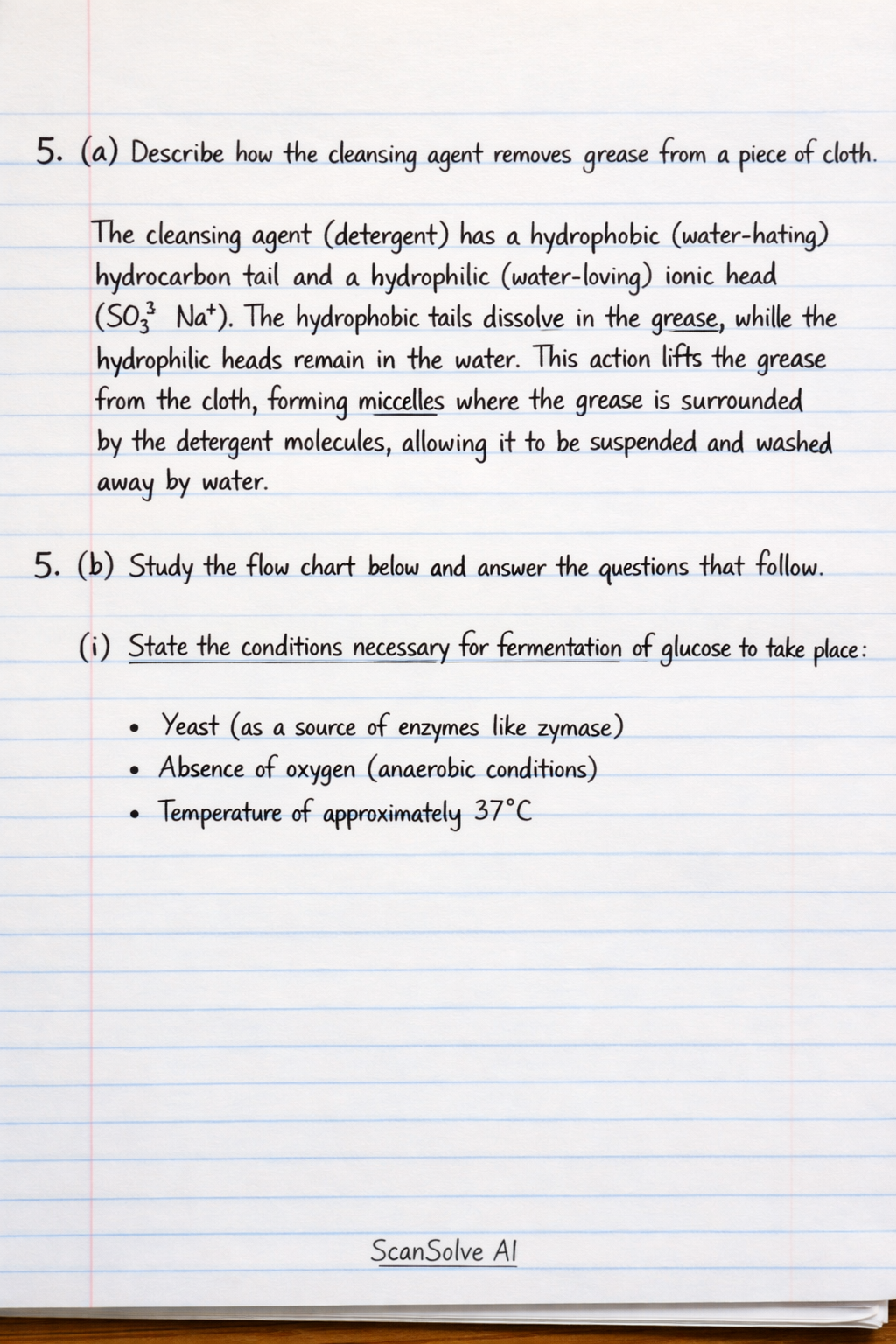
5. (a) Describe how the cleansing agent removes grease from a piece of cloth.
The cleansing agent (detergent) has a hydrophobic (water-hating) hydrocarbon tail and a hydrophilic (water-loving) ionic head (). The hydrophobic tails dissolve in the grease, while the hydrophilic heads remain in the water. This action lifts the grease from the cloth, forming micelles where the grease is surrounded by the detergent molecules, allowing it to be suspended and washed away by water.
5. (b) Study the flow chart below and answer the questions that follow.
-
(i) State the conditions necessary for fermentation of glucose to take place.
- Yeast (as a source of enzymes like zymase)
- Absence of oxygen (anaerobic conditions)
- Temperature of approximately
-
(ii) State one reagent that can be used to carry out process S.
- Acidified potassium dichromate(VI) ()
- Acidified potassium permanganate(VII) ()
-
(iii) Identify gases:
- I. P: Ethene ()
- II. T: Methane ()
-
(iv) How is sodium hydroxide kept dry during the reaction (v) Give one commercial use of process R.
- Sodium hydroxide is kept dry by using it as soda lime, which is a mixture of sodium hydroxide and calcium oxide (). Calcium oxide acts as a drying agent.
- Commercial use of process R (hydrogenation of ethene to ethane): Production of saturated hydrocarbons or hardening of vegetable oils (margarine production).
5. (c) When one mole of ethanol is completely burnt in air, 1370 kJ of heat energy is released. Given that 1 litre of ethanol is 780 g, calculate the amount of heat energy released when 1 litre of ethanol is completely burnt (C=12.0; H=1.0; O=16.0)
Calculate the molar mass of ethanol ().
Calculate the number of moles in 1 litre of ethanol.
Calculate the total heat energy released.
The amount of heat energy released is .
5. (d) State two uses of ethanol other than as an alcoholic drink.
- As a fuel (e.g., in internal combustion engines)
- As a solvent (e.g., in perfumes, cosmetics, and pharmaceuticals)
- As an antiseptic or disinfectant
- As a raw material in the chemical industry for synthesizing other organic compounds.
Still stuck on this one?
Ask a follow-up, and the answer starts from this question.
More Chemistry Questions
Handwritten Step-by-Step Solution
Get this as a handwritten image on WhatsApp — like a tutor wrote it for you.
Try on WhatsApp