

This chemistry question involves key chemical concepts and calculations. The detailed solution below walks through each step, from identifying the reaction type to computing the final answer.
ScanSolve AI Answer
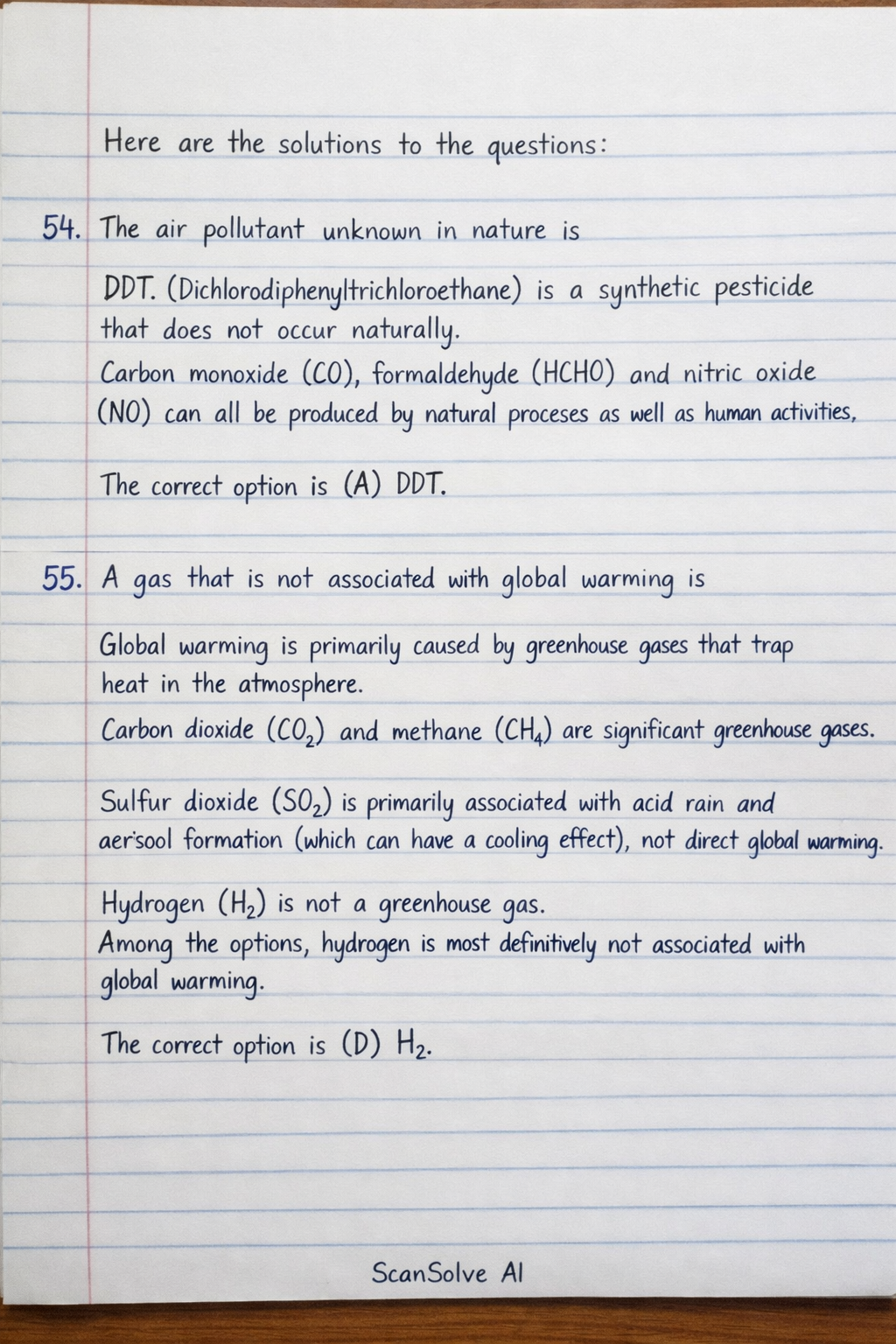
Here are the solutions to the questions: 54. The air pollutant unknown in nature is DDT (Dichlorodiphenyltrichloroethane)* is a synthetic pesticide that does not occur naturally. Carbon monoxide (CO), formaldehyde (HCHO), and nitric oxide (NO) can all be produced by natural processes as well as human activities. The correct option is (A) DDT*. 55. A gas that is not associated with global warming is Global warming* is primarily caused by greenhouse gases that trap heat in the atmosphere. Carbon dioxide (CO_2) and methane (CH_4) are significant greenhouse gases. Sulfur dioxide (SO_2) is primarily associated with acid rain and aerosol formation (which can have a cooling effect), not direct global warming. Hydrogen (H_2) is not a greenhouse gas. Among the options, hydrogen is the most definitively not associated with global warming. The correct option is (D) H_2*. 56. The pollution from petroleum spillage in rivers and lakes can best be dispersed by Detergents* (or dispersants) are chemical agents that break down oil slicks into smaller droplets, allowing them to mix with water and be more easily degraded by natural processes. The correct option is (A) Pouring detergents*. 57. What is the decrease in volume of air when pyrogallol is shaken with 30.00cm^3 of air? Alkaline pyrogallol absorbs oxygen gas. Air contains approximately 20-21% oxygen by volume. Assuming 20% oxygen in air: Decrease in volume = 0.20 × 30.00 cm^3 = 6.00 cm^3 The correct option is (B) 6.00cm^3*. 58. Environment pollution is worsened by the release from automobile exhaust of Automobile exhaust contains various pollutants, including carbon monoxide, nitrogen oxides, unburnt hydrocarbons, and particulate matter* (smoke). Smoke contributes to smog, respiratory problems, and reduced visibility, thus worsening environmental pollution. The correct option is (C) Smoke*. 59. Phosphorus is stored under water to prevent it from White phosphorus is highly reactive and spontaneously ignites in air upon contact with oxygen. Storing it under water prevents it from coming into contact with oxygen, thereby preventing it from catching fire. The correct option is (D) Catching fire*. ENTHALPY CHANGE 60. When sodium chloride and metallic sodium are each dissolved in water, The dissolution of sodium chloride* (NaCl) in water is a slightly endothermic process (absorbs a small amount of heat). The dissolution of metallic sodium* (Na) in water involves a vigorous chemical reaction (2Na(s) + 2H_2O(l) → 2NaOH(aq) + H_2(g)) that is highly exothermic (releases a large amount of heat). Therefore, the dissolution of metallic sodium is exothermic. The correct option is (d) the dissolution of metallic sodium is exothermic*. 61. When heat is absorbed during a chemical reaction, the reaction is said A chemical reaction that absorbs heat from its surroundings is defined as an endothermic* reaction. The correct option is (d) endothermic*. 62. The reaction 3C_(s) + 2Fe_2O_3(s) → 4Fe_2(aq); H = 46.0KJ is The enthalpy change ( H) for the reaction is positive (+46.0 KJ). A positive H indicates that the reaction absorbs heat from the surroundings. Therefore, the reaction is endothermic*. The correct option is (c) endothermic*. 63. When sodium nitrite dissolves in water, H is positive. This means that A positive H for a process indicates that heat is absorbed from the surroundings. This is the definition of an endothermic* process. The correct option is (d) the reaction is endothermic*. 64. In the reactions (I) H_2(g) + (1)/(2)O_2(g) → H_2O_(l); H = -286KJ (II) C_(s) + O_2(g) → CO_2(g); H = -406KJ. The equations imply that Both reactions have negative H values, meaning they are exothermic* and evolve (release) heat. For reaction (I), 286 KJ of heat is evolved. For reaction (II), 406 KJ of heat is evolved. Comparing the magnitudes, 406 KJ > 286 KJ. Therefore, more heat is evolved in reaction (II) than in reaction (I). The correct option is (d) more heat is evolved in (II)*.