
We read your photo as:
What is the electron configuration of Beryllium (Z=4) and its Be2+ ion? Why does Beryllium prefer to lose electrons?
ScanSolve AI Answer
Step-by-step solution
14 stepsHere are the solutions to your chemistry questions:
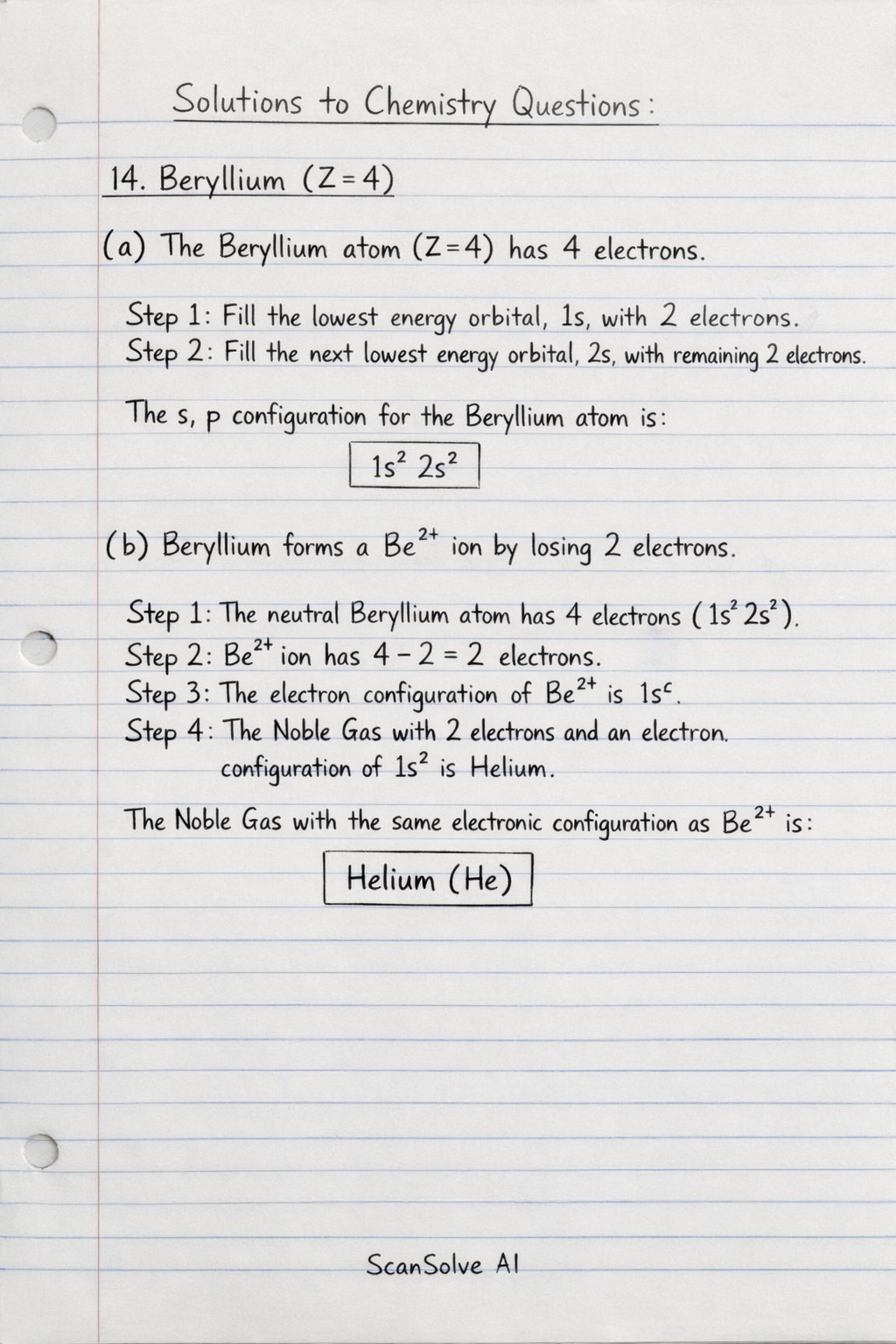
14. Beryllium (Z=4)
a) The Beryllium atom (Z=4) has 4 electrons.
Fill the lowest energy orbital, 1s, with 2 electrons.
Fill the next lowest energy orbital, 2s, with the remaining 2 electrons.
The s, p configuration for the Beryllium atom is:
b) Beryllium forms a Be ion by losing 2 electrons.
The neutral Beryllium atom has 4 electrons ().
The Be ion has electrons.
The electron configuration of Be is .
The Noble Gas with 2 electrons and an electron configuration of is Helium.
The Noble Gas with the same electronic configuration as Be is:
c) Beryllium prefers to lose 2 electrons rather than gain 6 to fill its outer shell because losing 2 electrons requires significantly less energy. By losing its two valence electrons from the 2s orbital, Beryllium achieves a stable electron configuration identical to that of the Noble Gas Helium (). Gaining 6 electrons would be energetically unfavorable due to the large energy input required and increased electron-electron repulsion.
15. Aluminum Phosphate (AlPO)
a) Aluminum (Al) has an atomic number Z=13. It typically forms an Al ion by losing its 3 valence electrons.
A neutral Aluminum atom has 13 protons and 13 electrons.
The Al ion has 13 protons (in the nucleus) and electrons.
These 10 electrons are arranged in shells.
The first shell (K-shell) holds 2 electrons, and the second shell (L-shell) holds the remaining 8 electrons.
The structure for the Aluminum ion (Al) can be described as:- A nucleus containing 13 protons.
- An inner electron shell (K-shell) containing 2 electrons.
- An outer electron shell (L-shell) containing 8 electrons. (Note: Neutrons are not included as the mass number is not provided.)
b) The formula for Aluminum Phosphate is AlPO and not Al(PO) due to the principle of charge balance and the convention of writing ionic formulas in their simplest whole-number ratio.
Aluminum (Al) is in Group 13 and typically forms an ion with a charge of +3, so it is Al.
The Phosphate radical (PO) has a charge of -3, so it is PO.
For a neutral ionic compound, the total positive charge must balance the total negative charge.
A 1:1 ratio of Al ions to PO ions results in a neutral compound.
Ionic compound formulas are always written using the simplest whole-number ratio of the ions.
Therefore, one Al ion combines with one PO ion to form AlPO. While Al(PO) represents the same 1:1 ratio, it is not the simplest formula and thus not the correct chemical formula.
The formula is because one Al ion balances the charge of one PO ion, and the formula represents the simplest whole-number ratio of the ions.
Still stuck on this one?
Ask a follow-up, and the answer starts from this question.
More Chemistry Questions
Handwritten Step-by-Step Solution
Get this as a handwritten image on WhatsApp — like a tutor wrote it for you.
Try on WhatsApp