

This chemistry question involves key chemical concepts and calculations. The detailed solution below walks through each step, from identifying the reaction type to computing the final answer.
ScanSolve AI Answer
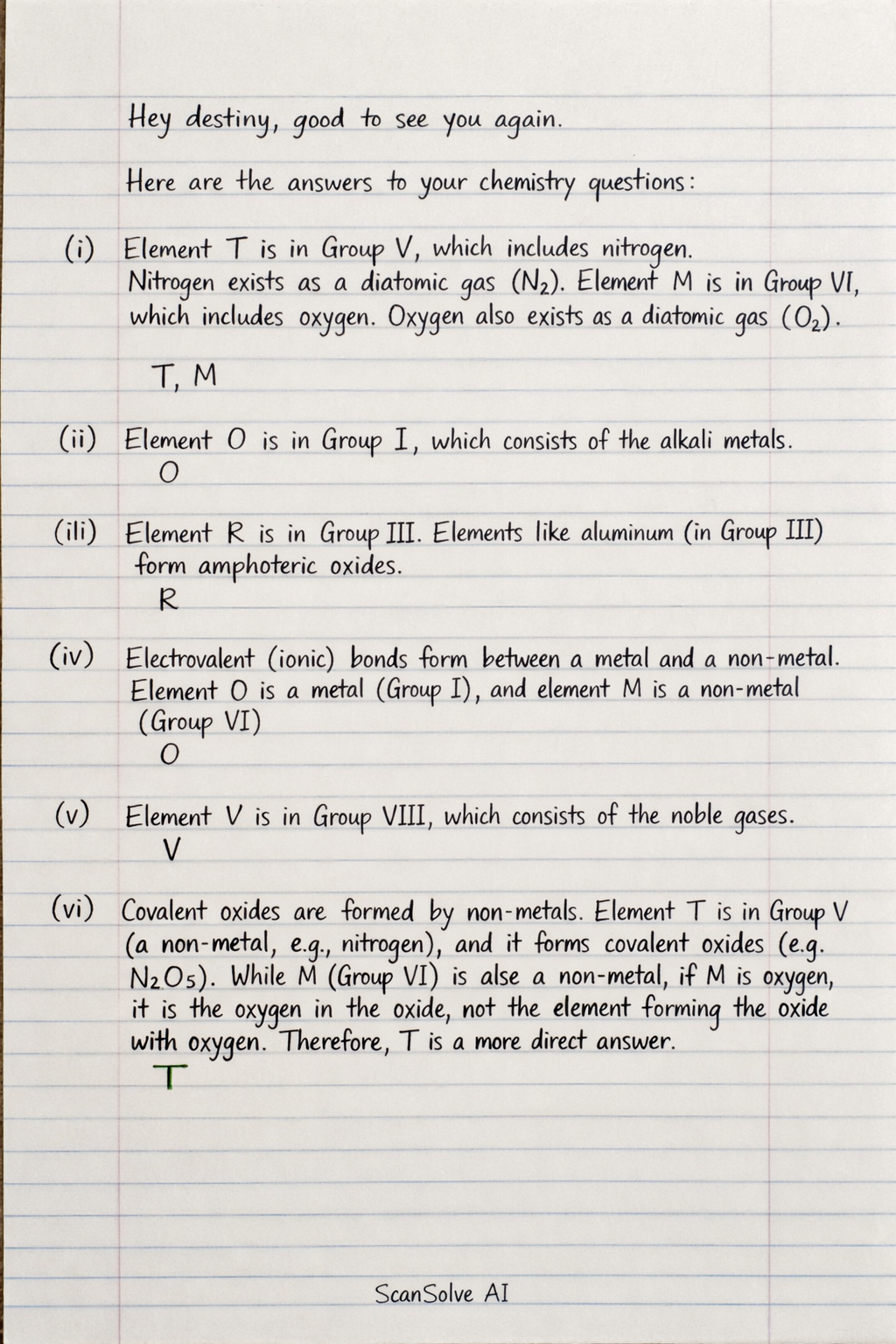
Here are the answers to your chemistry questions: a) (i) Element T is in Group V, which includes nitrogen. Nitrogen exists as a diatomic gas (N_2). Element M is in Group VI, which includes oxygen. Oxygen also exists as a diatomic gas (O_2). T, M (ii) Element O is in Group I, which consists of the alkali metals. O (iii) Element R is in Group III. Elements like aluminum (in Group III) form amphoteric oxides. R (iv) Electrovalent (ionic) bonds form between a metal and a non-metal. Element O is a metal (Group I), and element M is a non-metal (Group VI). O (v) Element V is in Group VIII, which consists of the noble gases. V (vi) Covalent oxides are formed by non-metals. Element T is in Group V (a non-metal, e.g., nitrogen), and it forms covalent oxides (e.g., N_2O_5). While M (Group VI) is also a non-metal, if M is oxygen, it is the oxygen in the oxide, not the element forming the oxide with oxygen. Therefore, T is a more direct answer. T b) (i) A saturated solution is a solution that contains the maximum amount of solute that can be dissolved in a given amount of solvent at a specific temperature and pressure. If more solute is added, it will not dissolve and will remain as a solid. Send me the next one 📸