
We read your photo as:
What are the fundamental principles behind UV-Visible spectroscopy, the Beer-Lambert law, and the typical carrier gas in gas chromatography?
ScanSolve AI Answer
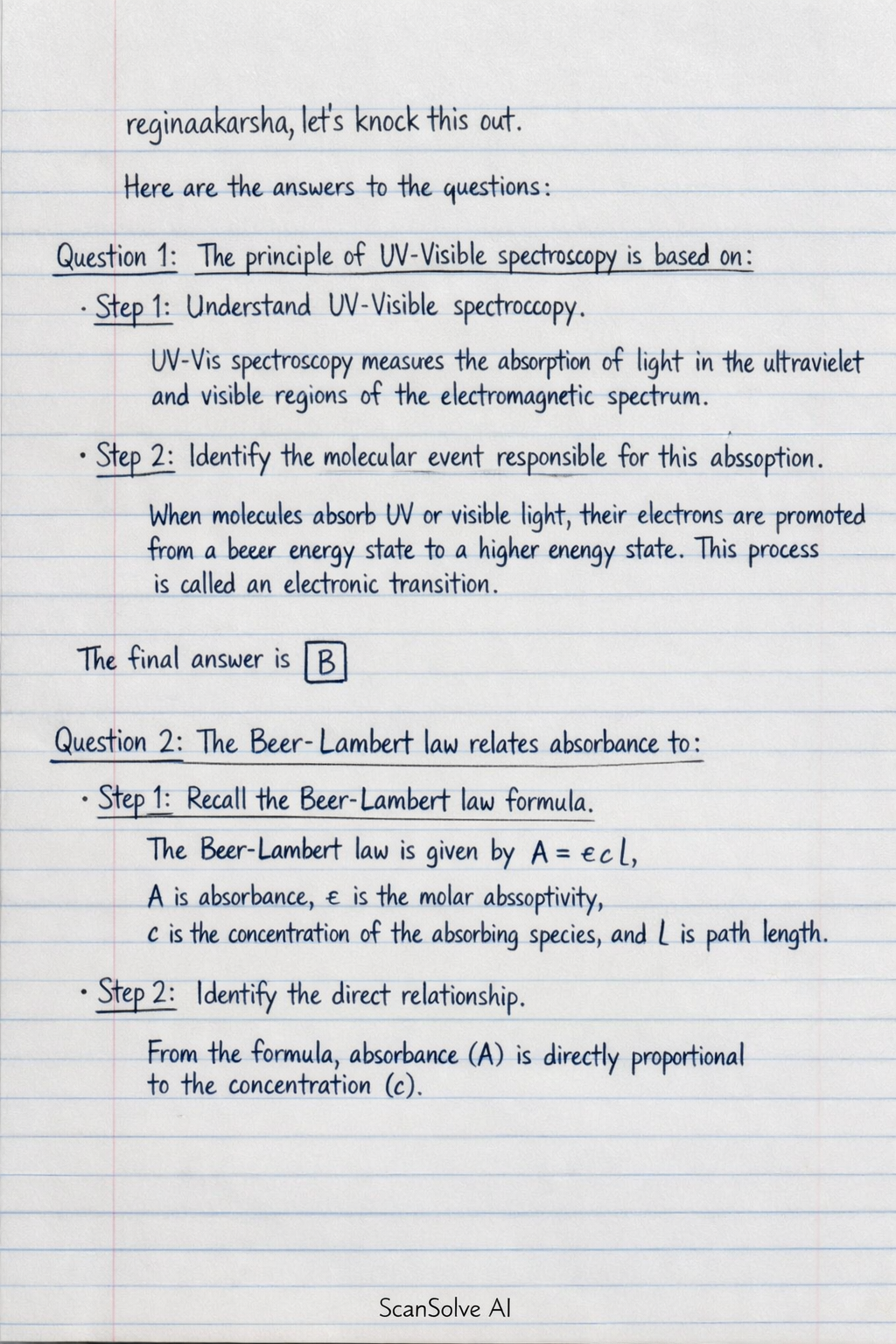
Here are the answers to the questions:
Question 1: The principle of UV-Visible spectroscopy is based on:
- Step 1: Understand UV-Visible spectroscopy. UV-Vis spectroscopy measures the absorption of light in the ultraviolet and visible regions of the electromagnetic spectrum.
- Step 2: Identify the molecular event responsible for this absorption. When molecules absorb UV or visible light, their electrons are promoted from a lower energy state to a higher energy state. This process is called an electronic transition.
The final answer is
Question 2: The Beer-Lambert law relates absorbance to:
- Step 1: Recall the Beer-Lambert law formula. The Beer-Lambert law is given by , where is absorbance, is the molar absorptivity, is the concentration of the absorbing species, and is the path length.
- Step 2: Identify the direct relationship. From the formula, absorbance () is directly proportional to the concentration ().
The final answer is
Question 3: What is the usual carrier gas used in gas chromatography?
- Step 1: Understand the role of a carrier gas in gas chromatography. In gas chromatography (GC), the carrier gas acts as the mobile phase, transporting the sample through the chromatographic column.
- Step 2: Identify common inert gases used. The carrier gas must be inert to avoid reacting with the sample or the stationary phase. Common choices include nitrogen, helium, and hydrogen. Oxygen is generally avoided due to its reactivity.
The final answer is
Question 4: Chromophores are:
- Step 1: Define a chromophore. A chromophore is a part of a molecule that absorbs light, typically in the ultraviolet or visible region of the electromagnetic spectrum, and is responsible for the molecule's color.
- Step 2: Relate the definition to the options. Chromophores contain specific functional groups (e.g., conjugated double bonds, carbonyl groups) that have electrons capable of undergoing electronic transitions upon absorbing light.
The final answer is
Question 5: Hypsochromic shift means:
- Step 1: Define a hypsochromic shift. A hypsochromic shift, also known as a "blue shift," refers to a shift of an absorption band or peak in a spectrum to a shorter wavelength.
- Step 2: Relate to the options. Shorter wavelength corresponds to higher energy.
The final answer is
Question 6: The UV region range is:
- Step 1: Recall the electromagnetic spectrum. The electromagnetic spectrum is divided into different regions based on wavelength.
- Step 2: Identify the typical range for the UV region in spectroscopy. The ultraviolet (UV) region typically spans from approximately to . In analytical UV-Vis spectroscopy, the most commonly used range is to .
The final answer is
Question 7: Mass spectrometry uses which principle?
- Step 1: Understand the fundamental process of mass spectrometry. Mass spectrometry (MS) is an analytical technique that measures the mass-to-charge ratio of ions.
- Step 2: Describe the key steps involved. The process involves converting sample molecules into ions (ionization), separating these ions based on their mass-to-charge ratio, and then detecting them. Often, molecules break into smaller charged fragments (fragmentation) during ionization, providing structural information.
The final answer is
Question 8: Which of the following is NOT a spectroscopic technique?
- Step 1: Define a spectroscopic technique. Spectroscopic techniques involve the interaction of electromagnetic radiation with matter to obtain information about its composition or structure.
- Step 2: Evaluate each option.
- IR spectroscopy, UV-Vis spectroscopy, and NMR spectroscopy all involve the interaction of specific types of electromagnetic radiation with matter.
- Gas chromatography (GC) is a separation technique that separates components of a mixture based on their differential partitioning between a stationary phase and a mobile gas phase. It does not directly involve the interaction of electromagnetic radiation with the sample for analysis, although it can be coupled with spectroscopic detectors (e.g., GC-MS).
The final answer is
Question 9: Hypsochromic shift means:
- Step 1: Define a hypsochromic shift. A hypsochromic shift, also known as a "blue shift," refers to a shift of an absorption band or peak in a spectrum to a shorter wavelength.
- Step 2: Relate to the options. Shorter wavelength corresponds to higher energy.
The final answer is
Question 10: HPLC stands for:
- Step 1: Recall the full name of HPLC. HPLC is a widely used analytical technique in chemistry.
- Step 2: Identify the correct expansion. HPLC stands for High Performance Liquid Chromatography. While it also involves high pressure, "High Performance" is the more comprehensive and modern term emphasizing its efficiency and resolving power.
The final answer is
Still stuck on this one?
Ask a follow-up, and the answer starts from this question.
More Chemistry Questions
Handwritten Step-by-Step Solution
Get this as a handwritten image on WhatsApp — like a tutor wrote it for you.
Try on WhatsApp