
We read your photo as:
The image shows a titration experiment. Please provide the steps and calculations for: a) Average Volume of solution A used. b) Write a balanced equation & calculate the Conc of NaOH in mol dm⁻³. Ass
ScanSolve AI Answer
Step-by-step solution
8 stepsTo fully answer these questions, specific experimental data (titration readings, exact concentration of the standard acid, and which acid was used) is needed. Since this data is not provided in the image, I will outline the steps and use hypothetical values for the calculations to demonstrate the process.
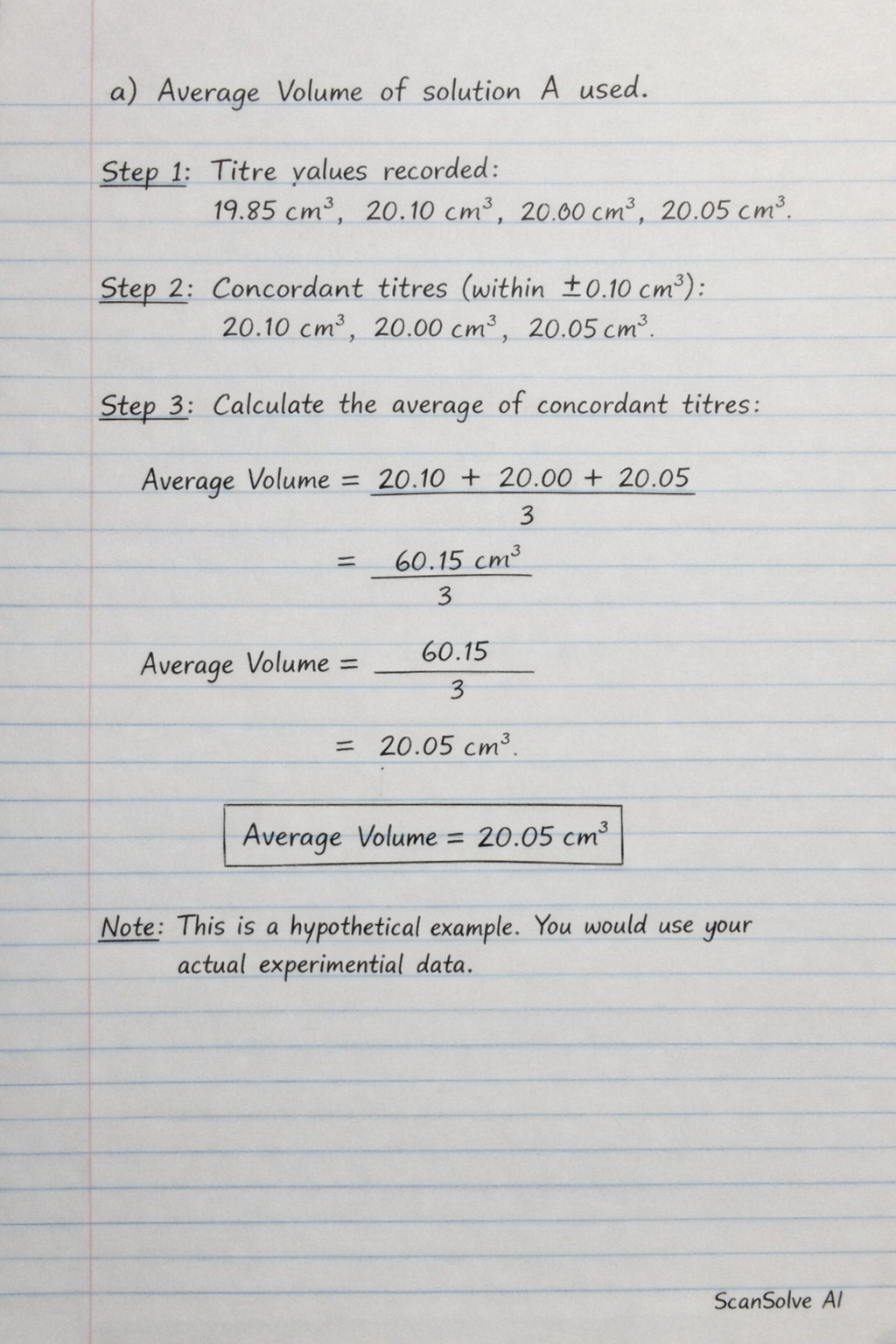
- a) Average Volume of solution A used.
Record all accurate titre values (volumes of solution A used in each titration).
Identify concordant titres.
These are titre values that are within of each other.
Calculate the average of the concordant titres.
For example, if the concordant titres were , , and :
(Note: This is a hypothetical example. You would use your actual experimental data.)
- b) Write a balanced equation & calculate the Conc of NaOH in mol dm.
Assuming solution A (Aqueous sodium hydroxide, NaOH) is titrated against solution E (Hydrochloric Acid, HCl).
Write the balanced chemical equation for the reaction.
The mole ratio of NaOH to HCl is .
State the known values and make hypothetical assumptions for unknown values.
Let's assume:
- Concentration of standard HCl (Solution E),
- Volume of HCl (Solution E) pipetted,
- Hypothetical average volume of NaOH (Solution A) used,
- Mole ratio from equation,
Calculate the moles of the known reactant (HCl).
Use the mole ratio to find the moles of NaOH.
Since the mole ratio of NaOH to HCl is :
Calculate the concentration of NaOH.
Rounding to three significant figures:
(Note: This calculation uses hypothetical values. You would substitute your actual average volume of NaOH and the known concentration and volume of the acid used.)
- c) State one possible source of error in the experiment and how it could be minimized.
One possible source of error is overshooting the endpoint during titration. This occurs when too much of the titrant (e.g., NaOH) is added beyond the point where the reaction is complete, leading to an inaccurate volume reading. This error can be minimized by adding the titrant drop by drop as the endpoint is approached, especially after the indicator starts to show temporary color changes, and by swirling the flask continuously to ensure thorough mixing.
Still stuck on this one?
Ask a follow-up, and the answer starts from this question.
More Chemistry Questions
Handwritten Step-by-Step Solution
Get this as a handwritten image on WhatsApp — like a tutor wrote it for you.
Try on WhatsApp