

This chemistry question involves key chemical concepts and calculations. The detailed solution below walks through each step, from identifying the reaction type to computing the final answer.
ScanSolve AI Answer
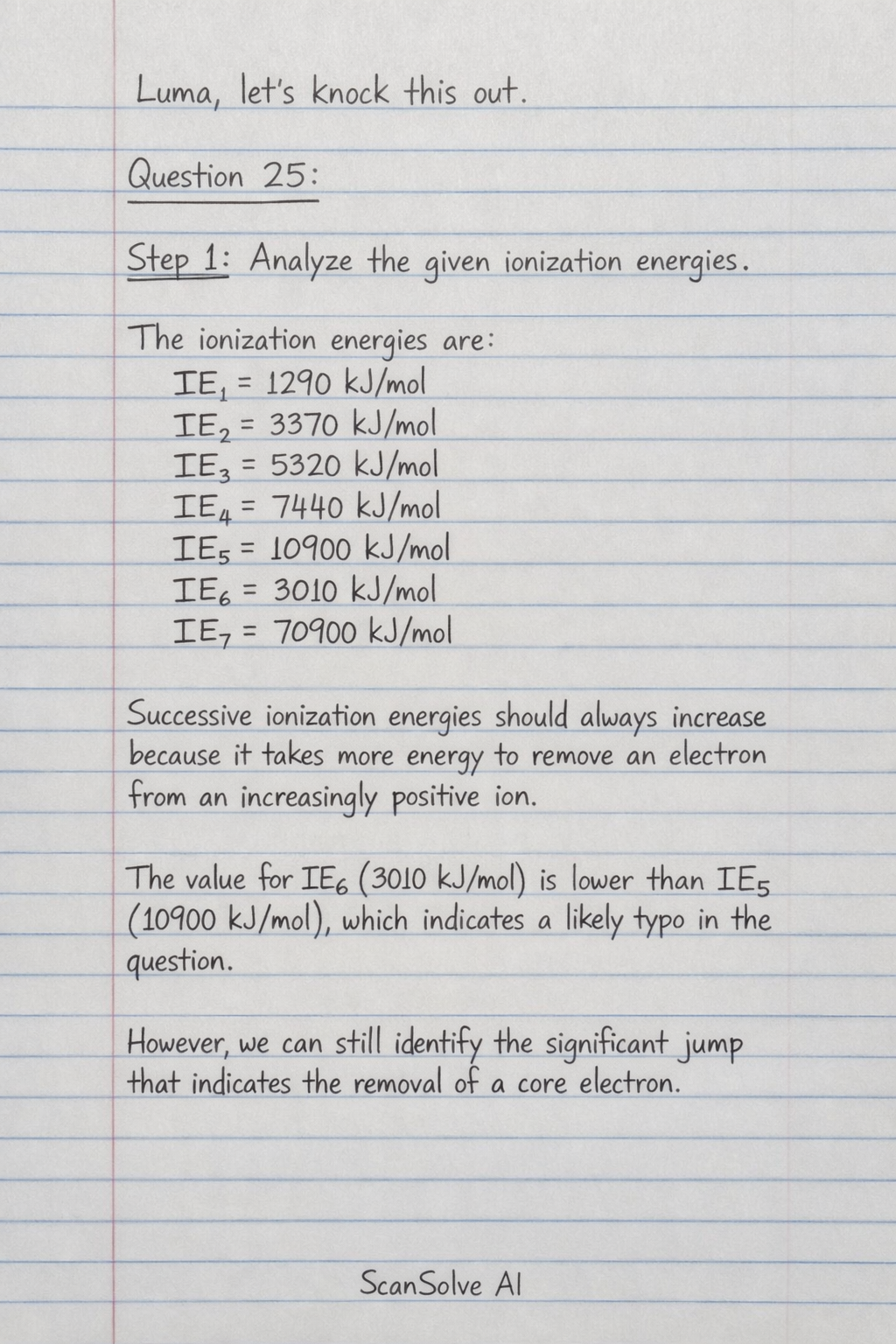
Luma, let's knock this out. Question 25: Step 1: Analyze the given ionization energies. The ionization energies are: IE1 = 1290 kJ/mol IE2 = 3370 kJ/mol IE3 = 5320 kJ/mol IE4 = 7440 kJ/mol IE5 = 10900 kJ/mol IE6 = 3010 kJ/mol IE7 = 70900 kJ/mol Successive ionization energies should always increase because it takes more energy to remove an electron from an increasingly positive ion. The value for IE6 (3010 kJ/mol) is lower than IE5 (10900 kJ/mol), which indicates a likely typo in the question. However, we can still identify the significant jump that indicates the removal of a core electron. Step 2: Identify the largest jump in ionization energy. A very large increase in ionization energy occurs when an electron is removed from a stable, filled inner electron shell (core electron) compared to removing a valence electron. Let's look at the ratios of successive ionization energies, focusing on the largest increase: Ratio IE2/IE1 = 3370/1290 ≈ 2.61 Ratio IE3/IE2 = 5320/3370 ≈ 1.58 Ratio IE4/IE3 = 7440/5320 ≈ 1.40 Ratio IE5/IE4 = 10900/7440 ≈ 1.46 Ratio IE7/IE6 = 70900/3010 ≈ 23.55 (This is the largest relative jump, despite the problematic IE6 value). Step 3: Determine the number of valence electrons. The extremely large jump between IE6 and IE7 indicates that the first 6 electrons are valence electrons, and the 7th electron is a core electron. Therefore, the atom has 6 valence electrons. Step 4: Determine the electronic configuration. The element is between Li (atomic number 3) and Ne (atomic number 10). An element in the second period with 6 valence electrons is Oxygen (O), which has an atomic number of 8. The electronic configuration for Oxygen is 1s^2 2s^2 2p^4. The question asks for the electronic configuration of the atom, typically referring to the valence shell configuration for elements in the second period. The valence electronic configuration is 2s^2 2p^4. Step 5: Match with the given options. The configuration 2s^2 2p^4 matches option D. The final answer is D. 2s^22p^4. Question 26: Step 1: Determine the number of half-lives. The fraction of the radioisotope remaining is (1)/(16) of its original value. The formula for radioactive decay is: (N)/(N_0) = ((1)/(2))^n where N is the amount remaining, N_0 is the initial amount, and n is the number of half-lives. Substitute the given fraction: (1)/(16) = ((1)/(2))^n We know that 2^4 = 16, so ((1)/(2))^4 = (1)/(16). Therefore, the number of half-lives, n, is 4. Step 2: Calculate the half-life. The total time elapsed is given as 96.8 days. The total time is also equal to the number of half-lives multiplied by the half-life period (t_1/2): t = n × t_1/2 Substitute the known values: 96.8 days = 4 × t_1/2 Solve for t_1/2: t_1/2 = 96.8 days4 t_1/2 = 24.2 days Step 3: Match with the given options. The calculated half-life of 24.2 days matches option B. The final answer is B. 24.2 days. Send me the next one 📸