
We read your photo as:
What are the IUPAC names for AlBr3, CrCl3, HBr, H3PO3, NaHCO3, Al4C3, Na3N, SO2, and MgSO4.7H2O?
ScanSolve AI Answer
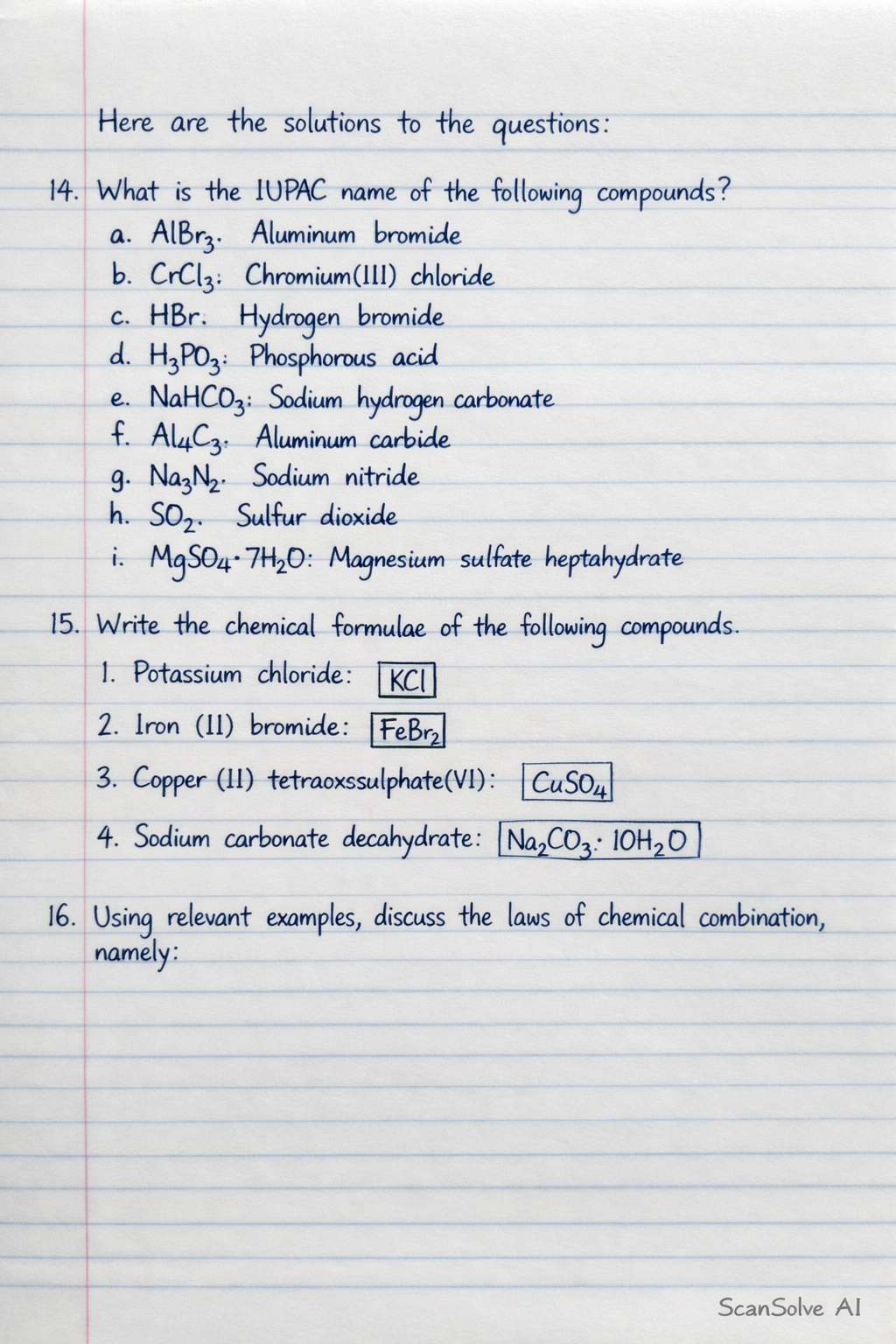
Here are the solutions to the questions:
14. What is the IUPAC name of the following compounds?
- a. AlBr3: Aluminum bromide
- b. CrCl3: Chromium(III) chloride
- c. HBr: Hydrogen bromide
- d. H3PO3: Phosphorous acid
- e. NaHCO3: Sodium hydrogen carbonate
- f. Al4C3: Aluminum carbide
- g. Na3N: Sodium nitride
- h. SO2: Sulfur dioxide
- i. MgSO4.7H2O: Magnesium sulfate heptahydrate
15. Write the chemical formulae of the following compounds.
- Potassium chloride:
- Iron (II) bromide:
- Copper (II) tetraoxosulphate(VI):
- Sodium carbonate decahydrate:
16. Using relevant examples, discuss the laws of chemical combination, namely:
-
a. Law of conservation of matter The Law of Conservation of Matter (or Mass) states that in any closed system, the mass of the reactants consumed in a chemical reaction must equal the mass of the products formed. Matter cannot be created or destroyed, only rearranged.
- Example: When 10 g of hydrogen gas reacts completely with 80 g of oxygen gas, 90 g of water is produced. Mass of reactants () equals the mass of product ().
-
b. Law of constant proportion The Law of Constant Proportion (or Definite Proportions) states that a given chemical compound always contains its component elements in fixed ratio by mass, regardless of the source or method of preparation.
- Example: Water () always consists of hydrogen and oxygen in a mass ratio of 1:8. This means that for every 1 gram of hydrogen, there are 8 grams of oxygen in any sample of pure water.
-
c. Law of multiple proportion The Law of Multiple Proportion states that if two elements can combine to form more than one compound, then the ratios of the masses of the second element which combine with a fixed mass of the first element will be ratios of small whole numbers.
- Example: Carbon and oxygen can form two common compounds: carbon monoxide (CO) and carbon dioxide ().
- In carbon monoxide (CO), 12 g of carbon combines with 16 g of oxygen.
- In carbon dioxide (), 12 g of carbon combines with 32 g of oxygen. For a fixed mass of carbon (12 g), the masses of oxygen that combine are 16 g and 32 g. The ratio of these masses is , which is a ratio of small whole numbers.
- Example: Carbon and oxygen can form two common compounds: carbon monoxide (CO) and carbon dioxide ().
Still stuck on this one?
Ask a follow-up, and the answer starts from this question.
More Chemistry Questions
Handwritten Step-by-Step Solution
Get this as a handwritten image on WhatsApp — like a tutor wrote it for you.
Try on WhatsApp