
We read your photo as:
What are the main impurities in bauxite, how is aluminium oxide's melting point lowered for electrolysis, and why is the anode replaced?
ScanSolve AI Answer
(i) The two main impurities present in bauxite are:
- Iron(III) oxide ()
- Silicon dioxide ()
(ii) Aluminium oxide's high melting point is lowered by dissolving it in molten cryolite (). This mixture has a much lower melting point, allowing the electrolysis to be carried out at approximately instead of .
(d) The equation for the reaction taking place at the anode is:
(e) The anode is replaced periodically. This is because the oxygen gas produced at the anode reacts with the carbon anode to form carbon dioxide gas, causing the anode to be consumed over time.
(f) One property of duralumin that is considered for aeroplane bodies is its high strength (or hardness).
3. (a) One ore of N is Bauxite.
Still stuck on this one?
Ask a follow-up, and the answer starts from this question.
More Chemistry Questions
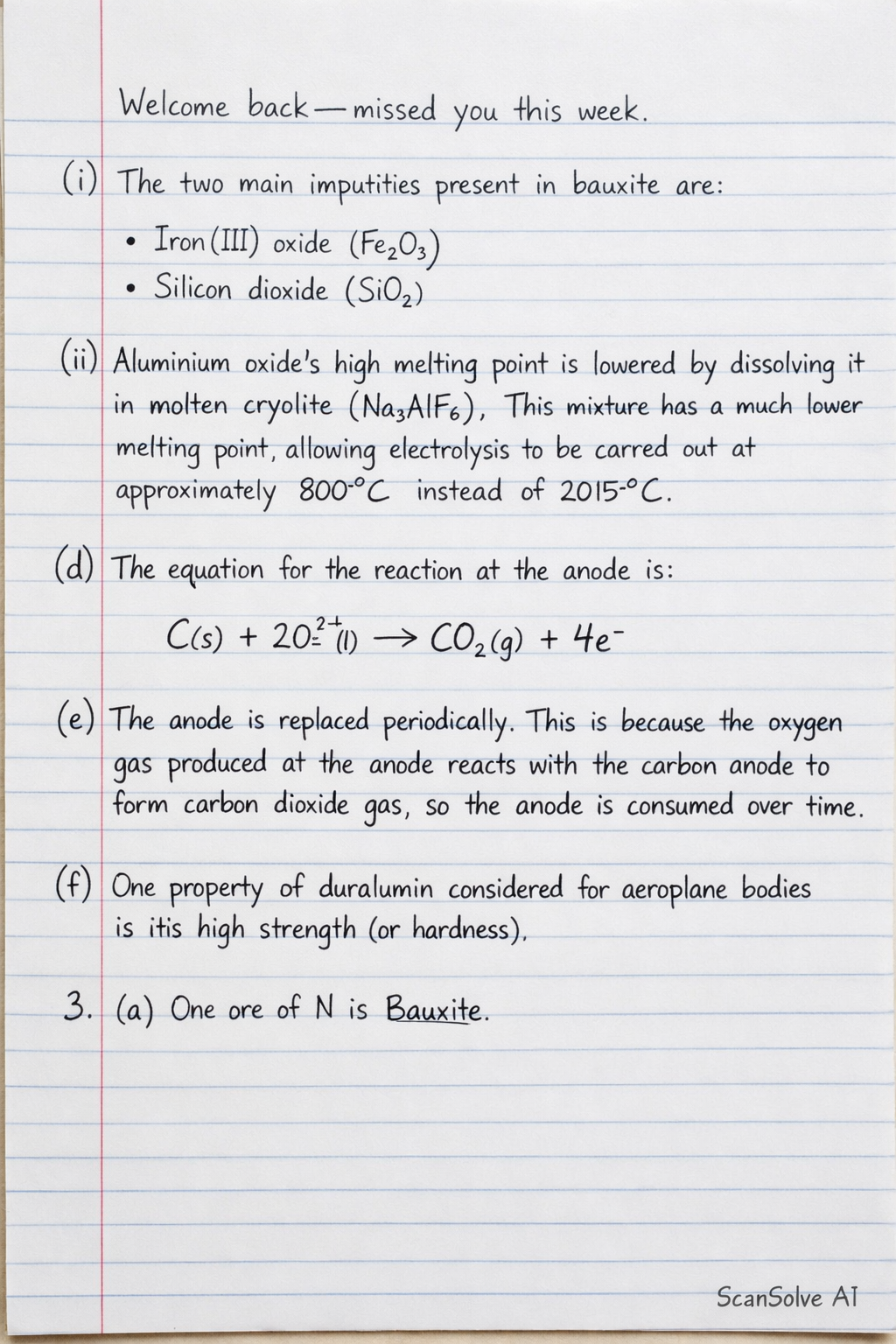
Handwritten Step-by-Step Solution
Get this as a handwritten image on WhatsApp — like a tutor wrote it for you.
Try on WhatsApp