
We read your photo as:
The presence or absence of a solute in the filtrate depends on the characteristics of both the solute and the membrane. The molecular weight and size of the solute determine if it is small enough
ScanSolve AI Answer
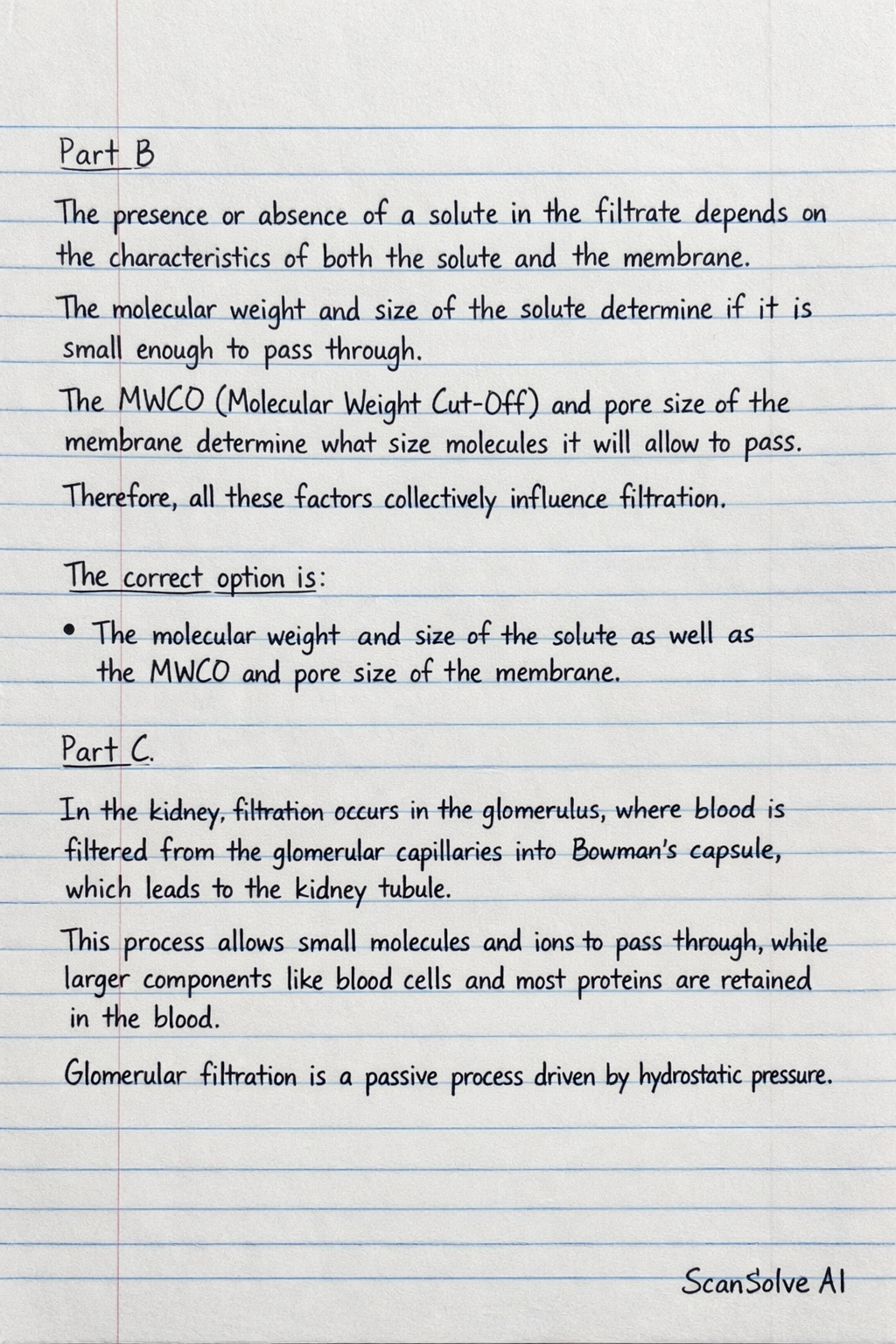
Part B
The presence or absence of a solute in the filtrate depends on the characteristics of both the solute and the membrane. The molecular weight and size of the solute determine if it is small enough to pass through. The MWCO (Molecular Weight Cut-Off) and pore size of the membrane determine what size molecules it will allow to pass. Therefore, all these factors collectively influence filtration.
The correct option is:
- The molecular weight and size of the solute as well as the MWCO and pore size of the membrane.
Part C
In the kidney, filtration occurs in the glomerulus, where blood is filtered from the glomerular capillaries into Bowman's capsule, which leads to the kidney tubule. This process allows small molecules and ions to pass through, while larger components like blood cells and most proteins are retained in the blood. Glomerular filtration is a passive process driven by hydrostatic pressure.
Let's evaluate the options:
- White blood cells and red blood cells are too large to be filtered into the kidney tubule under normal conditions.
- Ions and glucose are small molecules that are freely filtered from the glomerular capillaries into the kidney tubule.
- Glomerular filtration is a passive process, not an active one.
- Plasma proteins are generally too large to be filtered into the kidney tubule.
The correct option is:
- Ions and glucose filter from the capillary into the kidney tubule.
Still stuck on this one?
Ask a follow-up, and the answer starts from this question.
More Chemistry Questions
Handwritten Step-by-Step Solution
Get this as a handwritten image on WhatsApp — like a tutor wrote it for you.
Try on WhatsApp