
We read your photo as:
The provided text includes answers to questions about states of matter and their changes. What were the original questions?
ScanSolve AI Answer
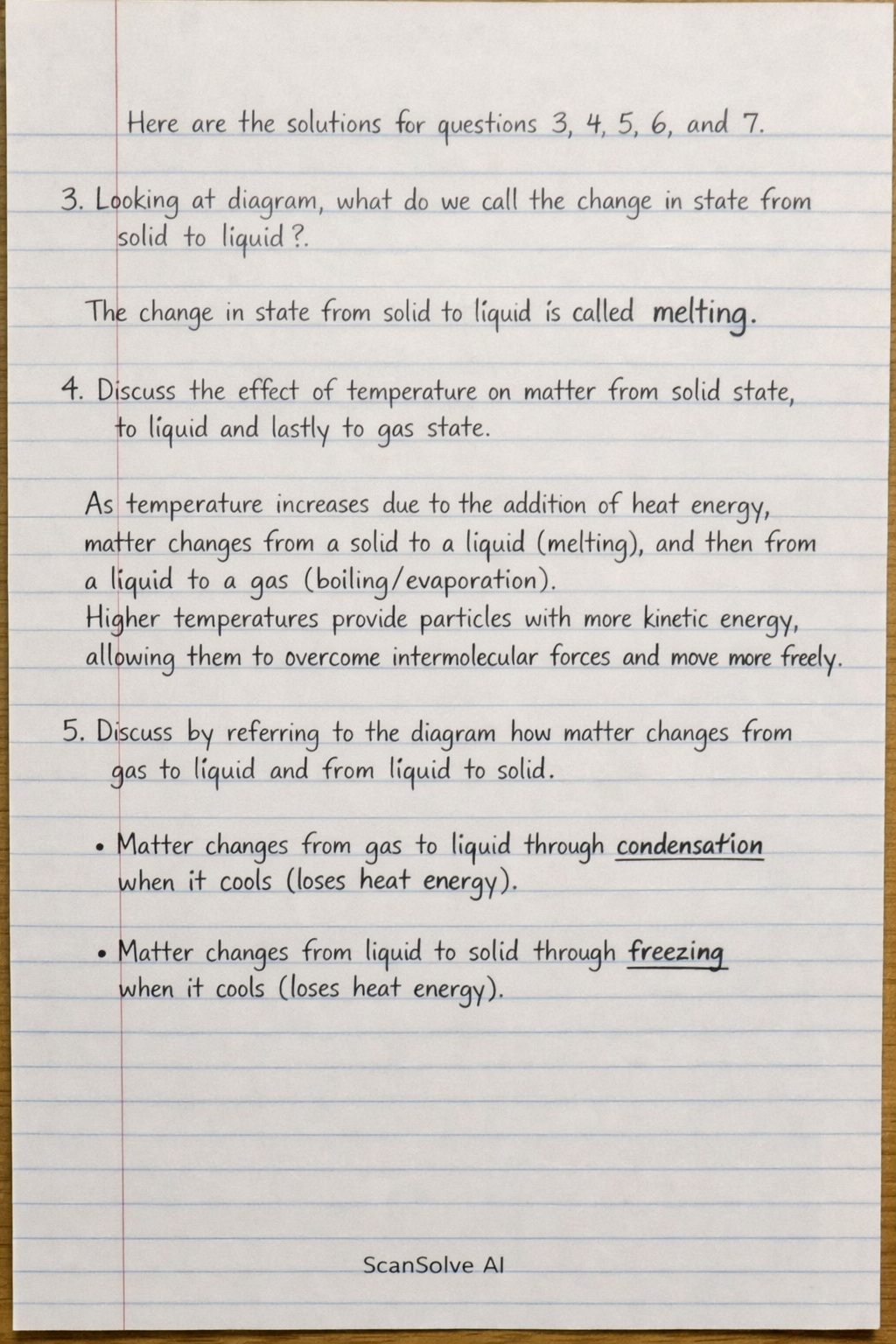
Here are the solutions for questions 3, 4, 5, 6, and 7.
3. Looking at diagram, what do we call the change in state from solid to liquid?
The change in state from solid to liquid is called melting.
4. Discuss the effect of temperature on matter from solid state, to liquid and lastly to gas state.
As temperature increases due to the addition of heat energy, matter changes from a solid to a liquid (melting), and then from a liquid to a gas (boiling/evaporation). Higher temperatures provide particles with more kinetic energy, allowing them to overcome intermolecular forces and move more freely.
5. Discuss by referring to the diagram how matter changes from gas to liquid and from liquid to solid.
Referring to the diagram:
- Matter changes from gas to liquid through condensation when it cools (loses heat energy).
- Matter changes from liquid to solid through freezing when it cools (loses heat energy).
6. Karabo's ice cream just melted, how can she get it back to a solid state?
Karabo can get her ice cream back to a solid state by cooling it down, for example, by placing it in a freezer. This process is called freezing.
7. Why do ice cubes in your cooler box start melting after a while?
Ice cubes in a cooler box start melting after a while because heat energy from the warmer surroundings (outside the cooler box) is gradually transferred into the cooler box and absorbed by the ice cubes. This absorbed heat causes the ice to change from a solid to a liquid state.
Still stuck on this one?
Ask a follow-up, and the answer starts from this question.
More Chemistry Questions
Handwritten Step-by-Step Solution
Get this as a handwritten image on WhatsApp — like a tutor wrote it for you.
Try on WhatsApp