
We read your photo as:
What are the reaction types for Ca + O3 -> Y and what is the molar mass of Y?
ScanSolve AI Answer
Here are the answers to questions 23, 24, and 25:
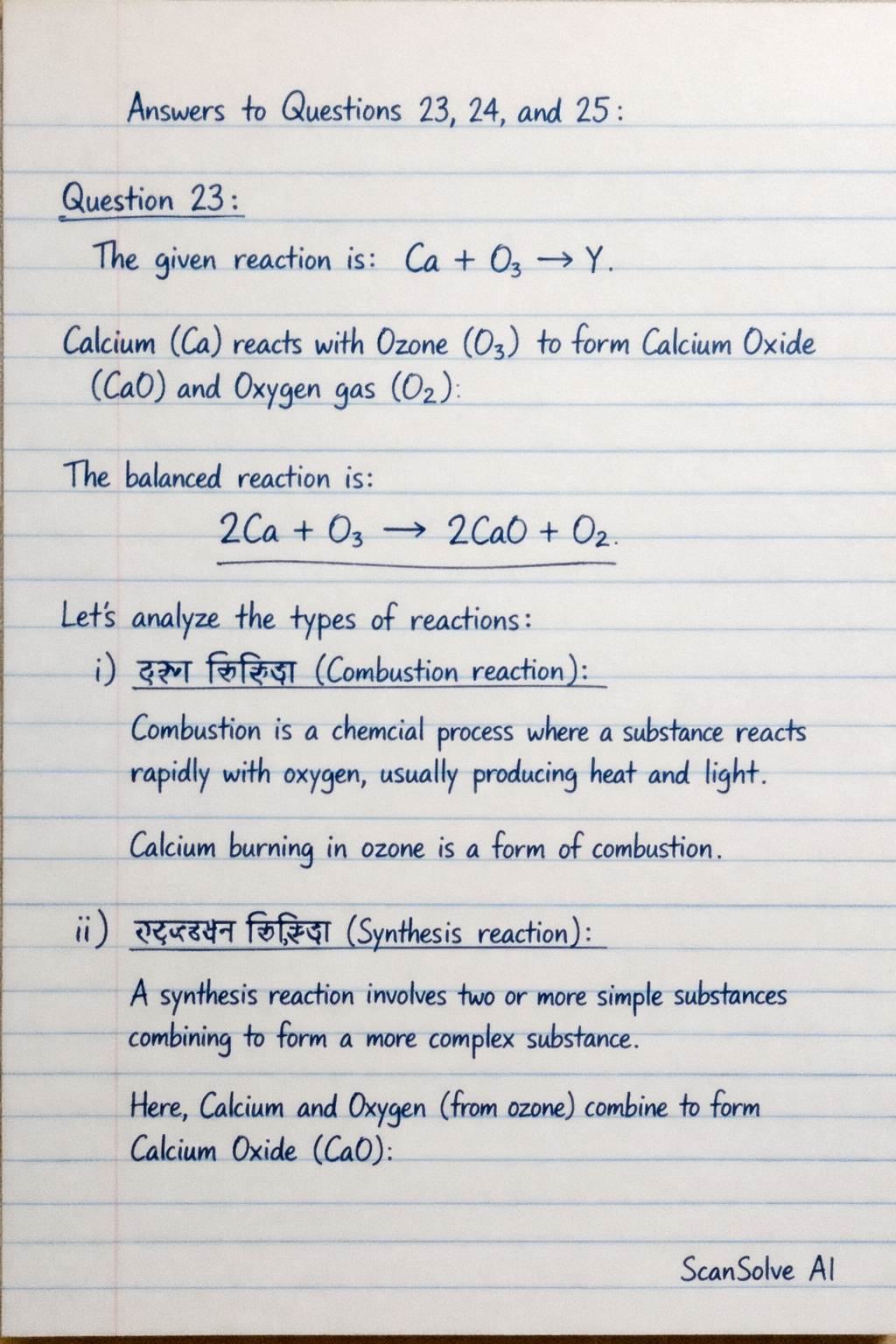
Question 23:
The given reaction is .
Calcium (Ca) reacts with Ozone () to form Calcium Oxide () and Oxygen gas ().
The balanced reaction is: .
Let's analyze the types of reactions:
- i) দহন বিক্রিয়া (Combustion reaction): Combustion is a chemical process where a substance reacts rapidly with oxygen, usually producing heat and light. Calcium burning in ozone is a form of combustion.
- ii) সংশ্লেষণ বিক্রিয়া (Synthesis reaction): A synthesis reaction involves two or more simple substances combining to form a more complex substance. Here, Calcium and Oxygen (from ozone) combine to form Calcium Oxide ().
- iii) রেডক্স বিক্রিয়া (Redox reaction): In this reaction, the oxidation state of Calcium changes from 0 to +2 (oxidation), and the oxidation state of Oxygen in (average 0) changes to -2 in (reduction). Therefore, it is a redox reaction.
All three classifications (combustion, synthesis, and redox) apply to this reaction.
The correct option is ঘ) i, ii ও iii.
Question 24:
From the previous question, the compound Y is Calcium Oxide ().
The molar mass of is:
Molar mass of .
So, 56 grams of Y () is approximately 1 mole of .
The balanced reaction is: .
From the stoichiometry, 2 moles of are produced from 1 mole of .
Therefore, to produce 1 mole of , we need mole of .
If "অক্সিজেন" (oxygen) refers to the oxygen source in the reaction, which is , then 0.5 mole of is required.
If "অক্সিজেন" refers to as a hypothetical reactant for formation (), then 1 mole of produces 2 moles of , meaning 0.5 mole of is needed for 1 mole of .
In both interpretations, the amount of oxygen molecules needed is 0.5 mole.
The correct option is গ) 0.5 মোল.
Question 25:
Iron is a metal. Metals are known for their ability to conduct electricity in the solid state. This property is due to the presence of delocalized electrons within their structure. These electrons are not bound to individual atoms but are free to move throughout the metallic lattice, forming a "sea" of electrons. This movement of electrons constitutes an electric current. This type of bonding is called metallic bonding.
- আয়নিক বন্ধন (Ionic bond): Ionic compounds typically do not conduct electricity in the solid state because their ions are fixed in a lattice. They conduct when molten or dissolved.
- সমযোজী বন্ধন (Covalent bond): Covalent compounds generally do not conduct electricity as their electrons are localized in bonds between specific atoms.
- ধাতব বন্ধন (Metallic bond): This type of bonding is characterized by a "sea" of delocalized electrons, which allows metals like iron to conduct electricity.
The correct option is ঘ) ধাতব বন্ধন.
Still stuck on this one?
Ask a follow-up, and the answer starts from this question.
More Chemistry Questions
Handwritten Step-by-Step Solution
Get this as a handwritten image on WhatsApp — like a tutor wrote it for you.
Try on WhatsApp