
We read your photo as:
Calculate the mass of calcium oxide that would be obtained when 10 g of calcium oxide reacts with excess oxygen.
ScanSolve AI Answer
Answer
Step-by-step solution
5 stepsHere are the answers to the questions:
Part a· 5 steps
Calculate the mass of calcium oxide that would be obtained when of calcium carbonate is strongly heated in excess oxygen.
(Ca = 40, C = 12, O = 16)
Write the balanced chemical equation for the decomposition of calcium carbonate.
Calculate the molar masses of and .
Molar mass of
Molar mass ofDetermine the moles of given.
Moles of
Use the mole ratio from the balanced equation to find moles of .
From the equation, of produces of .
So, moles of produced .Calculate the mass of produced.
Mass of
The mass of calcium oxide obtained is .
Part b
State three applications of standard electrode potentials.
- To predict the feasibility or spontaneity of a redox reaction.
- To calculate the electromotive force (EMF) of an electrochemical cell.
- To determine the relative strengths of oxidizing and reducing agents.
Part c(i)
What is meant by the term allotropy?
Allotropy is the property of some chemical elements to exist in two or more different physical forms (allotropes) in the same physical state. These different forms have distinct physical properties but similar chemical properties.
Part c(ii)
Apart from carbon, state one element that exhibits allotropy.
Sulfur (e.g., rhombic sulfur, monoclinic sulfur) or Phosphorus (e.g., white phosphorus, red phosphorus).
Part d
Give two characteristics of a homologous series.
- All members can be represented by a general formula.
- Successive members differ by a group.
- They show a gradual change in physical properties (e.g., boiling point) as molecular mass increases.
- They have similar chemical properties due to the same functional group.
Part e(i)
heavy chemical
Give one example each of a
Sulfuric acid () or Ammonia ().
Part e(ii)
fine chemical
Aspirin or a specific laboratory reagent.
Part f
State two factors which influence the rate of a chemical reaction.
- Concentration of reactants.
- Temperature of the reaction mixture.
- Surface area of solid reactants.
- Presence of a catalyst.
Try one yourself
A new problem that tests the same skill.
Still stuck on this one?
Ask a follow-up, and the answer starts from this question.
More Chemistry Questions
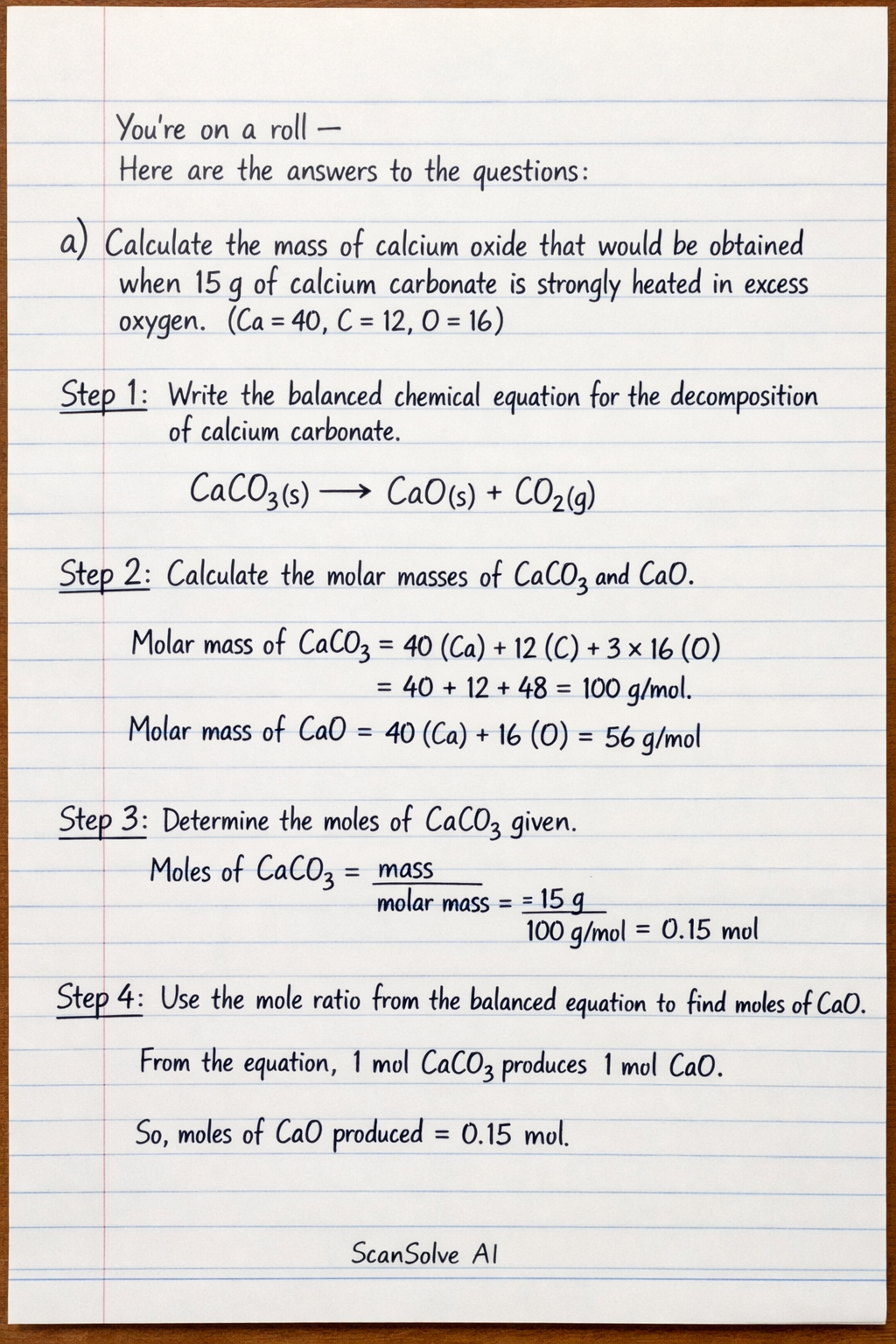
Handwritten Step-by-Step Solution
Get this as a handwritten image on WhatsApp — like a tutor wrote it for you.
Try on WhatsApp