
We read your photo as:
What are the solutions to the following questions? 1(a) Classify organisms into kingdoms. 1(b) List three plant cell structures. 2(i) Name molecules NF3, SO3, SiF4. 2(ii) Name atom particles, their ma
ScanSolve AI Answer
Answer
Step-by-step solution
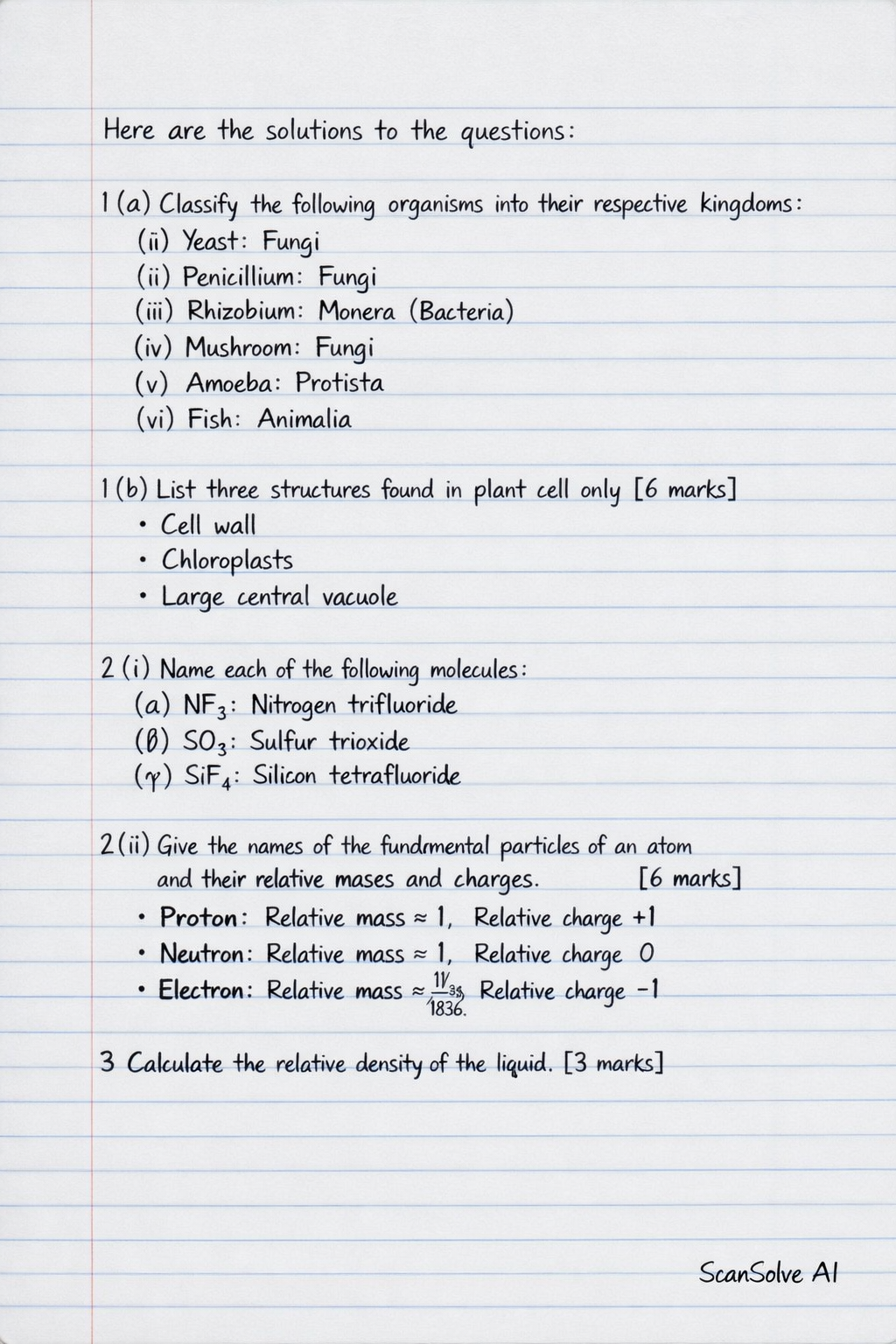
4 stepsHere are the solutions to the questions:
1 (a) Classify the following organisms into their respective kingdoms:
Part i
Yeast: *Fungi
Part ii
Penicillium: *Fungi
Part iii
Rhizobium: Monera (Bacteria)
Part iv
Mushroom: *Fungi
Part v
Amoeba: *Protista
Part vi
Fish: *Animalia
1 (b) List three structures found in plant cell only [6 marks]
- Cell wall
- Chloroplasts
- Large central vacuole
2 (i) Name each of the following molecules.
- (α) NF: Nitrogen trifluoride
- (β) SO: Sulfur trioxide
- (γ) SiF: Silicon tetrafluoride
2 (ii) Give the names of the fundamental particles of an atom and their relative masses and charges. [6 marks]
- Proton: Relative mass , Relative charge
- Neutron: Relative mass , Relative charge 0
- Electron: Relative mass , Relative charge
3 Calculate the relative density of the liquid. [3 marks]
Determine the density of the plank () using its flotation in water.
Let be the total volume of the plank, and be the density of water.
When floating, the buoyant force equals the weight of the plank.Determine the density of the plank using its flotation in the unknown liquid.
Let be the density of the unknown liquid.
Equate the expressions for to find the relationship between and .
Calculate the relative density of the liquid.
Relative density of liquid
4 (i) Distinguish between a grain and a cereal.
A grain is a small, hard, dry seed, with or without an attached hull or fruit layer, harvested for human or animal consumption. A cereal is a type of grain that comes from grasses cultivated for their edible components, such as wheat, rice, or maize. All cereals are grains, but not all grains are cereals (e.g., legumes like lentils are grains but not cereals).4 (ii) State one example of a grain.
Maize (Corn)4 (iii) Mention four uses of the named grain in d (ii). [5 marks]
(Assuming "d (ii)" refers to "4 (ii)", and the named grain is Maize)- Food for human consumption (e.g., cornmeal, sweet corn, popcorn).
- Animal feed for livestock.
- Production of ethanol (biofuel).
- Source of corn oil and corn starch.
5 (i) Define the following terms
- (α) Mitosis: Mitosis is a type of cell division that results in two daughter cells each having the same number and kind of chromosomes as the parent nucleus. It is essential for growth, repair, and asexual reproduction.
- (β) Meiosis: Meiosis is a type of cell division that reduces the number of chromosomes in the parent cell by half and produces four haploid gamete cells. This process is crucial for sexual reproduction.
5 (ii) Mention two ways in which meiosis is significant. [6 marks]
- Meiosis ensures genetic variation in offspring through processes like crossing over and independent assortment of chromosomes, leading to diverse traits within a species.
- It maintains a constant chromosome number across generations in sexually reproducing organisms by halving the chromosome number in gametes, so that when two gametes fuse during fertilization, the diploid number is restored.
6 (i) (α) Explain the term isomers.
Isomers are compounds that have the same molecular formula but different structural formulas or different arrangements of atoms in space. This difference in arrangement leads to distinct chemical and physical properties.6 (i) (β) Write down structures for three isomers of hexane. [6 marks]
Hexane has the molecular formula CH.-
n-Hexane (straight chain)
-
2-Methylpentane
-
2,3-Dimethylbutane
Try one yourself
A new problem that tests the same skill.
Still stuck on this one?
Ask a follow-up, and the answer starts from this question.
More Chemistry Questions
Handwritten Step-by-Step Solution
Get this as a handwritten image on WhatsApp — like a tutor wrote it for you.
Try on WhatsApp