
We read your photo as:
The specific gravity of concentrated tetraoxosulphate (VI) acid is 1.84. Calculate the volume of tetraoxosulphate (VI) acid required to make 0.01M H2SO4, if the percentage purity of H2SO4 is 98.7.
ScanSolve AI Answer
Answer
Step-by-step solution
4 stepsHere are the solutions to the problems.
Part 6· 3 steps
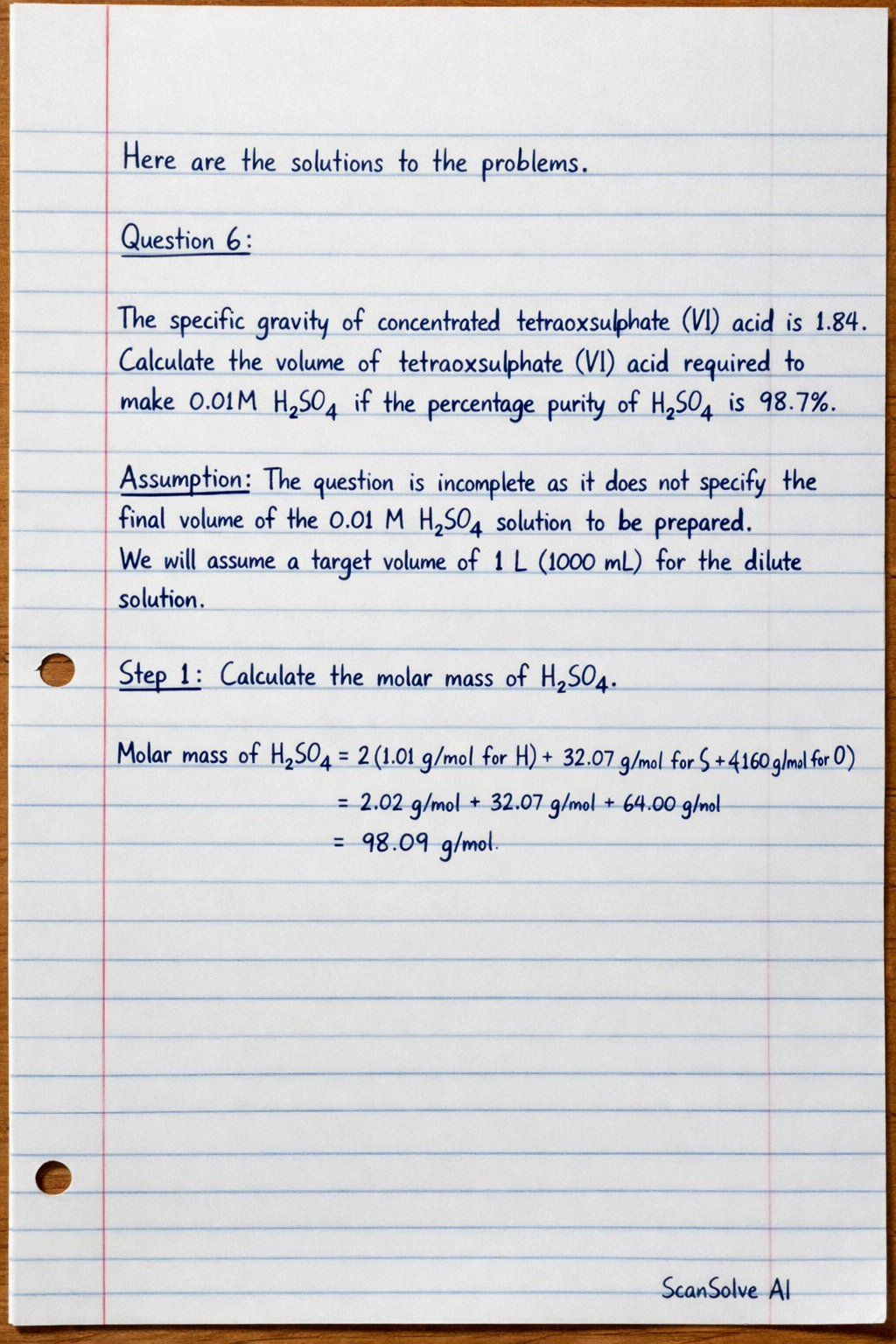
The specific gravity of concentrated tetraoxosulphate (VI) acid is 1.84. Calculate the volume of tetraoxosulphate (VI) acid required to make 0.01M HSO, if the percentage purity of HSO is 98.7.
Assumption: The question is incomplete as it does not specify the final volume of the 0.01 M HSO solution to be prepared. We will assume a target volume of () for the dilute solution.
Calculate the molar mass of HSO.
Molar mass of HSO =
Calculate the molarity of the concentrated HSO solution.
Density of concentrated HSO = Specific gravity Density of water = .
Mass of 1 L (1000 mL) of concentrated acid =Mass of pure HSO in 1 L of concentrated acid =
Moles of pure HSO in 1 L of concentrated acid =
Molarity of concentrated HSO () = .
Calculate the volume of concentrated acid required using the dilution formula.
We use the dilution formula:
Where:
(molarity of concentrated acid)
(volume of concentrated acid required)
(target molarity of dilute acid)
(target volume of dilute acid, assumed)Rounding to three significant figures:
The volume of concentrated tetraoxosulphate (VI) acid required is .
Part 7· 1 step
A solution of ammonia in water with a density of 0.93 g/cm contained 18% by mass of ammonia. What volume of this solution is required to form 30g of ammonium tetraoxosulphate(VI) based on the reaction: .
Calculate the molar mass of ammonium tetraoxosulphate(VI), .
Molar mass of = $2(\text{14.01 g/
Try one yourself
A new problem that tests the same skill.
Still stuck on this one?
Ask a follow-up, and the answer starts from this question.
More Chemistry Questions
Handwritten Step-by-Step Solution
Get this as a handwritten image on WhatsApp — like a tutor wrote it for you.
Try on WhatsApp