
We read your photo as:
What is the Van't Hoff factor and how is it related to the degree of dissociation for a binary electrolyte?
Chemistry
ScanSolve AI Answer
- The Van't Hoff factor () is a measure of the effect of a solute on colligative properties such as osmotic pressure, relative lowering of vapor pressure, freezing point depression, or boiling point elevation. It is defined as the ratio of the actual number of particles in solution after dissociation/association to the number of formula units initially dissolved.
For a binary electrolyte, which dissociates into two ions (e.g., AB A + B), the relationship between the Van't Hoff factor () and the degree of dissociation () is given by:
Here, represents the fraction of the electrolyte molecules that dissociate into ions in the solution.
Was this helpful?
Still stuck on this one?
Ask a follow-up, and the answer starts from this question.
Got a different question?Ask your own question
More Chemistry Questions
QA substance dissociates through a first-order reaction with a half-life of 32 ext min. If the…QCalculate the degree of ionization of a weak acid with Ka = 10⁻⁴ and initial concentration C = 0.01…QCalculate the moles of dichromate(VI) used in the reaction, given the concentration and volume of…QCalculate the amount, in moles, of dichromate (VI) ions used in the titration.QGive the ions formed when the following compounds dissociate: I. KOH II. Pb(NO3)2 III. Na2CO3
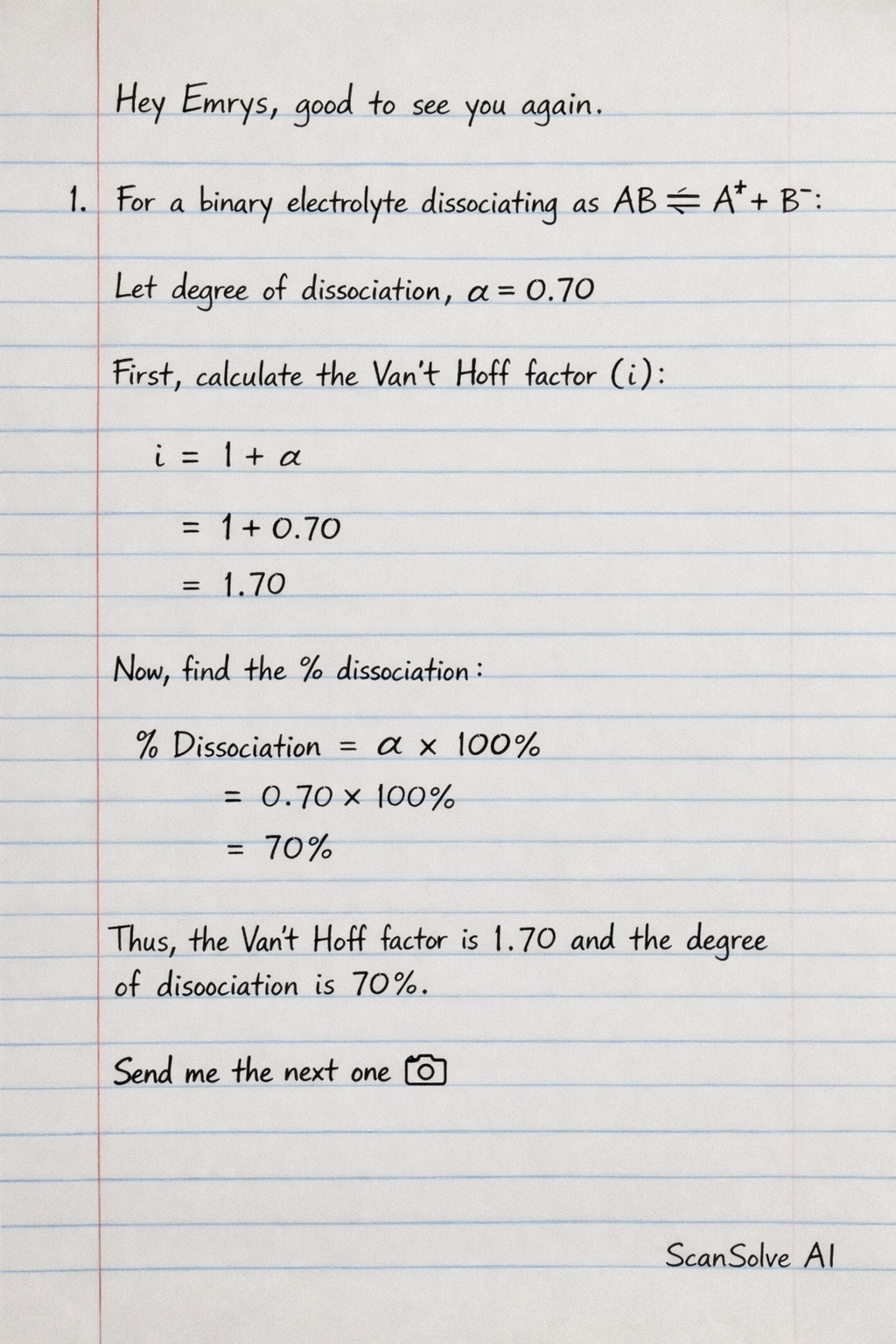
Handwritten Step-by-Step Solution
Get this as a handwritten image on WhatsApp — like a tutor wrote it for you.
Try on WhatsApp