
We read your photo as:
Solve this chemistry questions for me
Chemistry
ScanSolve AI Answer
Here are the answers to your chemistry questions:
-
Industrial Preparation of Hydrogen
- Bosch Process: This process involves two main steps:
- Step 1: Water Gas Production Steam is passed over red-hot coke (carbon) at about to produce water gas, which is a mixture of carbon monoxide and hydrogen.
- Step 2: Water Gas Shift Reaction The water gas is mixed with more steam and passed over a catalyst (iron(III) oxide, , with chromium(III) oxide, , as a promoter) at . Carbon monoxide reacts with steam to produce carbon dioxide and more hydrogen. The carbon dioxide is then removed by dissolving it in water under pressure or by absorption with potassium carbonate solution.
- Cracking of Petroleum Fractions: Hydrogen is also produced as a byproduct during the catalytic cracking of heavy hydrocarbon fractions from petroleum. In this process, large hydrocarbon molecules are broken down into smaller, more valuable hydrocarbons (like gasoline) and lighter gases, including hydrogen, at high temperatures and in the presence of catalysts. For example, a long-chain alkane can be cracked:
- Bosch Process: This process involves two main steps:
-
Uses of Hydrogen
- Manufacture of Ammonia: Hydrogen is a key reactant in the Haber process for the industrial synthesis of ammonia (), which is used to make fertilizers.
- Hydrogenation of Oils: It is used in the hydrogenation of unsaturated vegetable oils to produce saturated fats like margarine or vanaspati ghee.
- Fuel: Hydrogen is used as a rocket fuel and in fuel cells to generate electricity, producing only water as a byproduct.
- Reducing Agent: It acts as a reducing agent in the extraction of metals from their oxides (e.g., tungsten, molybdenum).
- Manufacture of Hydrochloric Acid: Hydrogen reacts with chlorine to produce hydrogen chloride, which dissolves in water to form hydrochloric acid.
- Welding: An oxy-hydrogen flame produces very high temperatures and is used for cutting and welding metals.
Was this helpful?
Still stuck on this one?
Ask a follow-up, and the answer starts from this question.
Got a different question?Ask your own question
More Chemistry Questions
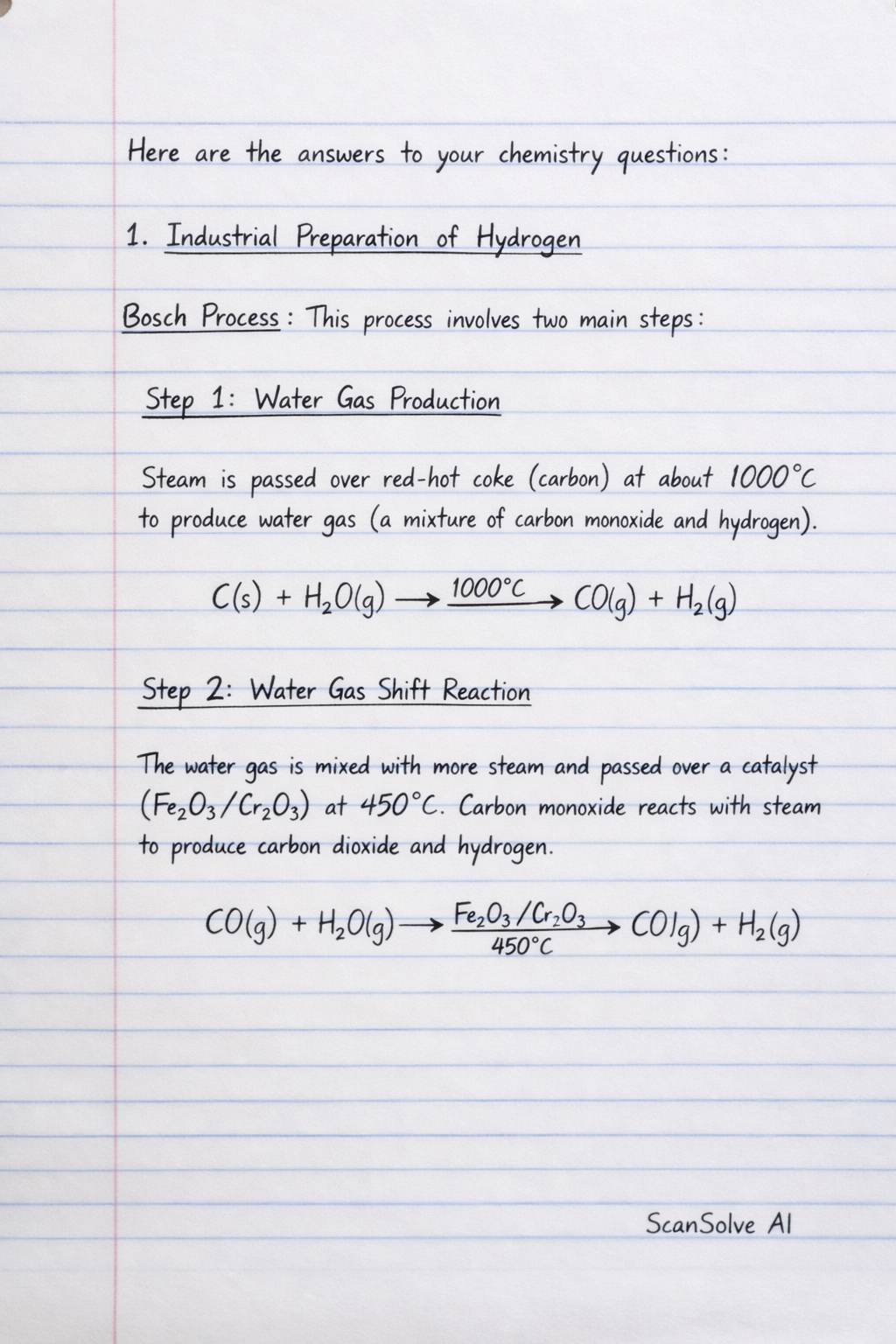
Handwritten Step-by-Step Solution
Get this as a handwritten image on WhatsApp — like a tutor wrote it for you.
Try on WhatsApp