
Solve this question in the way that I can explain to my lecturer
ScanSolve AI Answer
Answer
Step-by-step solution
2 stepsTo explain this to your lecturer, you would present the solution by clearly stating the principles and formulas used at each step.
The problem asks us to determine the fraction of diethyl ether remaining after a specific time, given its half-life for a first-order decomposition reaction.
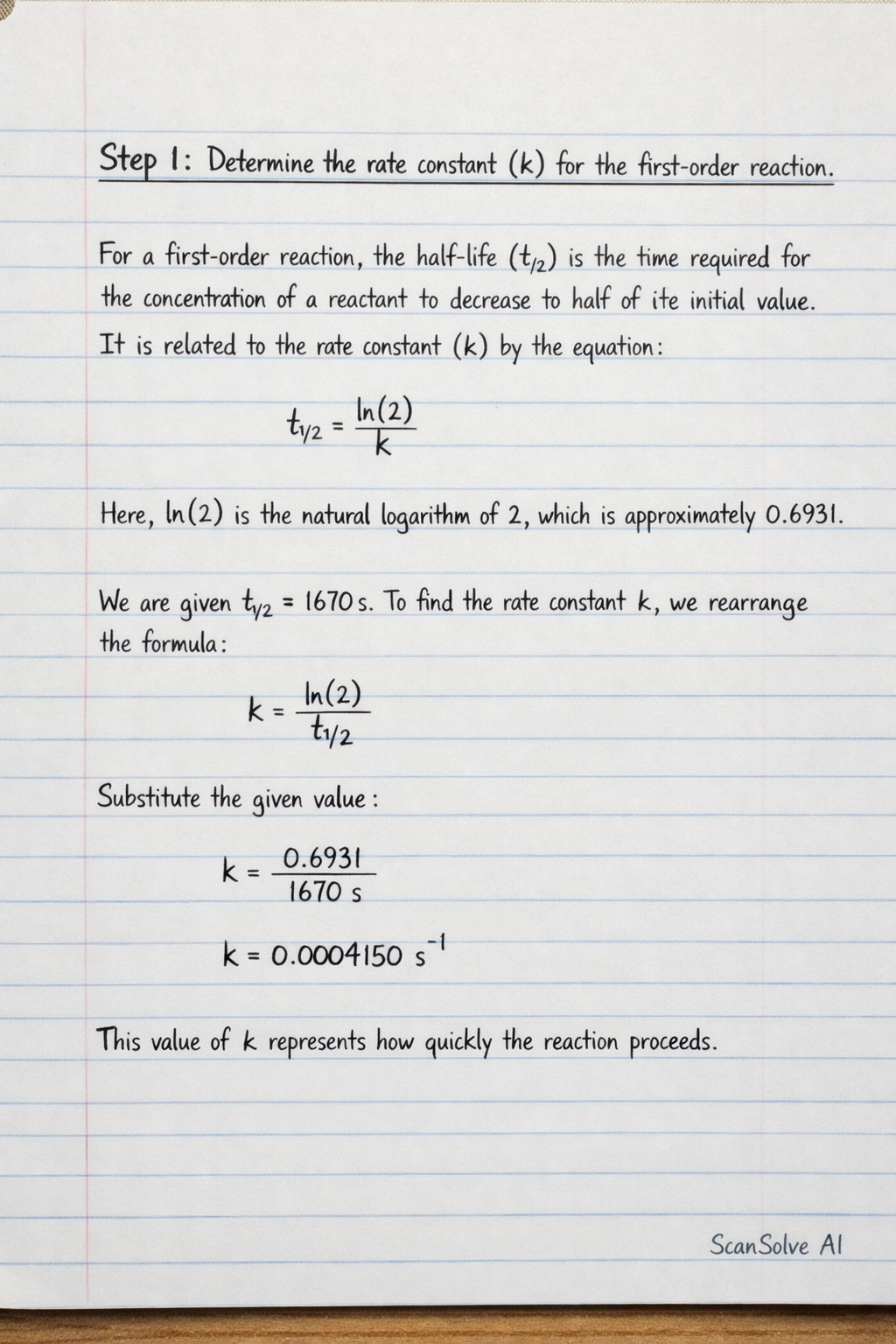
Determine the rate constant () for the first-order reaction.
For a first-order reaction, the half-life () is the time required for the concentration of a reactant to decrease to half of its initial value. This is a constant value for a given first-order reaction and is related to the rate constant () by the following equation:
Here, is the natural logarithm of 2, which is approximately 0.6931.
We are given the half-life . To find the rate constant , we rearrange the formula:Substitute the given value:
This value of represents how quickly the reaction proceeds.
Calculate the fraction of diethyl ether remaining after .
To find the amount of reactant remaining after a certain time, we use the integrated rate law for a first-order reaction. This equation relates the concentration of the reactant at time () to its initial concentration (), the rate constant (), and the time ():
The term represents the fraction of the reactant remaining at time . To solve for this fraction, we need to remove the natural logarithm (). We do this by taking the exponential (base ) of both sides of the equation:
This simplifies to:
Now, we substitute the calculated rate constant and the given time :
First, calculate the product in the exponent:
So, the equation becomes:
Finally, calculate the value:
This means that after , approximately 0.1416 (or ) of the initial diethyl ether remains.
Note: The value 0.750 was not used in these calculations. The constant used in the half-life formula is .
The fraction of diethyl ether remaining after is approximately .
Try one yourself
A new problem that tests the same skill.
Still stuck on this one?
Ask a follow-up, and the answer starts from this question.
More Chemistry Questions
Handwritten Step-by-Step Solution
Get this as a handwritten image on WhatsApp — like a tutor wrote it for you.
Try on WhatsApp