
We read your photo as:
Explain methods for water purification, water softening, air drying, and the properties and uses of alums.
ScanSolve AI Answer
Step-by-step solution
4 steps6. (a)
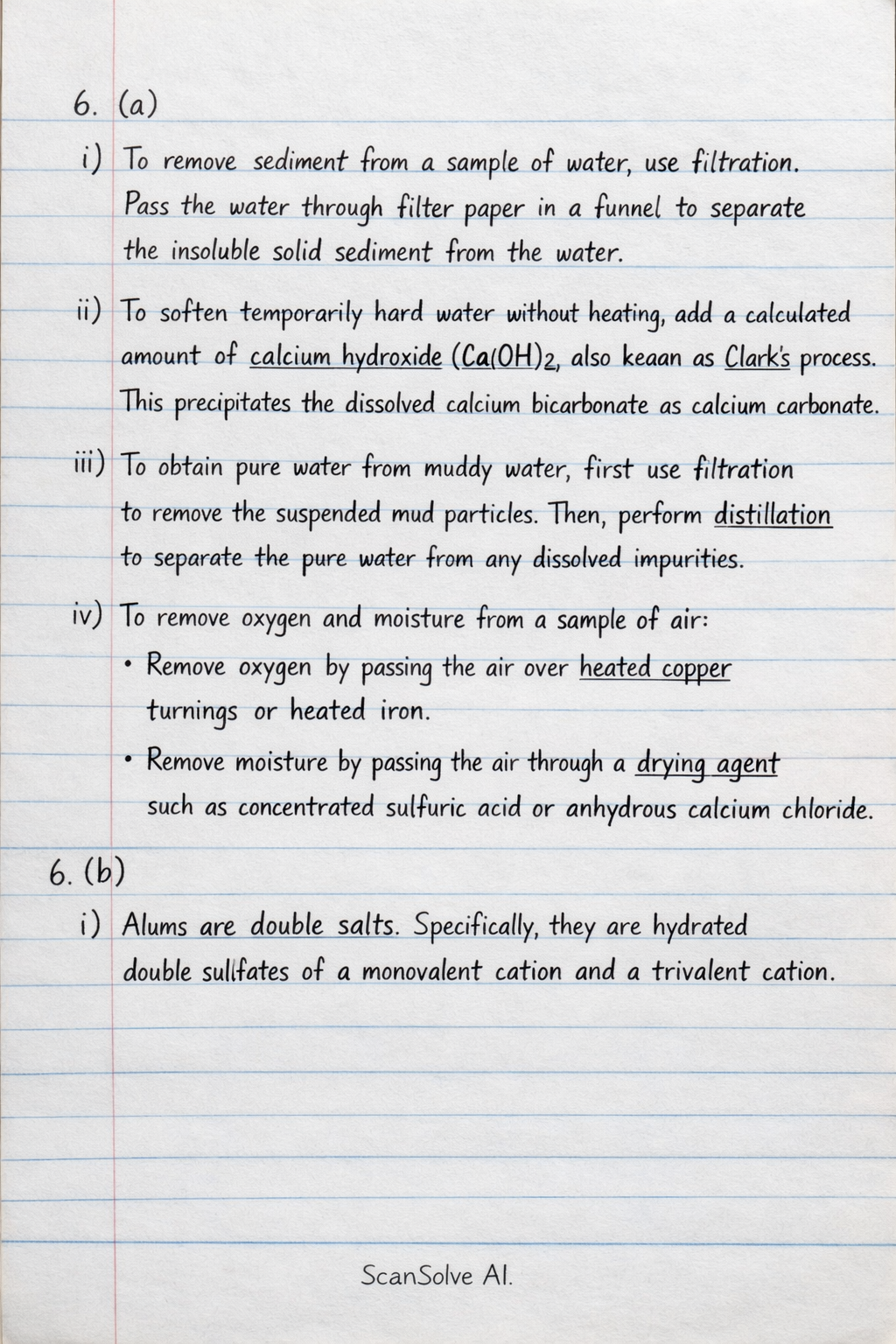
i) To remove sediment from a sample of water, use filtration. Pass the water through filter paper in a funnel to separate the insoluble solid sediment from the water.
ii) To soften temporarily hard water without heating, add a calculated amount of calcium hydroxide (), also known as Clark's process. This precipitates the dissolved calcium bicarbonate as calcium carbonate.
iii) To obtain pure water from muddy water, first use filtration to remove the suspended mud particles. Then, perform distillation to separate the pure water from any dissolved impurities.
iv) To remove oxygen and moisture from a sample of air:
- Remove oxygen by passing the air over heated copper turnings or heated iron.
- Remove moisture by passing the air through a drying agent such as concentrated sulfuric acid or anhydrous calcium chloride.
6. (b)
i) Alums are double salts. Specifically, they are hydrated double sulfates of a monovalent cation and a trivalent cation.
ii) In water treatment plants, alum acts as a coagulant. It causes small suspended particles in the water to clump together into larger, heavier flocs, which then settle out, making the water clearer.
iii) Rainwater that has passed through limestone deposits becomes temporarily hard due to the dissolution of calcium carbonate to form calcium bicarbonate. When this hard water reacts with soap solution, it forms an insoluble scum (calcium stearate) instead of a lather, because the calcium ions react with the soap molecules.
6. (c)
i) Equation for the laboratory preparation of chlorine using manganese(IV) oxide:
ii) The products of the reaction of chlorine with hot concentrated sodium hydroxide solution are sodium chloride (), sodium chlorate(V) (), and water ().
iii) When moist blue litmus paper comes in contact with chlorine, it first turns red (due to the formation of hydrochloric acid and hypochlorous acid) and then is bleached (turns white) by the hypochlorous acid.
iv) Calculation of the volume of chlorine:
Calculate the molar mass of .
Calculate the moles of .
Determine the moles of required from the stoichiometry.
From the equation , the mole ratio of is .
Calculate the volume of at s.t.p.
The volume of chlorine required is .
6. (d)
i) On warming ammonium trioxonitrate (V) () with sodium hydroxide solution, a pungent-smelling gas (ammonia, ) is evolved. This gas turns moist red litmus paper blue.
ii) Ammonium trioxocarbonate (IV) () leaves no residue on being heated because it undergoes complete thermal decomposition into gaseous products: ammonia (), carbon dioxide (), and water (). Since no solid product remains, there is no residue.
Still stuck on this one?
Ask a follow-up, and the answer starts from this question.
More Chemistry Questions
Handwritten Step-by-Step Solution
Get this as a handwritten image on WhatsApp — like a tutor wrote it for you.
Try on WhatsApp