

This chemistry question involves key chemical concepts and calculations. The detailed solution below walks through each step, from identifying the reaction type to computing the final answer.
ScanSolve AI Answer
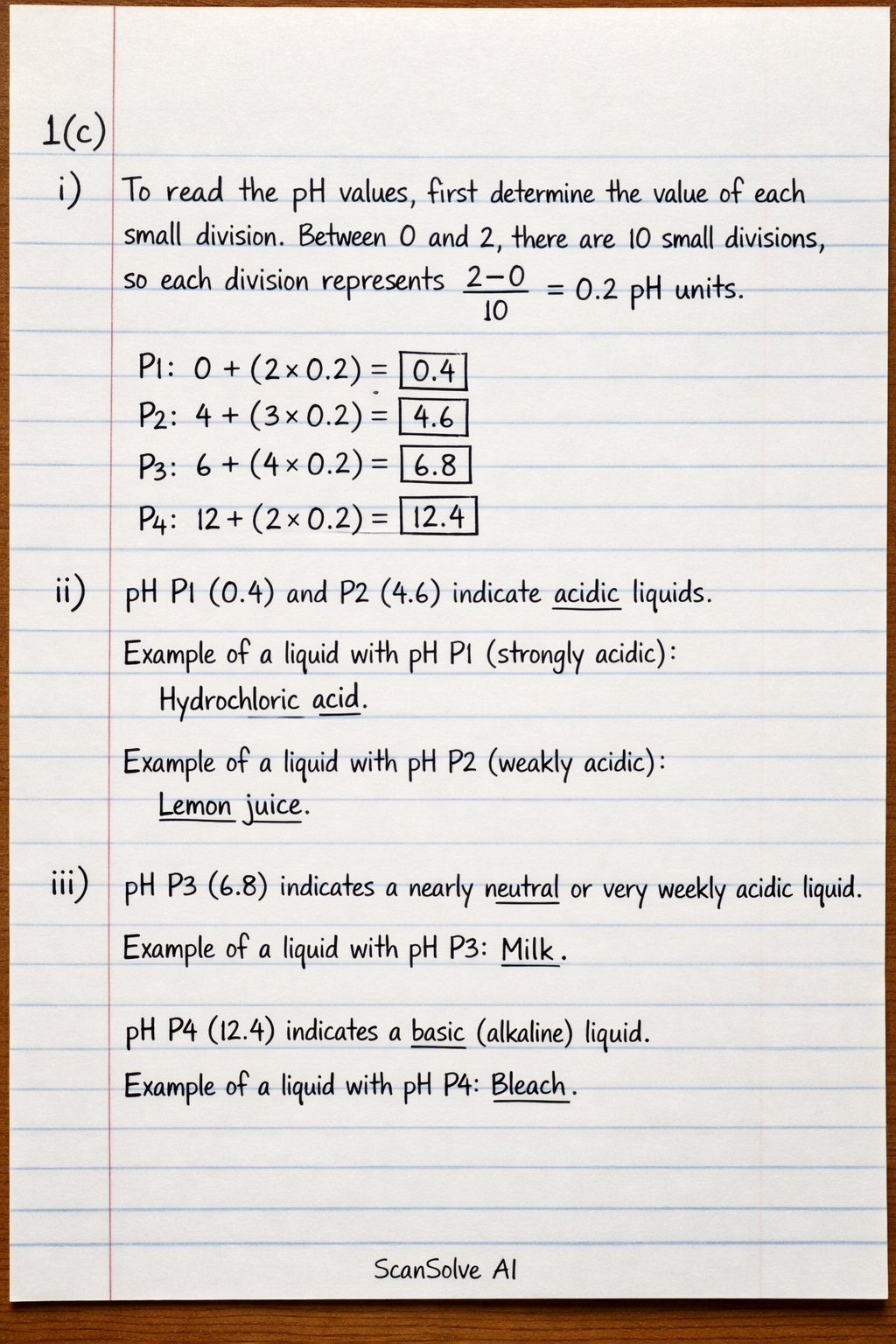
1(c) i) To read the pH values, first determine the value of each small division. Between 0 and 2, there are 10 small divisions, so each division represents (2-0)/(10) = 0.2 pH units. P1: 0 + (2 × 0.2) = 0.4 P2: 4 + (3 × 0.2) = 4.6 P3: 6 + (4 × 0.2) = 6.8 P4: 12 + (2 × 0.2) = 12.4 ii) pH P1 (0.4) and P2 (4.6) indicate acidic liquids. Example of a liquid with pH P1 (strongly acidic): Hydrochloric acid. Example of a liquid with pH P2 (weakly acidic): Lemon juice. iii) pH P3 (6.8) indicates a nearly neutral or very weakly acidic liquid. Example of a liquid with pH P3: Milk. pH P4 (12.4) indicates a basic (alkaline) liquid. Example of a liquid with pH P4: Bleach. iv) • For liquid P1 (pH 0.4, strongly acidic): Red litmus paper stays red, blue litmus paper turns red. • For liquid P2 (pH 4.6, weakly acidic): Red litmus paper stays red, blue litmus paper turns red. • For liquid P3 (pH 6.8, nearly neutral): Red litmus paper stays red, blue litmus paper stays blue. • For liquid P4 (pH 12.4, strongly basic): Red litmus paper turns blue, blue litmus paper stays blue. 1(d) i) Device A: Knapsack sprayer (or Backpack sprayer) Device B: Watering can ii) N: Tank (or Container) P: Hose (or Delivery tube) Q: Pump lever (or Pumping handle) R: Nozzle (or Spray nozzle) S: Lance (or Spray wand) T: Rose (or Sprinkler head) U: Spout iii) Use of Device A: To spray pesticides, herbicides, or liquid fertilizers on crops. Use of Device B: To water plants in a garden or nursery. iv) The part labelled Q (Pump lever) is used to pressurize the liquid inside the tank, allowing it to be sprayed out through the nozzle. v) One similarity between device A and B is that both are used for dispensing liquids (e.g., water, chemicals) for agricultural or gardening purposes. Send me the next one 📸