
We read your photo as:
Define a transition metal and write the electronic configurations for Mn2+ and Fe2+ ions, explaining why Fe2+ is readily oxidized to Fe3+ but Mn2+ is not readily oxidized to Mn3+.
ScanSolve AI Answer
Step-by-step solution
4 stepsSECTION B: INORGANIC CHEMISTRY
3 (a) (i) Define a transition metal.
A transition metal is an element that has a partially filled d subshell in at least one of its common oxidation states. These elements are typically found in the d-block of the periodic table.
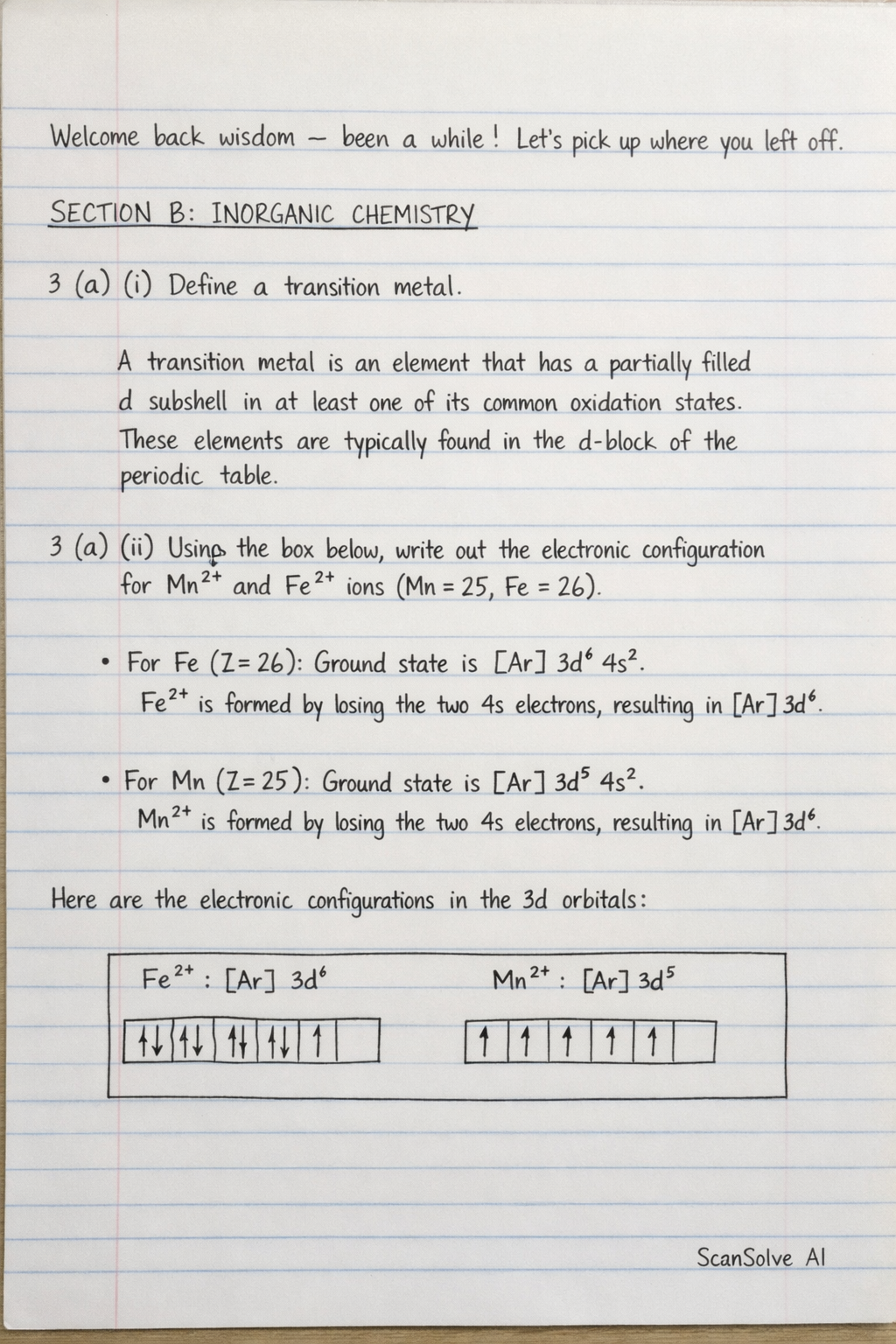
3 (a) (ii) Using the box below, write out the electronic configuration for Mn and Fe ions (Mn=25, Fe=26).
- For Fe (Z=26): Ground state is . Fe is formed by losing the two 4s electrons, resulting in .
- For Mn (Z=25): Ground state is . Mn is formed by losing the two 4s electrons, resulting in .
Here are the electronic configurations in the 3d orbitals:
3 (b) Account for the fact that Fe ions are readily oxidized to Fe ions but Mn ions are not readily oxidized to Mn ions.
Determine the electronic configurations of the ions involved.
- Fe has an electronic configuration of .
- Fe has an electronic configuration of .
- Mn has an electronic configuration of .
- Mn has an electronic configuration of .
Analyze the stability of the configurations.
- The configuration represents a half-filled d subshell, which is particularly stable due to exchange energy and symmetry.
Explain the oxidation of Fe to Fe.
- Fe () readily loses an electron to form Fe (). This conversion is favorable because it results in the highly stable half-filled configuration.
Explain why Mn is not readily oxidized to Mn.
- Mn already possesses the highly stable half-filled configuration. Oxidizing Mn to Mn would mean losing an electron from this stable configuration to form a less stable configuration. This process requires a significant amount of energy and is therefore not readily favorable.
3 (c) Give the transition metal or transition metal compound used as catalyst in the following conversions.
The conversions are not visible in the provided image. Please provide the conversions for this part.
Still stuck on this one?
Ask a follow-up, and the answer starts from this question.
More Chemistry Questions
Handwritten Step-by-Step Solution
Get this as a handwritten image on WhatsApp — like a tutor wrote it for you.
Try on WhatsApp