
We read your photo as:
State two methods that can be used to remove water hardness. (b) Define the term solubility. Use the data to calculate the solubility of solid Q.
ScanSolve AI Answer
Step-by-step solution
11 stepsHere are the solutions to the questions:
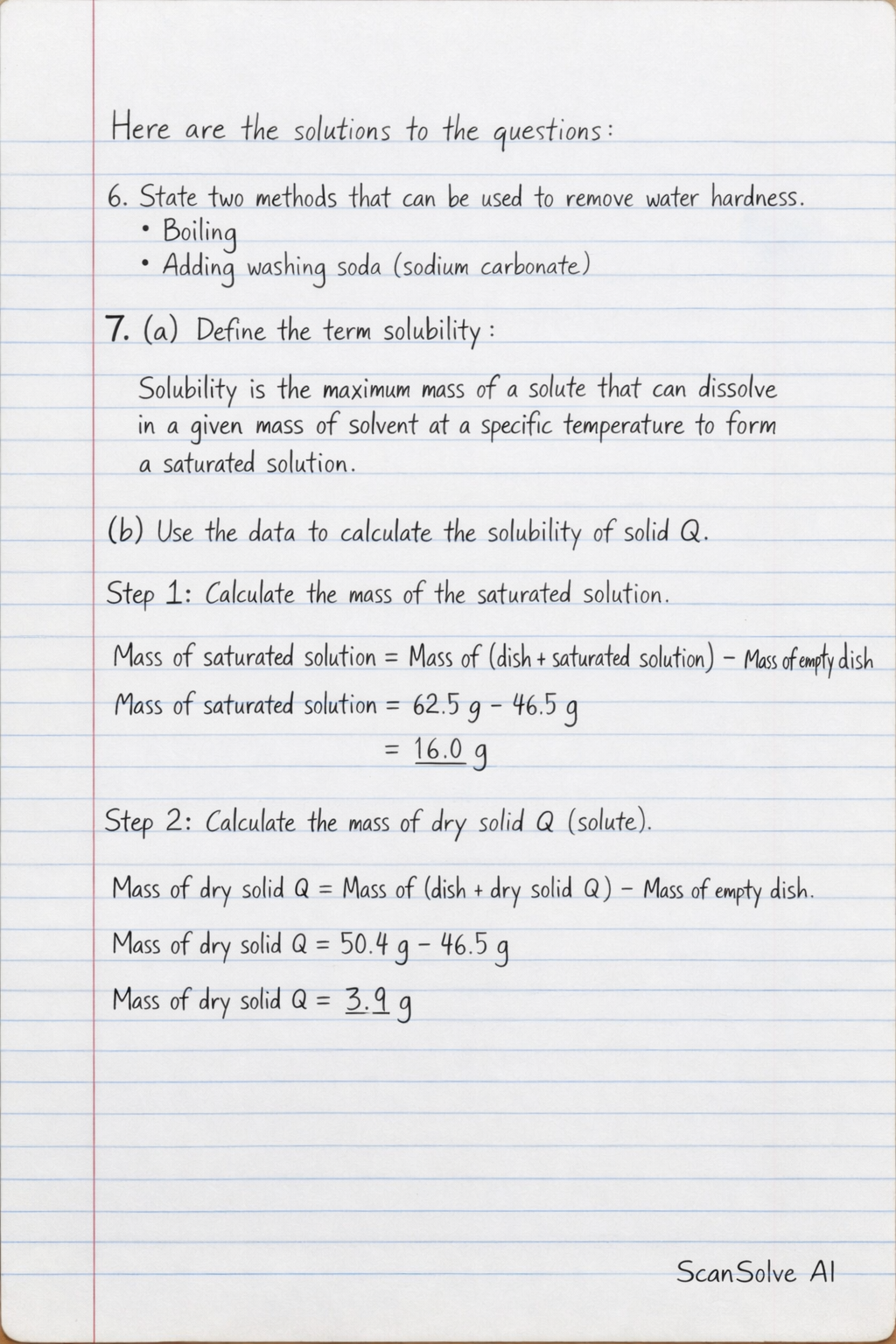
6. State two methods that can be used to remove water hardness.
- Boiling
- Adding washing soda (sodium carbonate)
7. (a) Define the term solubility.
Solubility is the maximum mass of a solute that can dissolve in a given mass of solvent at a specific temperature to form a saturated solution.
(b) Use the data to calculate the solubility of solid Q.
Calculate the mass of the saturated solution.
Calculate the mass of dry solid Q (solute).
Calculate the mass of water (solvent).
Calculate the solubility of solid Q (mass of solute per 100 g of water).
The solubility of solid Q is .
8. (a) What is meant by lattice energy?
Lattice energy is the energy change when one mole of an ionic compound is formed from its gaseous ions under standard conditions.(b) Use the information below to calculate the heat of solution of calcium chloride.
The heat of solution () can be calculated using Hess's Law:The given lattice energy for is -2195 kJ/mol, which is the energy released when the lattice is formed from gaseous ions. Therefore, the energy required to dissociate the lattice into gaseous ions is .
For , there is one ion and two ions.Write the equation for the heat of solution.
Substitute the given values.
Calculate the heat of solution.
The heat of solution of calcium chloride is .
9. (a) State Boyle's law.
Boyle's law states that for a fixed mass of gas at constant temperature, the pressure of the gas is inversely proportional to its volume.(b) A gas occupies 500 at 37°C and 100,000 Pa. What will be its volume at 10°C and 101,325 Pa?
Use the combined gas law:Convert temperatures to Kelvin.
List the given values.
Rearrange the combined gas law to solve for .
Substitute the values and calculate .
The volume of the gas will be (to 3 significant figures).
10. Describe how a solid sample of copper (II) carbonate can be prepared starting with copper metal.
- React the copper metal with concentrated nitric acid to form a soluble copper (II) nitrate solution.
- Add a solution of a soluble carbonate, such as sodium carbonate, to the copper (II) nitrate solution. This will cause copper (II) carbonate to precipitate as it is insoluble.
- Filter the precipitate (copper (II) carbonate) from the solution.
- Wash the solid copper (II) carbonate with distilled water to remove any soluble impurities.
- Dry the solid copper (II) carbonate, for example, by placing it in a desiccator or in a warm oven.
Still stuck on this one?
Ask a follow-up, and the answer starts from this question.
More Chemistry Questions
Handwritten Step-by-Step Solution
Get this as a handwritten image on WhatsApp — like a tutor wrote it for you.
Try on WhatsApp