

This chemistry question involves key chemical concepts and calculations. The detailed solution below walks through each step, from identifying the reaction type to computing the final answer.
ScanSolve AI Answer
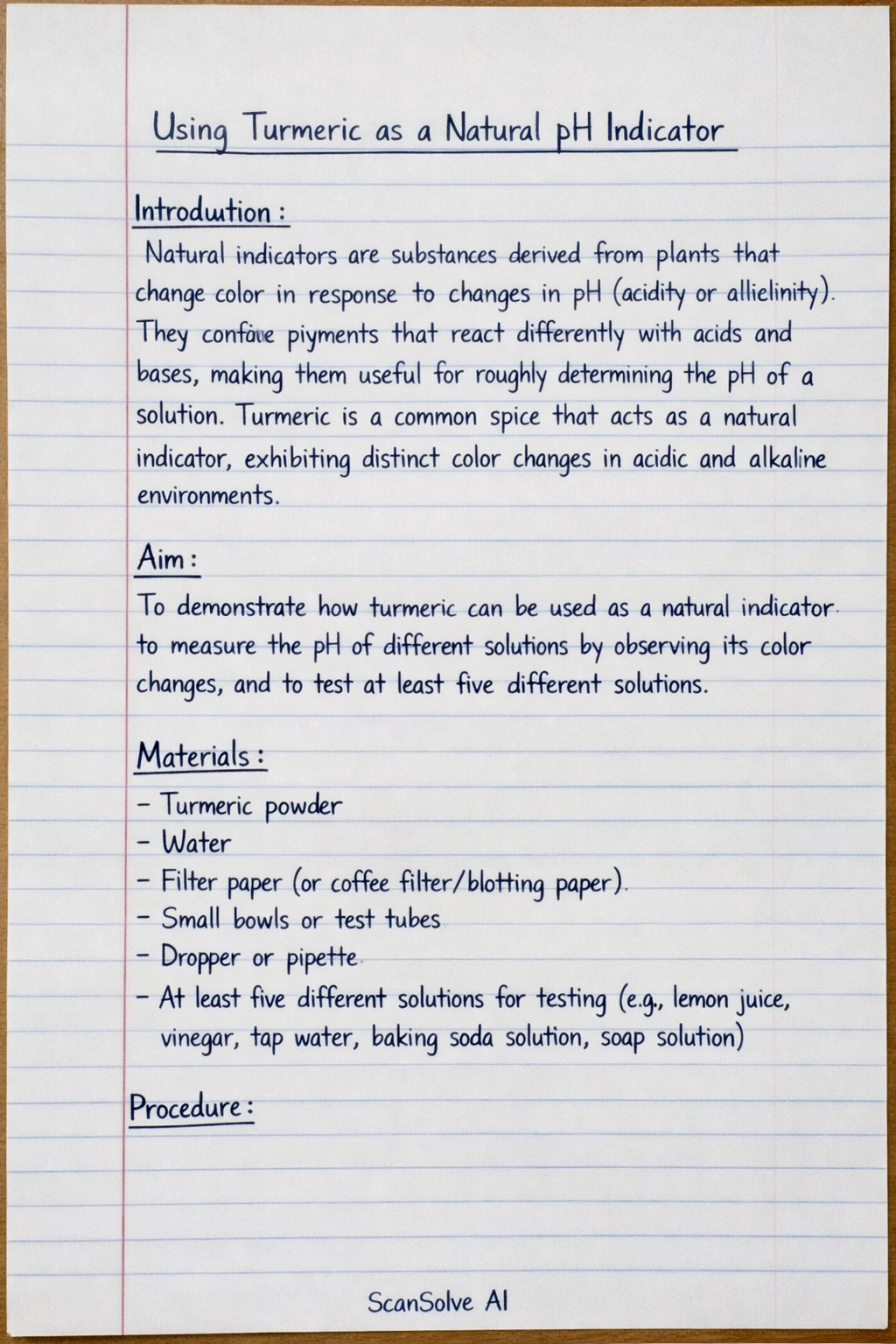
Here is a detailed report on using turmeric as a natural pH indicator: Using Turmeric as a Natural pH Indicator Introduction: Natural indicators are substances derived from plants that change color in response to changes in pH (acidity or alkalinity). They contain pigments that react differently with acids and bases, making them useful for roughly determining the pH of a solution. Turmeric is a common spice that acts as a natural indicator, exhibiting distinct color changes in acidic and alkaline environments. Aim: To demonstrate how turmeric can be used as a natural indicator to measure the pH of different solutions by observing its color changes, and to test at least five different solutions. Materials: Turmeric powder Water Filter paper (or coffee filter/blotting paper) Small bowls or test tubes Dropper or pipette At least five different solutions for testing (e.g., lemon juice, vinegar, tap water, baking soda solution, soap solution) Procedure: Step 1: Prepare the Turmeric Indicator Paper Mix about 1-2 tablespoons of turmeric powder with a small amount of water to form a thick paste. Apply a thin, even layer of this turmeric paste onto strips of filter paper. Allow the turmeric-coated filter paper to dry completely. Once dry, these strips will serve as your turmeric indicator paper. Step 2: Prepare Test Solutions Gather at least five different solutions you wish to test. Examples include: Lemon juice (acidic) Vinegar (acidic) Tap water (neutral) Baking soda solution (mix baking soda with water - alkaline) Soap solution (mix liquid soap with water - alkaline) Place each solution in a separate small bowl or test tube. Step 3: Test the Solutions Take a strip of the prepared turmeric indicator paper. Dip a small portion of the turmeric paper into each test solution, or use a dropper to place a few drops of each solution onto separate spots on the paper. Observe and record the color change for each solution. Observations/Results: Turmeric indicator paper is typically yellow in acidic and neutral solutions and turns reddish-brown or dark brown in alkaline (basic) solutions. | Solution Tested | Expected pH Range | Observed Color with Turmeric | | :------------------- | :---------------- | :--------------------------- | | 1. Lemon Juice | Acidic (pH 2-3) | Yellow | | 2. Vinegar | Acidic (pH 2-3) | Yellow | | 3. Tap Water | Neutral (pH 6-8) | Yellow | | 4. Baking Soda Sol. | Alkaline (pH 8-9) | Reddish-brown | | 5. Soap Solution | Alkaline (pH 9-10)| Reddish-brown | Discussion: The experiment demonstrates that turmeric effectively acts as a natural pH indicator. In acidic solutions like lemon juice and vinegar, the turmeric paper remains yellow. Similarly, in neutral solutions such as tap water, it also stays yellow. However, when exposed to alkaline solutions like baking soda solution and soap solution, the turmeric undergoes a distinct color change, turning reddish-brown or dark brown. This color change is due to the chemical structure of curcumin, the main pigment in turmeric, which is sensitive to pH variations. The intensity of the brown color can sometimes give a rough idea of how strongly alkaline a solution is. Conclusion: Turmeric is a reliable and easily accessible natural indicator for distinguishing between acidic/neutral and alkaline solutions. It remains yellow in acidic and neutral conditions and changes to a reddish-brown or dark brown color in alkaline conditions. This property allows for a simple and visual method to qualitatively assess the pH of various solutions.