
We read your photo as:
Calculate the vapor pressure at 298K above an aerosol mixture consisting of 30% w/w of aerosol propellant 114 (mol.wt = 170.9) with vapor pressure of 1.90 imes 105 ext Nm⁻² and 70% w/w of propellant
ScanSolve AI Answer
Step-by-step solution
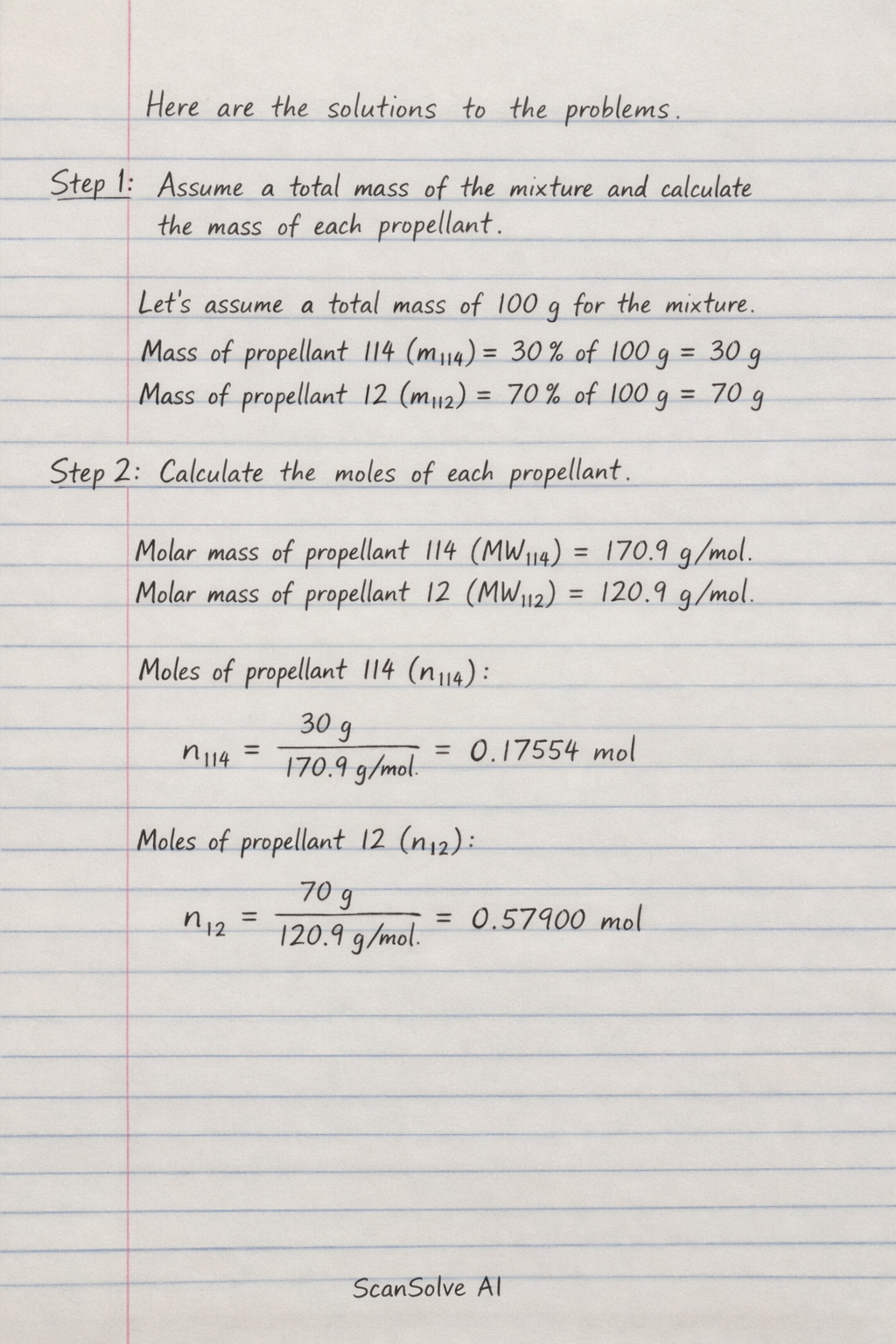
11 stepsHere are the solutions to the problems.
- Calculate the vapor pressure at K above an aerosol mixture consisting of w/w of aerosol propellant 114 (mol.wt = 170.9) with vapor pressure of and w/w of propellant 12 (mol.wt = 120.9) with vapor pressure of . Assume ideal behavior.
Assume a total mass of the mixture and calculate the mass of each propellant.
Let's assume a total mass of 100 g for the mixture.
Mass of propellant 114 () = of 100 g = 30 g
Mass of propellant 12 () = of 100 g = 70 gCalculate the moles of each propellant.
Molar mass of propellant 114 () = 170.9 g/mol
Molar mass of propellant 12 () = 120.9 g/mol
Moles of propellant 114 ():Moles of propellant 12 ():
Calculate the mole fractions of each propellant in the liquid mixture.
Total moles ():
Mole fraction of propellant 114 ():
Mole fraction of propellant 12 ():
Calculate the partial vapor pressure of each propellant using Raoult's Law.
Pure vapor pressure of propellant 114 () =
Pure vapor pressure of propellant 12 () =
Partial pressure of propellant 114 ():Partial pressure of propellant 12 ():
Calculate the total vapor pressure.
Total vapor pressure () =
The total vapor pressure is .
- Calculate the vapor pressure (in Pa) at above an aerosol mixture consisting of w/w of HFA 134a (tetrafluoroethane, molecular weight 102) with a vapor pressure of 68.4 psig and w/w of HFA 227 (heptafluoropropane, molecular weight 170) with a vapor pressure of 56.0 psig. Assume ideal behaviour. NOTE: Psia = Psig + 14.7, 1 Psia = 6894.74 Pa
Convert the pure vapor pressures from psig to psia, then to Pa.
For HFA 134a:
For HFA 227:
Assume a total mass of the mixture and calculate the mass of each HFA.
Let's assume a total mass of 100 g for the mixture.
Mass of HFA 134a () = of 100 g = 30 g
Mass of HFA 227 () = of 100 g = 70 gCalculate the moles of each HFA.
Molar mass of HFA 134a () = 102 g/mol
Molar mass of HFA 227 () = 170 g/mol
Moles of HFA 134a ():Moles of HFA 227 ():
Calculate the mole fractions of each HFA in the liquid mixture.
Total moles ():
Mole fraction of HFA 134a ():
Mole fraction of HFA 227 ():
Calculate the partial vapor pressure of each HFA using Raoult's Law.
Partial pressure of HFA 134a ():
Partial pressure of HFA 227 ():
Calculate the total vapor pressure.
Total vapor pressure () =
Rounding to three significant figures:
The total vapor pressure is .
Still stuck on this one?
Ask a follow-up, and the answer starts from this question.
More Chemistry Questions
Handwritten Step-by-Step Solution
Get this as a handwritten image on WhatsApp — like a tutor wrote it for you.
Try on WhatsApp