
We read your photo as:
Calculate the vapor pressure of pure B using Raoult's Law, given moles of A and B, total pressure, and vapor pressure of A.
ScanSolve AI Answer
Answer
Step-by-step solution
4 stepsTo find the vapor pressure of pure B, we will use Raoult's Law for ideal solutions, which states that the total vapor pressure of a solution is the sum of the partial pressures of its components. The partial pressure of each component is its mole fraction multiplied by its pure vapor pressure.
Calculate the total moles in the solution.
Number of moles of A () =
Number of moles of B () =Calculate the mole fraction of each component.
Apply Raoult's Law.
The total vapor pressure of the solution () at its normal boiling point is .
The vapor pressure of pure A () is .
Raoult's Law states:Substitute the known values:
Solve for the vapor pressure of pure B ().
Subtract from both sides:
Divide by 0.2778:
The vapor pressure of pure B at this temperature is .
Try one yourself
A new problem that tests the same skill.
Still stuck on this one?
Ask a follow-up, and the answer starts from this question.
More Chemistry Questions
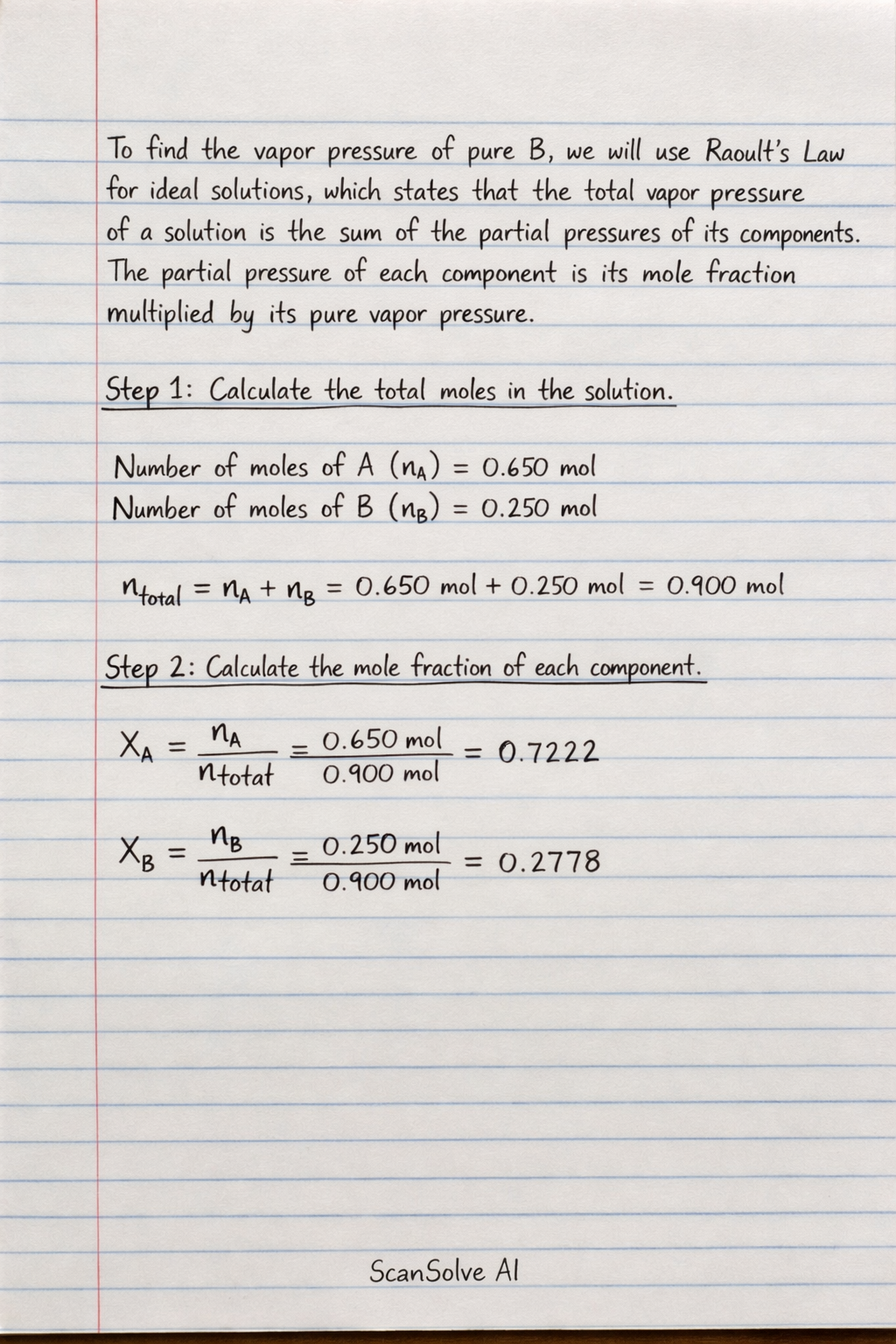
Handwritten Step-by-Step Solution
Get this as a handwritten image on WhatsApp — like a tutor wrote it for you.
Try on WhatsApp