
We read your photo as:
Explain what determines the buffering capacity of a buffer solution.
Chemistry
ScanSolve AI Answer
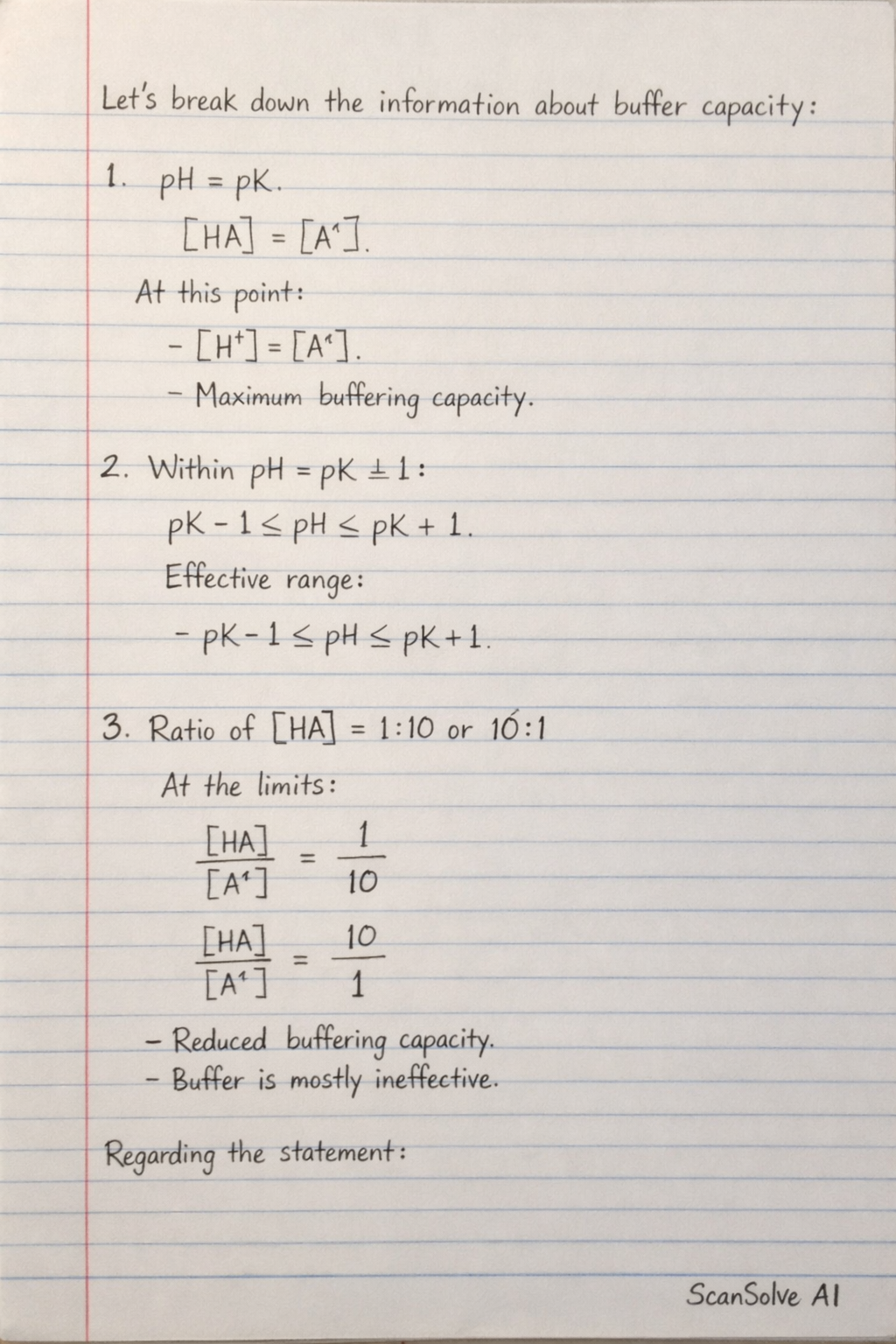
Let's break down the information about buffer capacity:
A buffer pair has its maximum buffering capacity when:
- pH is equal to pK: This occurs when the concentration of the weak acid is equal to the concentration of its conjugate base (). At this point, the buffer can neutralize added acid or base most effectively, as it has equal amounts of both components to react with.
- Within a pH interval of 1 unit of its pK: A buffer is generally considered effective within a pH range that is approximately one pH unit above and one pH unit below its pK value. Outside this range, the ratio of acid to base becomes too extreme, and the buffer's ability to resist pH changes significantly decreases.
- When the ratio of acid to base is 1:10 or 10:1: This describes the limits of a buffer's effective range, not its maximum capacity. While a buffer still functions within these ratios, its buffering capacity is significantly reduced compared to when the ratio is 1:1. Beyond these ratios, the buffer is largely ineffective.
Regarding the statement:
- The larger the pK value, the smaller the extent of dissociation: The pK value () is a measure of an acid's strength. A larger means a smaller acid dissociation constant (). A smaller indicates that the acid is weaker and therefore dissociates to a lesser extent in solution, meaning fewer hydrogen ions are released.
Was this helpful?
Still stuck on this one?
Ask a follow-up, and the answer starts from this question.
Got a different question?Ask your own question
More Chemistry Questions
QIdentify the components in each beaker and determine which solution has the greatest buffer…QDefine a buffer solution. Which of the following pairs of chemicals would act as buffer solution…QDescribe an industrial application of buffer solutions and explain the process involved.QExplain how the pH of the environment affects the absorption of weak bases, using the…QExplain the main buffer systems in the human body, including their pK, concentration, compartment…
Handwritten Step-by-Step Solution
Get this as a handwritten image on WhatsApp — like a tutor wrote it for you.
Try on WhatsApp