
We read your photo as:
Define a buffer solution. Which of the following pairs of chemicals would act as buffer solution: H3PO4 / NaH2PO4; H2SO4 / Na2SO4; NH3 / NH4Cl.
ScanSolve AI Answer
Step-by-step solution
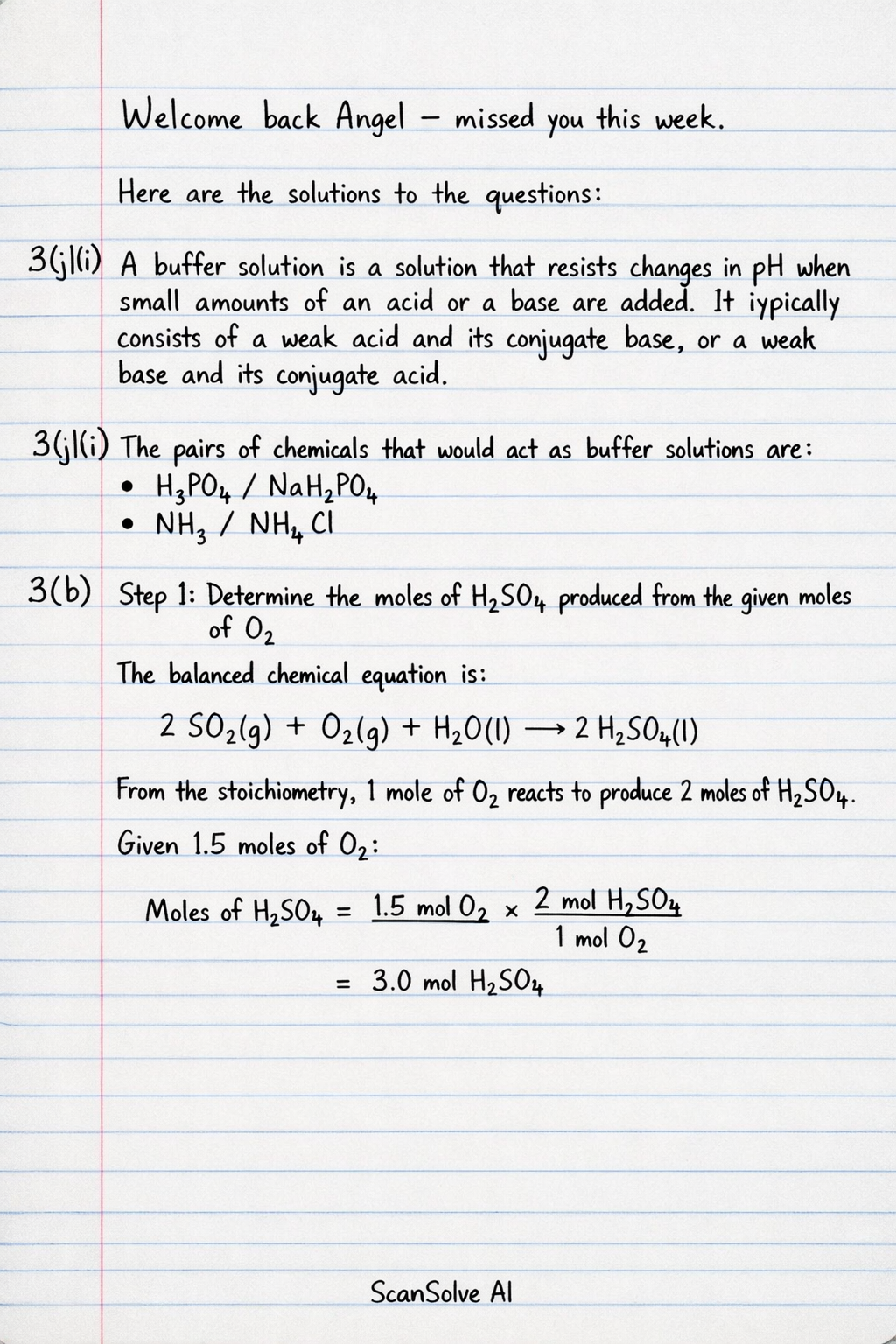
3 stepsHere are the solutions to the questions:
3(j)(i)
A buffer solution is a solution that resists changes in pH when small amounts of an acid or a base are added. It typically consists of a weak acid and its conjugate base, or a weak base and its conjugate acid.
3(j)(ii)
The pairs of chemicals that would act as buffer solutions are:
- HPO / NaHPO
- NH / NHCl
3(b)
Determine the moles of HSO produced from the given moles of O.
The balanced chemical equation is:
From the stoichiometry, 1 mole of O reacts to produce 2 moles of HSO.
Given 1.5 moles of O:Calculate the molar mass of HSO.
Given atomic masses: H = 1.0, O = 16.0, S = 32.0
Calculate the mass of HSO produced.
The mass of HSO that can be prepared is .
3(c)(i)
- (α) less than 7: NH with HSO
- (β) equal to 7: KOH with HCl
- (γ) greater than 7: NaOH with HCO
3(c)(ii)
- For (α) less than 7 (NH with HSO): This is a titration of a weak base with a strong acid. At the equivalence point, the resulting salt (ammonium sulfate) contains the ammonium ion (NH), which is the conjugate acid of a weak base. The NH ion hydrolyzes in water to produce H ions, making the solution acidic (pH < 7).
- For (β) equal to 7 (KOH with HCl): This is a titration of a strong base with a strong acid. At the equivalence point, the resulting salt (potassium chloride) is formed from a strong acid and a strong base. Neither the K nor the Cl ions hydrolyze significantly in water, so the solution remains neutral (pH = 7).
- For (γ) greater than 7 (NaOH with HCO): This is a titration of a strong base with a weak acid. At the equivalence point, the resulting salt (sodium carbonate or bicarbonate) contains the carbonate or bicarbonate ion, which is the conjugate base of a weak acid. These ions hydrolyze in water to produce OH ions, making the solution basic (pH > 7).
3(d)(i)
The factors that determine whether a given ionic solid would dissolve in water include:- Lattice energy: The energy required to break the ionic bonds in the solid. Lower lattice energy generally favors dissolution.
- Hydration energy: The energy released when ions are surrounded by water molecules. Higher hydration energy generally favors dissolution.
- Temperature: The solubility of most ionic solids increases with increasing temperature.
3(d)(ii)
- (α) NaCO + ZnCl 2NaCl + ZnCO: This is a precipitation reaction (or double displacement reaction) because two aqueous solutions react to form an insoluble solid (precipitate).
- (β) Zn + CuSO ZnSO + Cu: This is a single displacement reaction (or redox reaction) because a more reactive metal (zinc) displaces a less reactive metal (copper) from its compound.
- (γ) CH + 2O CO + 2HO: This is a combustion reaction because a hydrocarbon (methane) reacts rapidly with oxygen to produce carbon dioxide and water, releasing energy.
Still stuck on this one?
Ask a follow-up, and the answer starts from this question.
More Chemistry Questions
Handwritten Step-by-Step Solution
Get this as a handwritten image on WhatsApp — like a tutor wrote it for you.
Try on WhatsApp