
With an example explain Michael reaction in a simplest way in term of synthesis
Chemistry
ScanSolve AI Answer
Answer
The Michael reaction is a conjugate addition reaction where a nucleophile adds to an -unsaturated carbonyl compound.
Step-by-step solution
3 stepsExample:
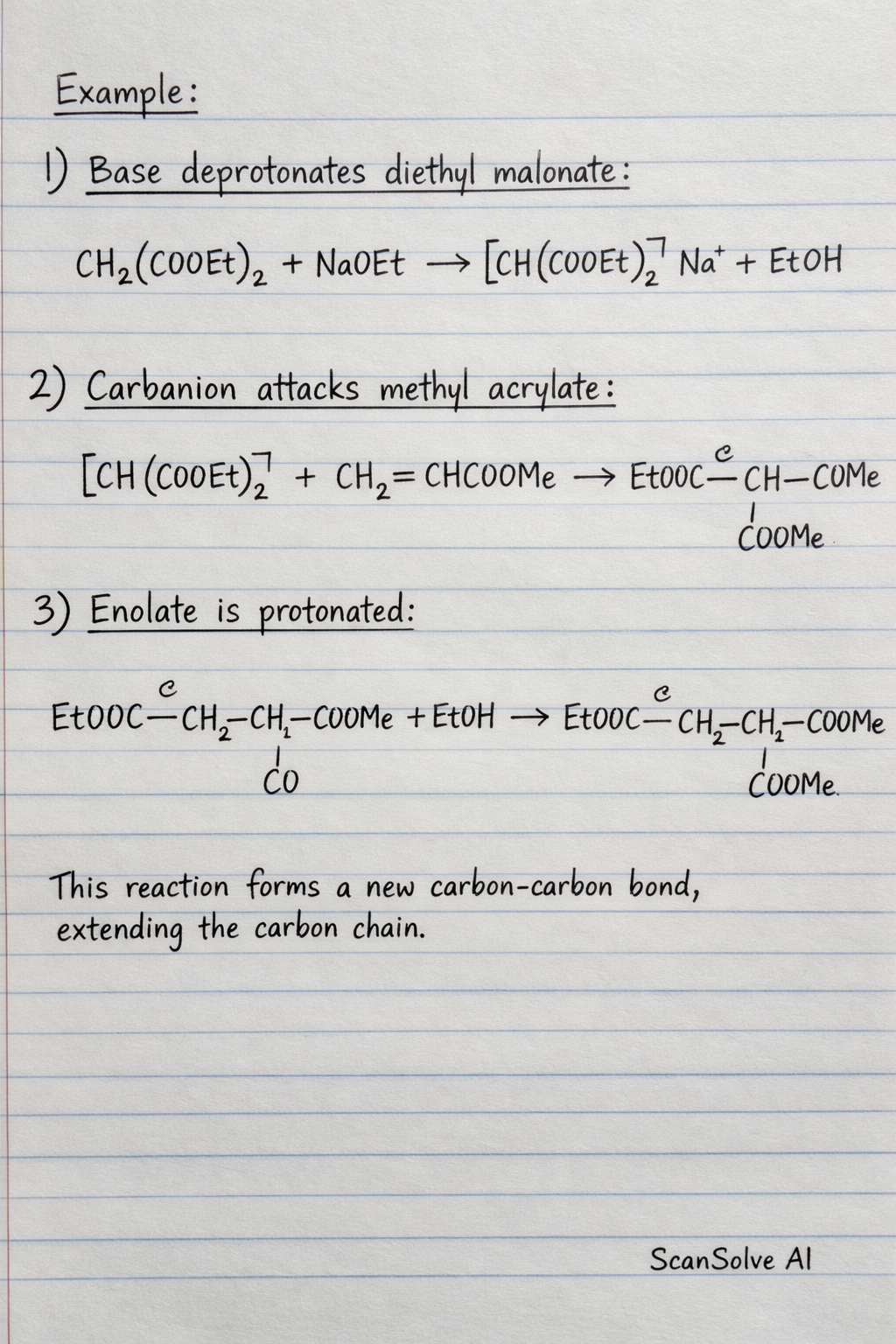
Consider the reaction between diethyl malonate (a nucleophile) and methyl acrylate (an -unsaturated carbonyl compound) in the presence of a base like sodium ethoxide.
The base deprotonates diethyl malonate to form a carbanion.
The carbanion attacks the -carbon of methyl acrylate (conjugate addition).
The resulting enolate is protonated.
This reaction forms a new carbon-carbon bond, extending the carbon chain.
Was this helpful?
Still stuck on this one?
Ask a follow-up, and the answer starts from this question.
Got a different question?Ask your own question
More Chemistry Questions
QIn a simplest way define Michael reaction in synthesisQIn a simplest and easier form explain synthesis Michael reactionQGive me examples of chemical reactionQStudy the reaction scheme below and answer the questions that follow. i. Name: 1mk A. Precipitate…QExplaining diverse reactions in terms of electron transfer
Handwritten Step-by-Step Solution
Get this as a handwritten image on WhatsApp — like a tutor wrote it for you.
Try on WhatsApp